
‘They dreamed about having a better life.’ Puerto Rico buries Haitians from capsized boat
Eleven caskets, draped with bicolored Haitian flags, stood side-by-side inside the Santa Teresita Parish in San Juan on Wednesday, where mourners said goodbye to the Haitian women who perished at sea last month when a migrant boat capsized off the U.S. territory of Puerto Rico.
The migrants are the latest to lose their lives as part of an increasing wave of Haitians who are taking to the sea in order to try and reach the United States from Hispaniola, the island that Haiti shares with the Dominican Republic.
While the U.S. Coast Guard has intercepted more than 5,900 U.S.-bound Haitians since October, in what they say is the largest exodus of boat refugees in nearly two decades, countless others have been lost, their bodies never recovered in voyages that can quickly turn deadly. The shark-infested waters are the scene of the second-highest number of migrant deaths and disappearances in the region after the U.S.-Mexico border, according to the International Organization for Migration.
“These people who have died, they had a dream,” a Roman Catholic Haitian priest said in Creole during the funeral Mass. “They dreamed about having a better life. That’s why they were trying to escape from underneath the insecurity in the country of Haiti, which is preventing the children of Haiti from living as people. It is this situation that left them with no other choice but to take this huge risk to escape this bad situation.”
That attempt, however, ended in tragedy. On May 12, the small, overloaded boat carrying an estimated 72 Haitians and two Dominicans capsized in the Mona Passage. The boat had departed from the shores of the Dominican Republic. Eleven migrants, all women, were confirmed dead while 38 others were rescued at sea by U.S. authorities. The Dominicans have been criminally charged with human smuggling, a felony, and could face life in prison if convicted.
Members of Puerto Rico’s small Haitian community, led by Father Olin Pierre-Louis, a longtime Haitian priest on the island, decided to give them a proper funeral and burial, celebrating their lives while acknowledging their sacrifice.
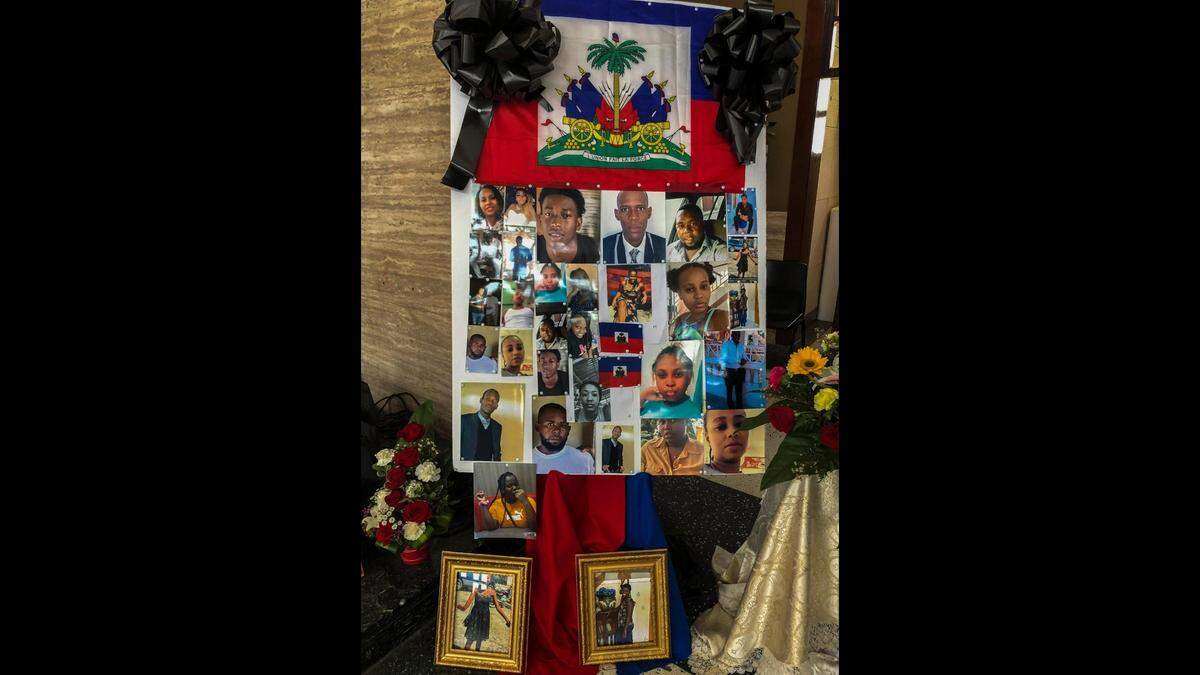
Bouquets of flowers, along with Haitian flags framing a golden portrait of the Virgin, decorated the altar. A collage with photos of those still lost at sea stood next to the row of caskets. Photographs of the women, smiling, sat atop their individual coffins. A nun read a Biblical verse in Creole. A live band played funeral hymns as scripture was read in Spanish and Creole.
The women were eulogized as being brave during a tribute service that touched on hope, and the difficult circumstances under which the women lived and from which they sought salvation. It was not lost on those in attendance that the victims were young women, some of whom had children.
“None of these women embarked expecting death,” said another priest in Spanish. “They embarked, trusting that they would live with great hope, so much so that God lives in the heart of man to fulfill the dream of going out in search of a better life because man was not born or created for suffering, but suffering is part of human injustice and sin.”
The church was filled with relatives of some of the deceased as well as activists, religious leaders, local politicians and strangers who were emotionally touched by the tragedy. Guerline Jozef, the co-founder of the Haitian Bridge Alliance, a San-Diego based advocacy group, was among the attendees.
After years of focusing her advocacy work on Haitians at the U.S. southern border with Mexico, the organization has begun to expand its scope to the U.S. territory as more Haitians land on its shores.
“It was extremely important for us to be here to honor the lives of these young people who were forced to leave home, and it was extremely painful to be with the families,” said Jozef, who had traveled to the island last month after the tragedy happened.
Jozef said she wanted to represent the Haitian community and show the families they are not alone in their grief.
“It’s very unfortunate we continue to live this reality, to bury our brothers and sisters,” she said.
Among the dead was a recent college graduate who was nearly kidnapped in Haiti. To try and save her, her family decided to help her get to U.S. soil. She didn’t make it.
“We are tired of burying our brothers and sisters from the U.S.-Mexico border and Puerto Rico,” Jozef said. “We just wish that one day the sons and daughters of Haiti would be able to stay home, and thrive at home and not have to make these journeys.”
She thanked the mayor of San Juan as well as Puerto Ricans for standing with the Haitian community.
The number of migrants intercepted by U.S. Customs and Border Protection in Puerto Rico has seen a 105% increase this fiscal year, which began in October, compared to the previous year, according to the agency. The migrants are mostly Haitian and Dominican.
The women were identified as the following during the service: Lunique Jean Pierre, Woodeline Towssaint, Smeralda Presrochea Verrier, Saint Ursula Marliol, Schmidi Bunie Bigord, Shelove Louguerre, Erlie Cemelud, Dania Jean Pierre, Echeler Meralud, Lucner Marieal, and Wendy Junior Aristem.
Miami’s Haiti consulate, which has responsibility for Puerto Rico, worked to get their names after appealing to the Haitian community in South Florida and elsewhere, Consul General Stéphane Gilles, told the Miami Herald.
The mayor of San Juan, Miguel Romero, said it was the circumstances in Haiti, “a sister republic,” facing insecurity, political and social upheaval that had driven the women and countless others to take to the sea in rickety boats across unpredictable Caribbean waters in search of a better life in the United States.
“Eleven daughters, 11 sisters, some of them mothers,” he said at the end of the solemn service. “They saw the need to leave everything behind and risk a journey, that although dangerous, had that very inert noble aspiration of the human being of searching for liberty, peace, happiness, and human dignity.”
Romero said Puerto Ricans have always been in solidarity with Haitians in moments of need. He cited community donations to make the funeral rites happen, as proof.
“The noble and selfless heart of our people merges with Haiti and I extend a hug and support to our dear neighbors,” he said.
At San Juan’s municipal cemetery, the mood was more emotional. Mourners gathered under dark skies around shallow trenches dug into the red dirt, the final destination of the 11 women. As one of the caskets was lowered into the ground, a man and woman watching the scene began to cry out.
“Everything is over for you darling, everything is over for you,” the woman said. “I will take care of the children for you.”
The man knelt down as another mourner came to comfort him, putting his hands on the man’s shoulders.
“This is not what I wanted,” the kneeling man said in Creole, before adding, “this pain is heavy.”
The sound of a bulldozer moving dirt could be heard in the background, competing with the tears of another grieving family walking behind another coffin, this time white, to be put in another freshly dug hole.
Inconsolable, they cried and said in Creole, “We won’t forget you. We won’t forget you. We love you, we love you.”
The coffin was still draped in the red and blue of the Haitian flag. Workers, using a rope, tried to line it up over the hole.
As the priest did the sign of the cross, the small crowd broke out in a Creole hymn. Slowly the coffin was lowered, the screams growing louder as it disappeared from view and rain began to fall.
“Bondye, Bondye, Bondye. God,” an aunt of the victim cried. “It is finished. It is finished. Go on, go be with your uncle.
“We love you all. We love you all,” she said before falling to her knees, her fall broken by two people holding her up on each side and carrying her away amid the rain. “My God. My God. Bondye. Bondye.”
This story was originally published June 15, 2022 at 6:22 PM.