Two doctors kidnapped as shaky truce with gangs hinders relief efforts in Haiti
Two surgeons, one an orthopedic surgeon treating earthquake victims from the Southern region, have been kidnapped in Haiti’s capital — underscoring the fragility of a gang truce designed to allow humanitarian aid to traverse a corridor to the nation’s hardest-hit victims.
In response to the kidnappings in the capital of Port-au-Prince, one hospital network declared a two-day shutdown, closing its doors Thursday and Friday to all patients, except for emergencies. The abduction of one doctor led to the death of a mother and her unborn child, after the pregnant woman, suffering from severe high-blood pressure, could not reach a hospital in time for a lifesaving Cesarean section.
“It’s unacceptable,” said Dr. Ronald Laroche, the founder of DASH, a network of eight private hospitals and clinics that operate in the capital. “Kidnapping is one thing. But the fact that the mother and child died is unacceptable.”
Kidnappers have contacted the families of both doctors, but it is unclear how much ransom has been demanded — or who is responsible for the abductions.
At the same, Haitian police on Thursday also announced that 22 prisoners had escaped from the Les Cayes jail after the quake.
In an interview with the Miami Herald, Prime Minister Ariel Henry, himself a doctor who worked at Bernard Mevs Hospital, said that the government was not depending on the supposed gang truce to get humanitarian aid to quake victims in the South. Police security, he said, had been increased in the area of Martissant, and officers have been given additional equipment.
Haitian National Police said Thursday that it was reinforcing the road to Martissant with specialized police units to protect humanitarian aid passing along it.
Haiti National Police spokesman Marie-Michelle Verrier said anyone seeking to take aid to the south to quake victims should check in with police and that there is a specialized unit charged with helping donations arrive safely. The announcement was made after Haitian artist Widler Octavius, known as Wid, complained to the Miami Herald Wednesday that the police commissioner assigned to Les Cayes had refused to provide him with a police escort to the hospital in nearby Port Salut, where he was donating cooked meals and toiletries kits to quake victims. The police’s refusal left him at the mercy of bandits, he said, who attacked his group as they headed to the beachfront community.
“The police has taken all the necessary steps to reinforce its presence along the Martissant route,” Verrier said during a press conference. “There are still threats along this road. ... Everyone who has donations to take to the Great South, we will remind you again that the police are here to accompany you. The police had taken all steps to ensure the security of the convoys in the areas that are at risk up until they arrive at their destination.”
Police said Thursday that villagers along the route leading to the quake-struck regions had barricaded roads to prevent aid from getting through under the pretext that they needed assistance also.
Verrier said people who are blocking roads at their leisure to stop aid from getting through to the people need to wait their turn.
In an address to the nation Wednesday night, Henry said he had ordered additional security for aid vehicles leaving Port-au-Prince and traveling on the national road from Martissant to the worst-hit regions of the south.
Haiti, he said, has confirmed nearly 2,200 deaths and more than 12,268 injuries from the earthquake. There are also 684,400 people — or about 40 percent of the population of the three quake-struck regions — in need of humanitarian assistance.
On Thursday, a group of Colombian search-and-rescue workers was forced to leave Jeremie, the capital city of the Grand’Anse department, under police escort after residents accused them of being behind last month’s assassination of Haitian President Jovenel Moïse. Moïse was killed on July 7, and 18 Colombian commandos are among 44 people who have been arrested by Haitian police in connection with the killing.
Wadson Montisino Cledanor, the head of Office of Civil Protection for the Grand’Anse region, confirmed that the Colombians had been escorted back to the Jeremie airport. Jeremie is among the cities struck by Saturday’s tremors.
In Washington, a White House official reported that the U.S. has dispatched Three CH-47 Chinooks and five UH-60 Black Hawks that are moving relief supplies and personnel and that a field hospital in Les Cayes is about 60 percent done. The USS Arlington was also sailing loaded with supplies, among other efforts by the military.
But violence, particularly when directed at aid workers, won’t help. “It’s horrific,” Laroche said of the abduction of one of his doctors.
Laroche said DASH is part of a group of private hospitals that organized to accept patients from the earthquake damage zone along the Tiburon peninsula in southwest Haiti. The hospital is currently treating 27 earthquake victims, free of charge, he said.
“Now they are kidnapping us,” said Laroche, speaking of doctors in general. “It doesn’t make sense. This country is going in a very, very bad direction. Things are getting worse.”
The abduction, he said, is yet another reminder of Haiti’s widening insecurity and the criminality that can derail efforts to help victims, some in need of urgent care.
Though Laroche did not know who was behind the kidnappings, he said that the truce, announced earlier in the week by gangs to allow for humanitarian aid to pass through gang-controlled Martissant, is not something aid workers can trust. Martissant is at the southern entrance of Port-au-Prince and roads to the damage zone pass through it.
The kidnapping of the DASH doctor occurred in Petionville, which has been mostly spared from the epidemic of kidnappings in Haiti.
“We feel that the gangsters are getting more daring, they are working now in Petionville, the center of the city” Laroche said.
On Thursday, with the hospital’s door closed, a spontaneous demonstration erupted in front of a DASH hospital in Delmas to protest the abduction, and demand that the kidnapped surgeon be freed.
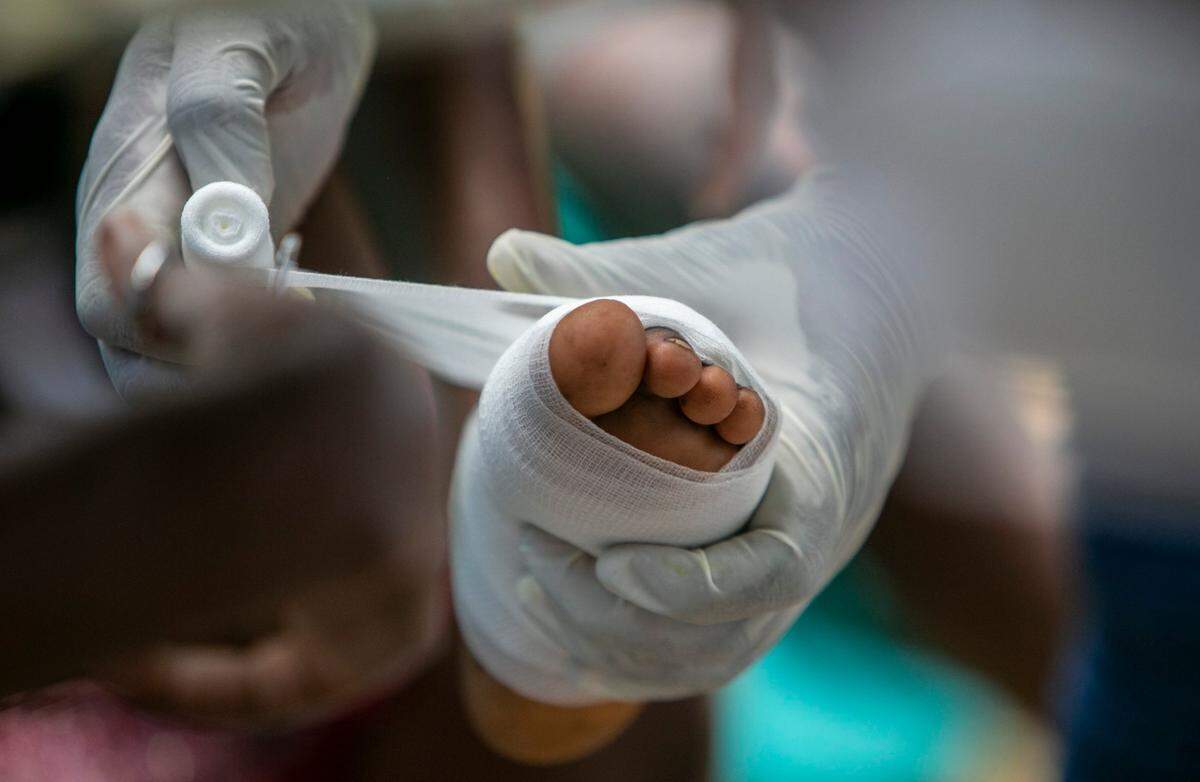
“It’s frustrating,” said an official at Bernard Mevs Hospital in Port-au-Prince, which has been treating patients from the 7.2 magnitude tremor that hit three regional departments of Haiti. Bernard Mevs currently has 48 patients from the earthquake, and 45 of them are in need of orthopedic surgery to treat fractures.
Orthopedic surgeon Workens Alexandre was abducted Wednesday on his way to work. Alexandre was grabbed in Torcel, a neighborhood near Route Frere in the capital.
He became the hospital’s third doctor to be kidnapped.
“He’s one of the best on our team,” the hospital official said of Alexandre, one of only a handful of orthopedic surgeons in Haiti, which is in desperate need of doctors and medical supplies to treat quake victims. “Can you imagine ... they kidnapped him.”
The official said only the dire need brought by the earthquake has prevented the hospital from closing its doors in protest, too. Administrators are instead meeting to develop a program that would allow doctors to sleep at the hospitals several nights. “The patients cannot suffer because of this,” he said.
“Going up and down in Haiti is very dangerous,” said the official, who requested anonymity for his own safety.
This story was originally published August 19, 2021 at 12:17 PM with the headline "Two doctors kidnapped as shaky truce with gangs hinders relief efforts in Haiti."