‘We don’t exist.’ In Haiti’s isolated villages, there’s fear help may never come
From Chardonnieres and Port-à-Pimentt on the southern coast to Marceline on the western outskirts of Les Cayes, Haiti’s remote outposts have been hard hit by the 7.2 magnitude tremor over the weekend — and many are feeling as if they’ve been forgotten.
“People are suffering,” said Edy Jean, 49. “Even if you see people here, it’s just their skin that’s there.
“There is no more life,” he added. “There are still people trapped in the woods and underneath the rubble and they can’t get them. They cannot say the amount of lives that have been lost.”
Five days after the earthquake, the death toll stands at more than 2,100 while the number of people injured is over 12,000. An estimated 684,000 people are in need of some sort of humanitarian assistance.
Haitian Prime Minister Ariel Henry, in an address to the nation late Wednesday, said that Haitian and foreign crews are still trying to get to those trapped underneath fallen debris.
Calling for Haitian solidarity, he said, “What is most urgent for us is to provide Haitians with temporary shelter, water, food and medical care.”
The United States and humanitarian organizations were also working to ramp up response but in small communities across the quake-struck south, few are believing that the government will respond to their needs — even as they beg for tents and tarps to escape the rain that continued to pour Thursday morning after another powerful aftershock.
That reality, for many residents in Marceline, has given way to a sense of defeat.
On the outskirts of Les Cayes, Marceline is located off Route National 7, a recently paved two-lane highway connecting Les Cayes in the south with the Grand’Anse, the other region that’s been hit.
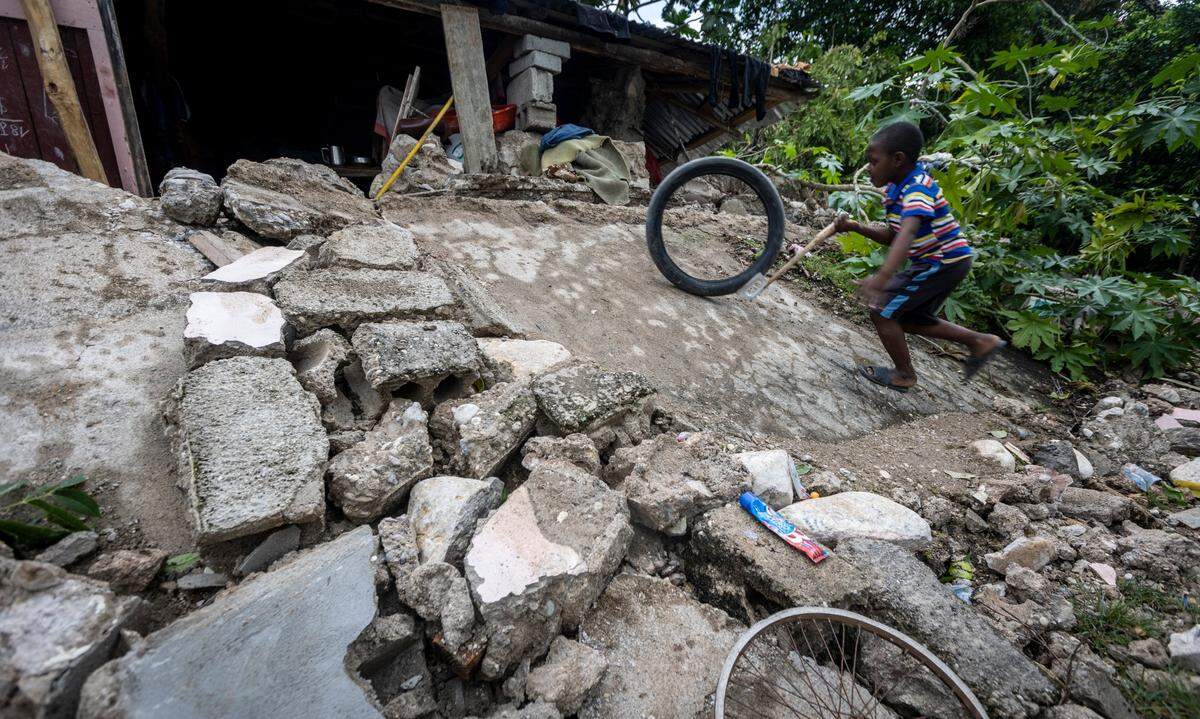
Along a two-mile stretch, it’s one destructive scene after another as piles of rocks and crumbled cement litter yards where homes, churches and businesses once stood.
“Things are not easy for us here,” said Yvrose Louis-Jeune, 42, whose house was flattened along with that of several other families in Marceline.
“You plant some plantains and before you can pick them someone steals it. We plant plantains, we plant yams, we plant beans but every time they are ready to harvest, a disaster happens.”
Residents say they feel defeated.
Just up the street, there is more destruction. One mound of rubble was a voudou temple, or peristyle, that belonged to Yolene Vital, a well-known mambo or voudou priestess. The house collapsed, burying her and others who were participating in a dance ritual that had gone well into the night before the early morning earthquake. Two bodies were removed, including that of Vital, but at least 24 other people are still buried underneath the ruins, neighbors say.
“Life was hard before. Now it’s become worse,” said Jean-Privillo Lampy, 49, sitting on the side of the road with two friends, one of them with an injured foot, bloodstain seeping through the bandage, just down from the house. “Every time you hear there is bad weather coming you’re never at ease. The churches, the schools where you would take shelter, they are destroyed.”
There are signs of resilience. At one collapsed house, Isaac Cadet, just 6, played in front of a home that had fallen on him during the quake. He’d been trapped for five hours before his family rescued him.
Still, many people in the isolated villages say it’s as if they’ve been forgotten.
“They don’t remember us over here,” said Loudie Jean-Baptiste, 48. “We don’t exist.”
On Thursday, as a World Food Program helicopter landed in Les Cayes and 13 U.S. Coast Guard helicopters flew the Haitian skies continuing airlifts, the government defended its response, saying it was working non-stop to provide assistance.
Public works vehicles were out there unblocking roads, some of which were blocked again by boulders brought down by Tropical Depression Grace, and its third convoy was traveling to cities struck by the quake. Since the weekend, hot meals had been delivered, said Jerry Chandler, the head of the Office of Civil Protection.
Still the aid rollout was slow and quake victims’ patience was wearing thin as local volunteers continue to get quake victims to hospitals in the capital with the help of the U.S. Coast Guard, which made news of the two doctors kidnapped in Port-au-Prince especially infuriating for some.
At what used to be St. Agnes Catholic Church, a pair of blue slippers belonging to one of two parishioners who was killed while cleaning the church remains untouched along with the mop she went to get when the ground began to shake.
“Total destruction,” said Father Jean Edy Desravines. He is more worried about the community than his lost church, rectory and school — fearful that the latest tragedy will only plunge an already struggling population deeper into poverty.
This story was originally published August 19, 2021 at 11:26 AM with the headline "‘We don’t exist.’ In Haiti’s isolated villages, there’s fear help may never come."