Looking back at the deadly 2010 earthquake in Haiti. How tragedy unfolded in first days
In January 2010, Haiti was hit with a strong and deadly earthquake. Here is a look back at a few of our original stories in that coverage from the Miami Herald archive:
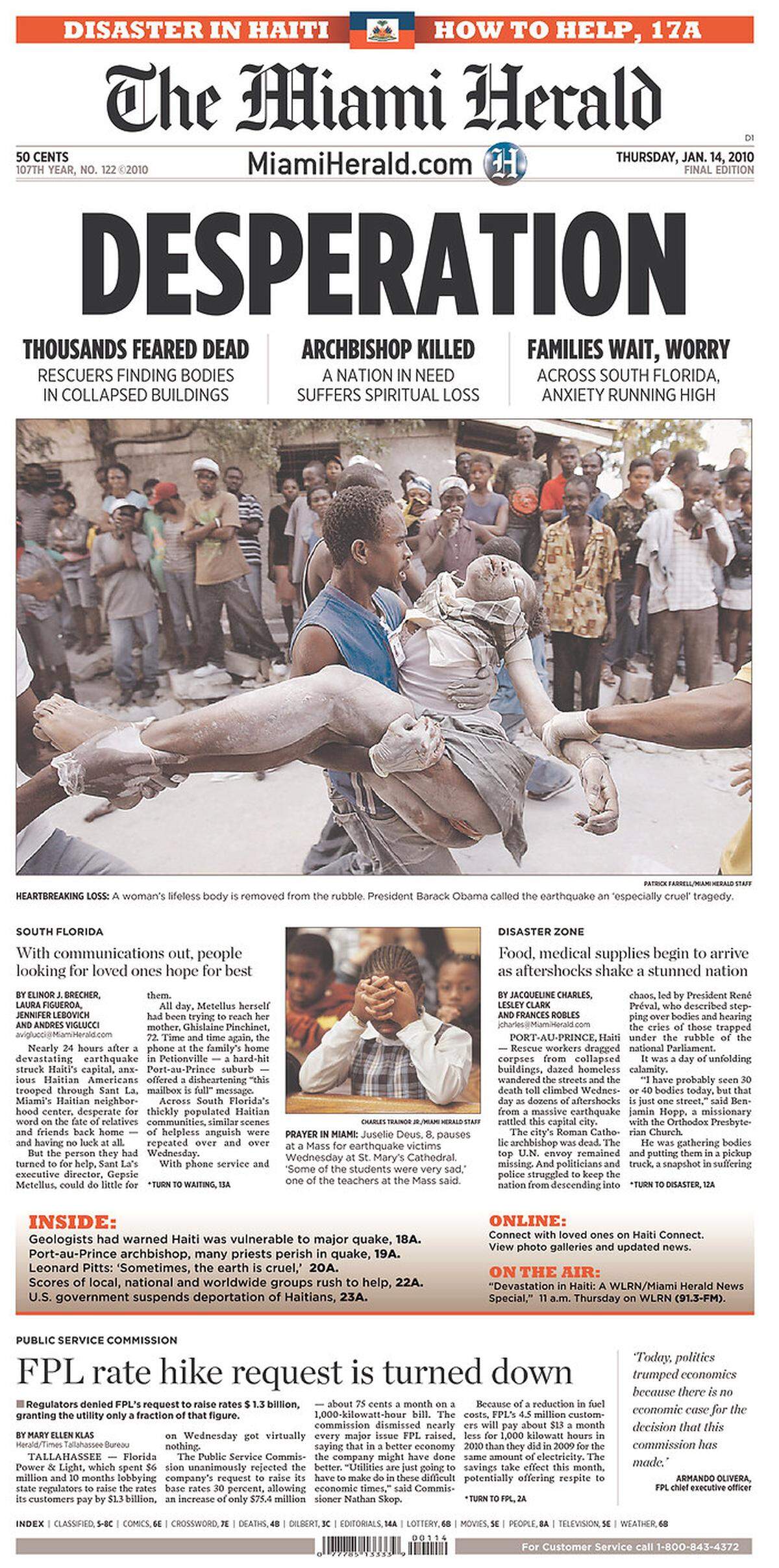
Breaking news in 2010
Published 1/12/2010
PORT-AU-PRINCE - Teams of rescue and aid workers were rushing to Haiti on Wednesday to assess damage from a powerful 7.0-magnitude earthquake that crippled the island nation, severing communications with the outside world and severely damaging countless buildings, including the historic National Palace.
There were no estimates of casualties, but there were numerous reports of damage. The United Nations said late Tuesday that its headquarters had collapsed and “a large number of personnel remain unaccounted for.”
“Casualties, we can’t say for now,” the organization said in a statement.
A hospital was reported to have collapsed and people were heard screaming for help, and portions of the National Palace in downtown Port-au-Prince crumbled.
“There are people injured in the palace,” said Fritz Longchamp, the building’s executive director. “I’m calling for help and medical assistance for them.”
Haitian President René Préval sought safe haven on the island, The Miami Herald has learned.
Part of the road to Canape Vert, a suburb of the capital city of Port-au-Prince, has collapsed, along with houses perched in the mountains of Petionville, where the quake was centered. Petionville is a suburb about 10 miles from downtown from Port-au-Prince.
Several aftershocks followed the main 4:53 p.m. earthquake, according to The Associated Press and a tsunami alert was briefly issued for the region and canceled as a blanket of dust completely covered the city for about 10 minutes, USAID contract employee Mike Godfrey told CNN from Port-au-Prince.
“At this point I’m frustrated trying to find colleagues and staff,” Godfrey said. “Phones are not working.”
Eyewitness accounts of the destruction were hard-to-come-by, some came via Twitter, Facebook and Skype. Richard Morse, owner of the Oloffson Hotel in Port-au-Prince, sent tweets to the outside world.
“Just about all the lights are out in Port au Prince,” he said. “People still screaming but the noise is dying as darkness sets. Lots of rumors about which buildings were toppled. The Castel Haiti behind the Oloffson is a pile of rubble. It was eight stories high. Our guests are sitting out in the driveway.”
Haitian businessman Georges Sassine, who was in Washington, spoke to his wife minutes after the quake.
“She said, suddenly her car started shaking, and she saw houses crumbling and she could not understand what was happening,” he said.
Antwan Edmund, former head of the Caribbean-Central American Action advocacy group, said “he was sitting in Port-au-Prince watching the mountain crumble.”
Raymond Alcide Joseph, Haiti’s ambassador to the United States, told CNN that the quake has crippled his country.
“I spoke to a government official on the island who I reached on his cellphone and he told me: ‘Tell the world this is a catastrophe of major proportions,’ “ he said.
President Barack Obama was aware of the tragedy in Haiti, the White House said, and the State Department is working to confirm the safety of its personnel at the U.S. Embassy in Port-au-Prince.
“My thoughts and prayers go out to those who have been affected by this earthquake,” Obama said in a statement. “We are closely monitoring the situation and we stand ready to assist the people of Haiti.”
Former President Bill Clinton, U.N. Special Envoy for Haiti, issued a statement offering assistance.
“My U.N. office and the rest of the U.N. system are monitoring the situation, and we are committed to do whatever we can to assist the people of Haiti in their relief, rebuilding and recovery efforts,” he said.
In Honolulu, Hawaii, Secretary of State Hillary Clinton said America’s thoughts were “with the people of Haiti.”
And help was on the way. The U.S. Agency for International Development is dispatching a Disaster Assistance Response Team and has activated its partners, the Fairfax County Urban Search and Rescue Team and the Los Angeles County Search and Rescue Team. The USAR teams will be composed of up to 72 personnel, six search and rescue canines and up to 48 tons of rescue equipment.
The USAR team will be accompanied by USAID disaster experts who will assist with assessments of the situation.
“This is a tragic situation and we will work alongside the Haitian government to provide immediate assistance in the rescue effort,” said USAID Administrator Rajiv Shah.
In Miami, a prayer service is planned for quake victims at 9 a.m. Wednesday at the Cathedral of St. Mary, 7525 NW Second Ave., and local aid efforts were starting to form.
The University of Miami began assembling an emergency response team to use a private plane to fly to Haiti, said Michel Dodard, an assistant professor and member of the school’s medical and community development program in Haiti.
The moment he heard about the earthquake, Dodard contacted his two brothers who live there, one in Petionville -- the center of the quake.
“Clearly, what they are describing is a dreadful situation,” Doudard said. “Haiti has a very fragile disaster relief to begin with and many of the construction is extremely haphazard. You see shantytowns there, and they collapse sometimes during a tropical storm - not even a hurricane.”
Florida’s department of emergency management has offered its help to FEMA, said Sterling Ivey, spokesman for Gov. Charlie Crist. The federal agency may only need search and rescue teams, of which Florida has two.
The quake rattled the U.S. Navy base at Guantánamo Bay, Cuba, just after 5 p.m. where there was no immediate report of damage or injury.
“It felt like when a building shakes when a subway goes by. But I know there’s no subway here and the island’s not moving,” said Army Maj. Diana R. Haynie.
An American Airlines flight bound for Miami with some 200-passengers aboard -- believed to be the last flight out of Haiti on Tuesday - was scheduled to arrive at Miami International Airport at 8:42 p.m.
The jet had been preparing for takeoff at the time of the earthquake. It was allowed to leave after airport personnel determined the runway was not seriously damaged.
At Southern Command in Miami-Dade, the military was on standby for a formal request from the Haitian government for assistance. None had been made.
South Florida Haitians dialed friends and relatives in the island nation -- to no avail. All connections were cut.
“My mother just went to Haiti on Friday and I’m terrified . . . “ said Gepsie Metellus, a Haitian community leader.
Digging for the dead and for survivors
Published Jan. 15, 2010
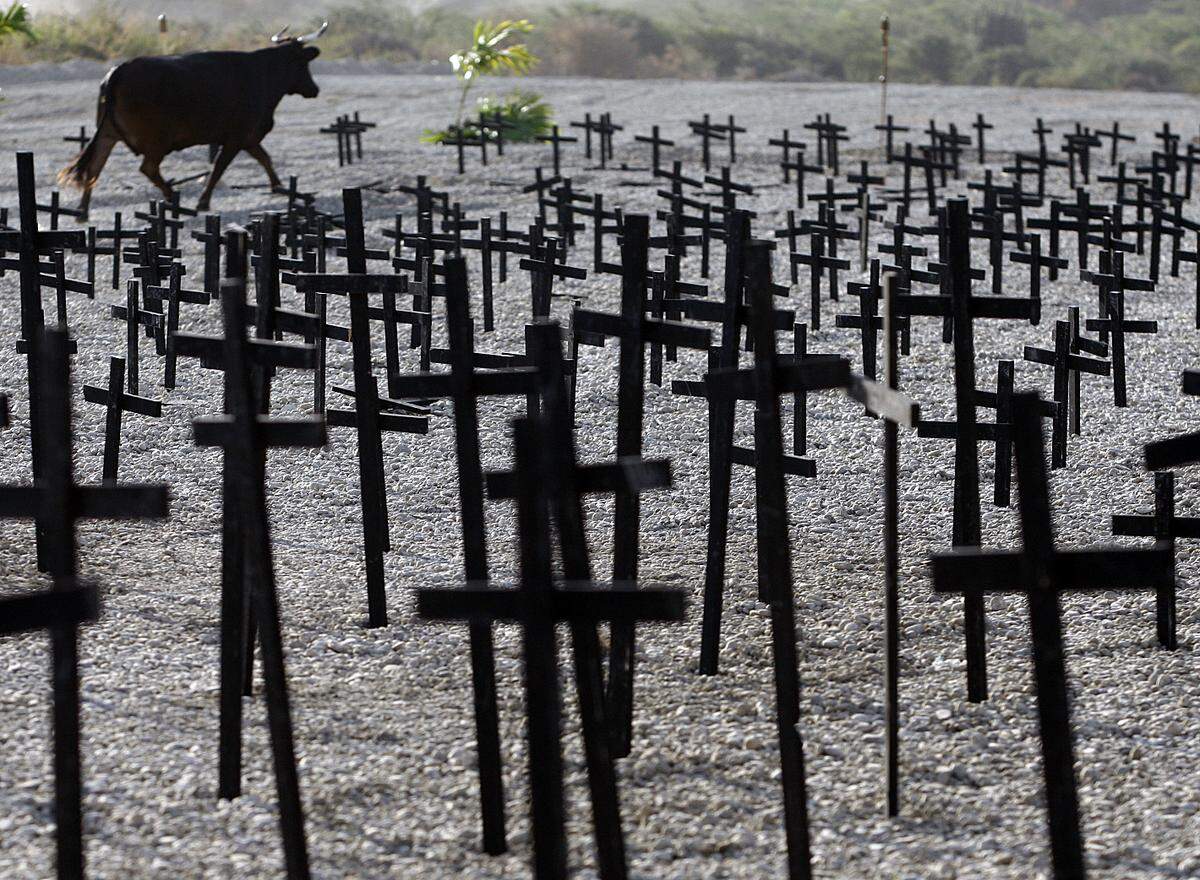
PORT-AU-PRINCE - Government workers dug mass graves and buried more than 7,000 dead Thursday as corpses overwhelmed this earthquake-ravaged city awaiting a surge of relief supplies amassing in Miami and elsewhere.
Thousands more corpses crammed hospitals and morgues still without electricity and communications two days after the massive 7.0-magnitude earthquake.
Casualty estimates were still unknown but the Haitian Red Cross in Port-au-Prince estimated the dead at 45,000-50,000, a figure reported in Geneva by spokesman Jean-Luc Martinage of the International Red Cross.
In portions of the city, the nauseating odor of the dead was inescapable.
“We need help,” said Rothin Massena, 29, a student who stood amid the wails of earthquake wounded outside a Petionville hotel. “Where is the international community for us? We don’t have food. We don’t have water. We don’t have money.”
President René Préval told The Miami Herald that in a 20-hour span, government workers removed 7,000 corpses from the streets and morgue and buried them in mass graves. Still, thousands more awaited burial, a trail of dead along sidewalks from downtown to the hills of Petionville, many abandoned, some covered in sheets or carted through the streets on makeshift stretchers fashioned from wood and soiled mattresses.
There was no choice, said Dr. Ariel Henry of the Ministry of Health, but to resort to landfill-style burials.
“We are out of hospitals. We don’t even have electricity. And we don’t even have supplies,” including syringes, antibiotics, painkillers, and blood for transfusions.
Communications remained sporadic, if not gone, in most portions of the shattered city of two million people. Haitians mostly fended for themselves, some still digging through the rubble of collapsed buildings, others searching for gasoline and water.
There was one bit of relief in the otherwise bleak news. Aftershocks tapered off to a mere four Thursday, compared to 37 in the aftermath of the massive quake that struck around 5 p.m. on Tuesday.
Some rescue teams got in and scoured the wreckage for survivors. Miraculously, Gladys Louis Jeune was found after 43 hours in the rubble of her home. Hours earlier, a U.S. search-and-rescue team dug for five hours at the flattened six-story U.N. headquarters. Tarmo Joeveer of Miami Shores emerged and pumped a fist of celebration.
A United Nations security officer, Joeveer was inside the building when it collapsed Tuesday, apparently entombing dozens of others, including the chief U.N. envoy to Haiti. Hédi Annabi, who was meeting with a Chinese delegation when the earthquake struck, remained missing Thursday.
In Washington, President Barack Obama announced “one of the largest relief efforts in our recent history,” starting with $100 million in aid.
Throughout the day, waves of desperation whipped survivors and wounded who heard help was on the way, saw helicopters fly over but wondered when it would arrive.
“We had a problem with the international coordination,” said Interior Minister Paul Antoine Bien-Aime, predicting a break in the bottleneck of relief flights as early as Friday.
The flow of private charitable relief ground to a halt because the Federal Aviation Administration grounded most civilian U.S. aircraft and permitted only U.S. military flights to land at Port-au-Prince.
Water, syringes, intravenous lines, tarps, tents, 45,000 pounds of beans and diapers from the American Red Cross and other charities lay stacked by the tons on pallets in warehouses across Miami-Dade and elsewhere.
“Logistics is a crucial issue,” said State Department spokesman P.J. Crowley. “So we are trying to work to create a system where we get the planes stacked down on the ground, offload cargo, onload evacuees that might be going on it.”
Thirty-one countries had offered assistance, he said, some still en route Thursday. But eight search-and-rescue teams were on the ground, from Iceland, Spain, Chile and the United States.
Miami-Dade’s Fire Department Urban Search and Rescue Team and Rescue Team Task Force One, with 80 people and seven dogs, were among them.
International relief from elsewhere was permitted to land, said Bob Appin at the U.S. Southern Command in Miami-Dade. But U.S. air-cargo traffic was grounded to give the military airlift priority to bring moving equipment and the first 100 of a planned 900-paratrooper deployment of the 82nd Airborne Division from North Carolina.
While the runways were functional, cargo executives told The Miami Herald that the battered airport also lacked the equipment needed to unload massive freight pallets from the planes.
Some Miami aircraft headed for Haiti but found themselves diverted elsewhere.
“We had to hold for two hours,” said Christine Richard, marketing director for Amerijet, a Miami cargo company hired by relief agencies to deliver supplies. “We ended up landing in the Dominican Republic. . . . It’s very frustrating.”
Some aircraft managed to land in Port-au-Prince, however. American Airlines had two flights scratched but two more made it from Puerto Rico as well as charters carrying Miami Fire and Rescue and a Fairfax, Va., County search and rescue team.
In Geneva, the International Committee of the Red Cross sent 40 tons of medical supplies -- and 3,000 body bags -- as well as experts on reuniting families separated by disaster in two flights. The shipment could arrive Friday at the earliest.
But for much of Thursday, Haiti was on its own.
Outside the Port-au-Prince morgue, Lionel Gaedi was confronted by a horrific scene when he went in search of the remains of his brother Josef.
Toddlers piled up on naked adults, some wrapped in sheets, others exposed to the blazing sun, with solemn onlookers staring at the half-block blanketed in bodies.
Throughout the day, police, civilians and private clean-up companies dumped cadavers because they had no other place to take them.
The morgue had run out of room so people were left on the street, where family members like Gaedi walked among them in search of their lost loved ones.
The rescue mission
Published Jan. 20, 2010
PORT-AU-PRINCE - A team of French and Turkish workers wielding pick axes and drills worked furiously late Tuesday to free one more possible survivor from a downtown market, as the odds for a live rescue closed in on miracle status.
Exactly a week after the quake buried tens of thousands of Haitians, rescue workers used a microphone inserted into the ruins to speak with a woman they knew only as Natalie, trapped between two collapsed floors at the Olympic Market.
“It’s a miracle,” marveled ambulance driver Lousma Ullick, waiting to transport the woman to a hospital. “With no food or water, she should be dead.”
The spark of hope came as anxious family and friends held vigils across the city at buildings reduced to jagged piles of rubble and dust, hoping and praying that their ordeals would end with relief rather than mourning.
Rescue workers putting in 24-plus-hour shifts focused on defeating the odds.
Since the quake struck, international rescuers have pulled at least 72 survivors from the wreckage.
“Today is the needle in a haystack, working the seventh day into the eighth,” said Joe Kaldda of the Fairfax County, Va., Urban Search and Rescue Team. “We’re looking for that miracle, those miracle people. We’re not going to get big numbers. But we’re not going to give up.”
The struggle to free Natalie began just after 1 p.m., less than an hour after rescuers discovered 10 bodies in a nearby building, and continued into the night.
A tip had indicated someone might be alive in the market. Shortly after the team began sledge-hammering a wall of the collapsed market, Dundare Saahin, of the Turkish Akut search and rescue group, yelled for them to stop. Searchers had heard a woman’s voice.
Natalie had been on the third-floor of the market. Through a video camera and microphone slipped into the space, rescuers spoke to her in French. She had landed in an open pocket and had found water.
From the roof, rescuers sawed a hole in the buckled concrete. For hours, they used drills, jackhammers, picks and sledgehammers on the debris, kicking up clouds of gray dust and orange sparks. With a team of Haitian firefighters and later some U.S. rescuers, they formed bucket lines to remove the broken concrete. Some wore face masks against the smell of decaying flesh.
The Virginia team joined the group on the roof, preparing IVs and a stretcher. Progress was slow and grisly -- rescuers found a female corpse under the concrete.
At 9 p.m., rescuers were still working and Natalie remained patient, telling them she could feel her feet and could grasp the long rod of the TV camera inserted into the hole.
“She can answer questions,” Saahin said. “Her answers are very logical.”
Across town, other familes kept vigil for their own missing. Relatives of Marie Gabrielle Frederic, 25, Rihito Brene, 28, and Moleron Emmanuel, 47 -- presumed to be in the ruins of the Groupe Olivier Collaborateur University in Petionville -- gathered to comfort each other, carrying pictures of their loved ones.
Their hopes were raised Monday, when two young women were plucked from the stories-deep rubble at the school, alive.
“The teacher is supposed to be alive, because they said there were a lot of people in there, and they were making noise,” said Steven Jimmy Pointejour, whose cousin Claude Pointejour is believed to be in the rubble. He held his cousin’s ID card.
Jane Frederic, who hasn’t left the school since the quake, toted a picture of her daughter, Marie Gabrielle, so rescuers will recognize her when they see her. She longs for that to happen, even if her daughter is dead.
“The dogs came and they said no, there is no one here, but they are in there too deep,” she said. “We want to see them. Dead. Alive. We want to see them.”
On top of the mountain of debris at the school were 30 bodies of those pulled from the wreckage. An engineering professor, Mathew Guirnald, was helping Israeli rescuers. He was wearing the same gray slacks, blazer and brown dress shoes that he went to work in a week ago. He had stepped out for a break when the quake hit. Now the clothes are the only ones he owns.
Guirnald pulled the two young women from the debris Monday night, after rescuers drilled a hole big enough to lower an acoustic device that detected the heartbeats.
“It was like they were sleeping,” he said. “Their breath was just about to give up -- almost.”
Guirnald said Americans told him quake survivors can live for eight days in the rubble, while the French have said 10 days.
“Of course I am preferring the French limits,” he said. “It is the reason we are here day to day.”
Across town at the landmark Hotel Montana, rescue teams from Korea, Ecuador, Chile, Iceland and the United States toted sledgehammers and crowbars to open a wall of concrete that once served as the hotel roof.
Friends and families of those feared buried under the rubble looked on anxiously. Gary Lerebours waited for word about his brother, Allan, who was supposed to be home in Cap-Haitien when the earthquake struck, but stayed for a late lunch on the hotel porch.
Gary Lerebours, who flew in from New York, watched rescue workers fire up a jackhammer to tear into a piece of the hotel. He exchanged a tearful hug with Sabine Wehder, whose 7-year-old grandson, Aile, was also at the Montana and is feared dead.
“We know the chances are slim to none,” Lerebours said, his face etched in pain. “But we still have hope.”
This story was originally published August 14, 2021 at 1:04 PM.