It’s not the first time they tried to take his Haiti land. This time he was left for dead.
Every couple of years, they try to take his land. This time, it turned bloody and the perpetrators were heavily armed off-duty Haitian National Police officers and a justice of the peace.
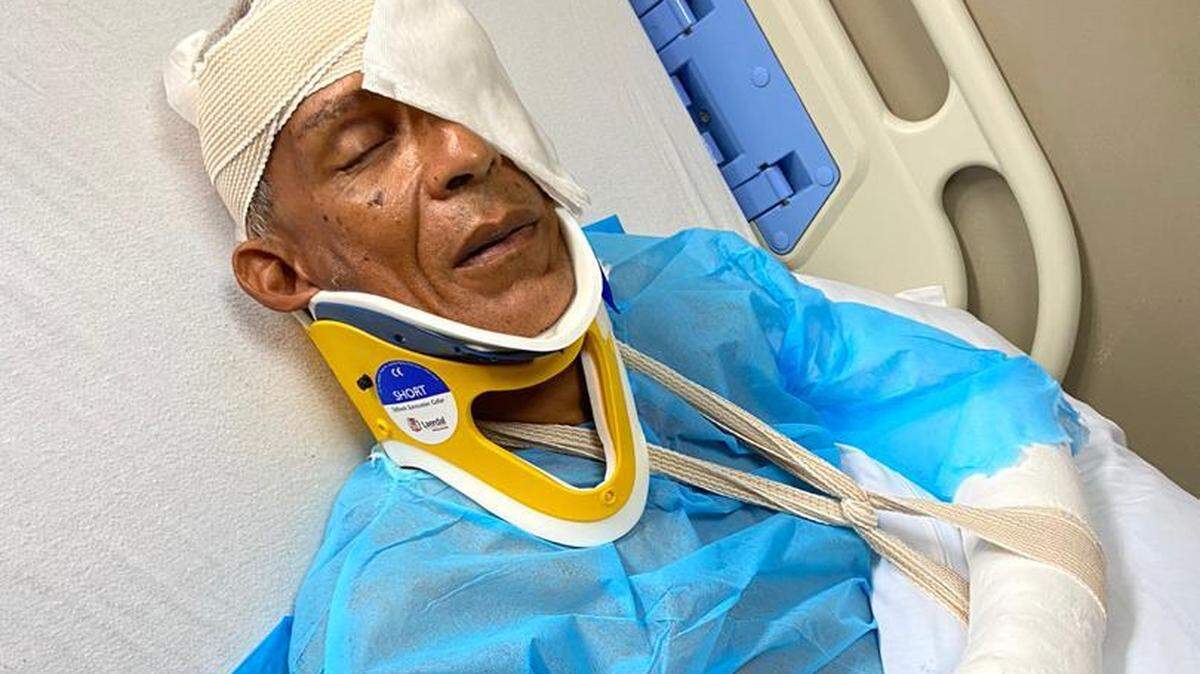
On Tuesday, the group invaded Patrick Benoît’s 48 acres in the mostly residential Vivy Mitchell suburb of Port-au-Prince, savagely beat him, tied his hands and feet behind him with a rope like a crab, then refused to take him to a hospital for medical attention.
The incident, partly captured on video filmed by the perpetrators as his wife also came under attack, has triggered outrage in some quarters of Haiti and its diaspora, while raising questions about the depths of impunity and corruption in a country that some worry is increasingly moving toward becoming a rogue state.
It has also brought into focus a problem that’s 216 years in the making where an archaic land titling system, subject to manipulation, offers no guarantee of property rights, and has increasingly left property owners at the behest of a land-stealing mafia.
“This land mafia has in it lawyers; it has notaries, it has bailiffs and there is a group of real estate agents in it who are searching for property all over the place ... to claim,” said Herold Jean-Francois, the director of Radio IBO, whose personal outrage over the saga led him to call for Haitian indignation on his airwaves and for Haiti to finally settle the issue of property rights.
“The Haitian justice system is so dysfunctional that once someone comes and makes a claim on a piece of land ... you’re suddenly in a legal proceeding and it goes on indefinitely. These people have neither a title nor legitimacy.”
The failure of multiple Haitian governments, dating back to founding father Jean-Jacques Dessalines, to deal with the issue of land tenure, is not only turning regular citizens into victims, but is a huge impediment to economic growth. It was one of the principal reasons why Haiti’s reconstruction efforts after the 2010 earthquake failed. Foreign governments, including the United States, and nongovernmental organizations did not want to invest in housing for the country’s 300,000 homeless victims of the quake when the state could not guarantee their right to the land after homes were built.
While the Benoît family has been at the center of a property dispute dating back to 2014 that has resulted in animals being slaughtered, trees being destroyed and people invading the property once before, last week’s incident is the worst that it has ever gotten.
The 64-year-old family patriarch was terrorized in front of his elderly and disabled wife, whose death and arrest were heard being called for on the video that went viral. In the crowd were a judge, Ricot Vrigneau, who has since been suspended, and a bailiff along with uniformed and off-duty Haitian police officers. There were also a gang of other unidentified individuals who also attacked a Benoît family worker and a security guard.
“Even when someone doesn’t have a valid document in their hands, and they come to execute an order,” Rachelle Benoît said, “there is a way that it should be done.”
A crowd, machine guns and a court order
Rachelle Benoît, 64, said she and Patrick were on the hillside property Tuesday when they heard a lot of commotion. Her phone rang, and the person on the other line told her “they saw a crowd and a tractor, and guns.”
She and Patrick decided to investigate. Patrick Benoît took the lead in his white Ford pick-up, and she followed behind in her black Mitsubishi Montero SUV, Rachelle said in an interview with the Miami Herald.
“When we were arriving in the area, there were a lot of shots being fired,” she said. “There were a bunch of people who were destroying things, firing guns.”
But she did not see Patrick, whom she had lost sight of on the expansive hilltop overlooking parts of Haiti’s capital. When she turned down another road, she saw the pickup and a bunch of people near the vehicle. “I realized there was something they were hitting on the ground near the vehicle,” Rachelle said.
When the crowd of men spotted her, they approached her Montero and yelled, “Stop the vehicle. Stop the vehicle.”
“I didn’t advance. I stopped because they started shooting at me,” she said. “They kept firing shots. I saw all kinds of guns. I don’t know how is it I didn’t take a bullet.”
After the group reached the Montero, Rachelle Benoît said they started banging on it while screaming, “Get out, get out.”
She explained that she was disabled and could not exit the vehicle.
“One of them said, ‘Kill her!’ And then one of them said to me, ‘We kidnapped your husband, we took him ...and you will not see him again,’ ” she said.
Rachelle had a worker inside the vehicle with her. After making her cut off the SUV, “they dragged him,” out of the vehicle.
“After they dragged him, they started beating him with a stick,” she said. “They beat him with a gun, they beat him with all kinds of things. They beat him, they beat him, they threw him on the ground. I am looking at them beating him and I don’t know what’s going to happen to the child.”
One of the men in the crowd was dressed in a police uniform. He was tall, well-built and was starting to gray.
“He said kill her, kill her and take her away,” Rachelle said of the police officer. “Another one said, ‘No, no.”
Her cellphone rang. In between demanding that she not pick up, Rachelle said, the police officer continued to insist that they kill her. When the group refused, he demanded that they take her. She again refused to step down saying, “I am handicapped, I cannot come out.”
In the two-minute video, which she said only shows a quarter of the drama that unfolded that day, Patrick Benoît is seen lying on his stomach on the rocky terrain. His face is covered in blood, which is also flowing down his neck and long sleeve red shirt. His hands, and feet, which are elevated in the air, are all tied to a long rope.
“You took over people’s property,” an unidentified voice says.
Then another voice is heard saying, “I would have killed him.”
The unsteady camera pans around to Patrick’s face, and his truck, showing the license plate. Someone explains that shots are still being fired, while another voice said, “Let them keep shooting.” More talking is heard, and the situation appears to be getting out of control as a voice in charge says the crowd should follow orders.
“Don’t throw rocks,” the voice says. “These guys are not stupid; they need to listen....They have [officials] with them; they have to listen as well.”
The person, whose face is never shown, continues rushing toward Rachelle’s car. “Don’t hit the lady,” the voice says, as the camera shows someone reaching in through the opened passenger door.
“Arrest the woman,” the voice says. “Guys, arrest her. Do not destroy the car.”
Rachelle Benoît said what wasn’t shown on video was the group breaking her vehicle’s window. They also ransacked her car, and stole a megaphone.
Haiti’s land problem
Land conflicts and tensions are nothing new in Haiti where land records are not computerized and conflict over property ownership dates back to the founding of the nation in 1804. In some instances, the perpetrators behind the raid are mayors, senators or private individuals. The Haitian state has also been accused of illegally taking people’s property and not compensating them.
A recent case involved Haitian President Jovenel Moïse using his decree powers to seize the 150-year-old property of the El-Saieh family on Avenue du Chili in Port-au-Prince to build a school. The declaration of public utility earlier this year outraged Jean-Emmanuel El-Saieh, who called the state’s nationalization “robbery.”
But landowners in Haiti are not only vulnerable to state expropriation of their property. They are also regularly subjected to dubious claims — or in the case of a Haitian-American investor, whose million-dollar resort in northern Haiti was torched earlier this year, threats.
There are countless stories from property owners about waking up one day and learning that someone has laid claim to their land after presenting documents showing they acquired the property a year before they did, or they own part of a house.
Often a scam, it involved someone trying to fraudulently lay claim going to a judge out of jurisdiction, who issues an appearance notice, and when the unaware property owner doesn’t show up, a justice of the peace, accompanied by police, shows up at the property.
In the case of Patrick Benoît, and the 48 acres that have been in his family for over a century, the recent conflict dates back to 2014 when Benoît’s brother, Gilbert, was summoned by members of the Laurenceau family claiming rights to the property.
Haiti National Police Inspector General Hervé Julien, whose job it is to investigate police conduct, said there is an ongoing investigation. Julien said the officers involved “were not mandated by the hierarchy of the police,” and he currently has no idea how many cops were actually involved in the incident.
“We met with Mr. Benoît who said that it was only a single police officer who hit him,” Julien said. “We interviewed two police officers assigned to the courts who were with the judge. They said they knew nothing about the affair. We are continuing [the investigation].”
In a statement following the incident, Haiti’s justice ministry condemned the justice of the peace on the scene, saying “a simple analysis of the file and observation of the course of the facts suggests” that he “showed great laxity and great thoughtlessness; which constitutes a serious professional misconduct.”
Haiti Prime Minister Joseph Jouthe also condemned the brutal act, saying in a tweet that Benoît’s treatment was “unacceptable and inhumane.” He ordered the justice ministry to initiate an investigation that should not exceed one month to shed light on the incident.
Rachelle Benoît said Patrick was finally transported to a local hospital after great pressure. He has a broken arm, broken wrist, two damaged fingers and a damaged eye socket. Doctors drilled three holes into this head to check for injuries and were trying to get a medication currently not in Haiti out of the Dominican Republic, whose land and air border is currently closed due to the coronavirus pandemic.
“He is recovering,” she said. “His morale is good.”
Legal experts and the Benoît’s own lawyer, speaking on the radio after the incident, said there was no legal basis for the raid. Not only were those executing the order out of their jurisdiction and not authorized to do so, but the court order they relied on was a supreme court ruling over a wall that the Benoîts had constructed between their property and the Laurenceau’s property.
The ruling has nothing to do with the ongoing property ownership dispute, they said.
Furthermore, under Haitian law, every citizen has a right to interim legal measures in the event someone tries to execute a court order, which was disregarded by the judge in this case, Rachelle Benoît’s said.
“When a justice of the peace is accompanied by a bunch of individuals dressed in police uniforms and in civilian clothing, everybody with all kinds of big guns, machine guns in their hands, and masks, to beat everyone they find and injure people in this case. I have a right to ask” the judge to justify the legal reason for his appearance on the property, she said.
“Because we are in a legal proceeding and I have a right to ask,” Rachelle Benoît added. “I am present, live on the premises and I’m in possession.”
Jean-Francois said it’s clear the gang was trying to use the unrelated court order “to exterminate Patrick.”
“I don’t know how it’s possible he didn’t die in this,” he said, adding that a group of notaries have also come out in defense of the Benoît’s family’s property claims. “It’s the tradition of impunity that’s the cause of all this. They are chiefs and they are aligned with people in power, allowing them to create the disorder that they do.”
In his editorial, which was also published in the country’s daily, Le Nouvelliste, Jean-Francois said what happened to Patrick Benoît stems from “the attitudes of a primitive society.”
“If we don’t get angry today at this blatant case of human rights violations, tomorrow when it is someone else or you, there will be no one left to speak out against it,” he said, calling on Haitians to express their indignation.
This story was originally published May 10, 2020 at 4:02 PM.