Haiti president ushers in one-man rule, plans to use salaries of lawmakers to build schools
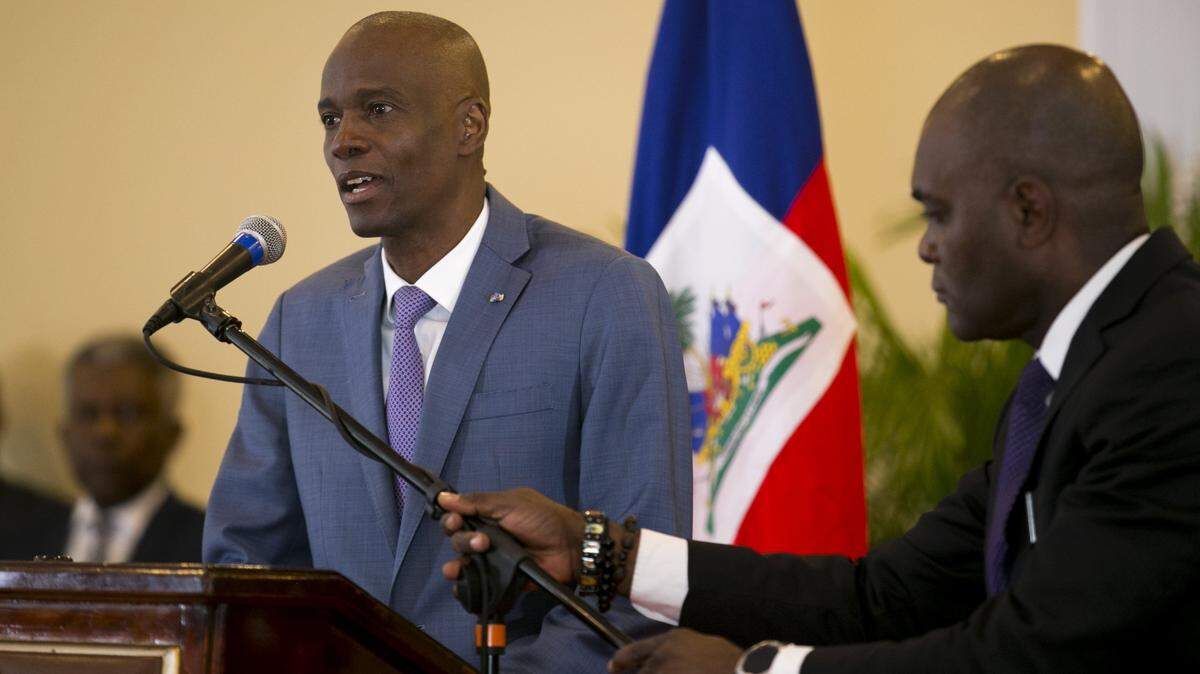
Haiti President Jovenel Moïse began his first day of one-man rule Monday by declaring he will build 10 public schools around the country with the salaries of departed members of Parliament.
The amount, about $16.3 million, would have gone to pay 118 members of the Lower Chamber of Deputies and 19 senators this year. The entire budget of the Parliament is roughly $60 million. Moïse did not say what he plans to do with the rest of the money.
Shortly after midnight, Moïse issued two tweets Monday declaring the end of the bicameral Parliament with the departure of all members of the lower chamber and two-thirds of the Senate, leaving just 10 senators. The institutional void occurred after the country failed to hold legislative and local elections in October.
In press conference on Monday at the National Palace, Moïse called the void “a historical opportunity” for the country to “put our heads together to find a good direction for the country, where we can do good reforms ... reforms where everyone is included.”
This was the fourth time since 1987, he said, that Haiti will be governed without a parliament. In recent years, Parliament has earned the reputation of being ineffectual and corrupt as a result of some of the lawmakers’ criminal pasts.
Moïse, who has been the target of resignation calls and anti-government protests since his Feb. 7, 2017, swearing-in, is experiencing a rare period of calm in his mandate. He has for weeks now hinted at his desire to reform Haiti’s amended 1987 constitution. It makes the country ungovernable, he has said, and on Monday, once more, he blamed it for the country’s political dysfunction.
But most of his blame was directed at the Parliament, which he said had failed for two years to ratify a national budget and on six different occasions had failed to approve the political programs of his two choices for prime ministers. Parliament also failed to vote on a penal code and an electoral law that was sent to them in order for elections to be held.
Though Moïse faced staunch opposition from four out of 29 senators, he still controlled a majority of the chamber as well as the lower house, whose president, Gary Bodeau, blocked the last budget ratification by sending the draft proposition for the 2018-2019 budget back to the executive branch. At the time, Bodeau said the proposed budget failed to address the needs of the Haitian population. In the fall of 2017, opposition senators also blocked the spending plan, calling it “a criminal budget.”
Last year, the International Monetary Fund estimated that Haiti’s budget — given the devaluation of its domestic currency and double-digit inflation rate — was roughly the equivalent of $1.4 billion. The country faces a budget deficit, and very little of the expenditures are devoted to healthcare, education and other social programs.
Moïse indicated that four of the schools will be constructed in the metropolitan Port-au-Prince area.
Five hours after Moïse’s confirming the end of the 50th Legislature, Bodeau weighed in. He said he took note of the “end of the Parliament.”
“Consequently,” he added, “I invite Haitians to get together to write a new inclusive CONSTITUTION that would allow to redefine the rules of the game and govern differently.”
An ally of the president, Bodeau told reporters Sunday that his mandate did not officially end until midnight Monday, indicating that Moïse had jumped the gun with his tweet issued two minutes after midnight Sunday.
Bodeau said he sees the president’s one-man rule as an opportunity to get some kind of political agreement together to name a new government and “to have a new constitution because we can’t have the same Parliament that we had; when you have senators that are doing protests inside the Parliament instead of voting laws. It was unacceptable.”
“The right to protest is in the streets,” Bodeau said. “Congressmen do not protest in the Congress.”
This story was originally published January 13, 2020 at 5:22 PM.