
Guantánamo’s USS Cole death-penalty case in limbo after key defense lawyer quits
In a stunning setback to the trial of the alleged mastermind of the 2000 USS Cole bombing, the case’s entire civilian legal team including its capital defense attorney has quit the case over a secret ethical conflict.
The move could freeze progress toward trial in the national security case for the foreseeable future.
The USS Cole bombing, which killed 17 U.S. sailors off Yemen two years after al-Qaida’s attacks on two U.S. embassies in Africa, underscored the terror movement’s aspirations on the global stage. The case was on track to be the first death-penalty trial held at this remote U.S. Navy base in the post-Sept. 11 war crimes trial system.
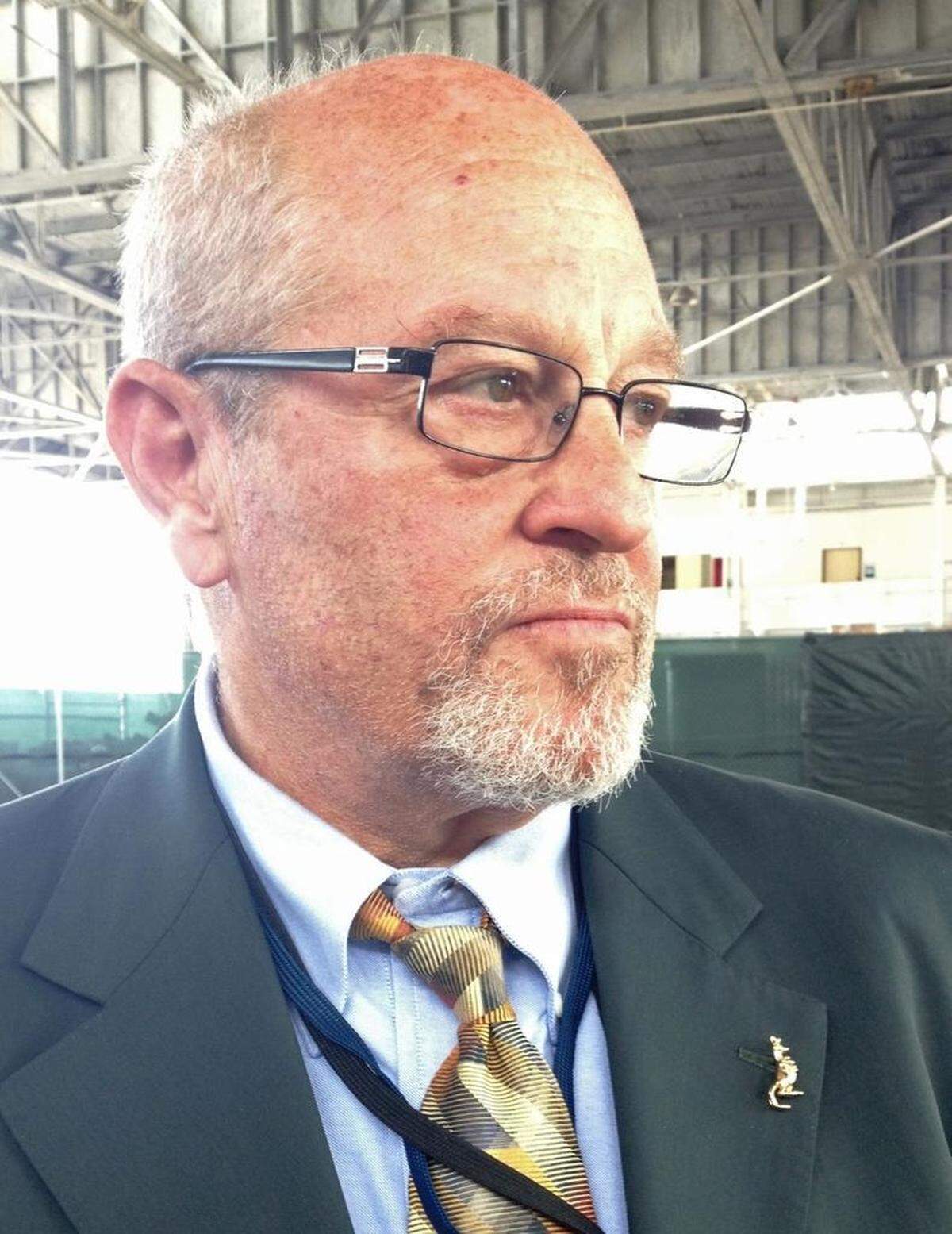
Attorney Rick Kammen, who has defended Saudi Abd al Rahim al Nashiri since 2008, was released on from the case by the chief defense counsel for military commissions, Marine Brig. Gen. John Baker. The case can’t proceed without him. Two other defense attorneys, who like Kammen are Pentagon-paid civilians, Rosa Eliades and Mary Spears, also quit with permission from Baker but remain on his staff.
Members of the legal team withdrew on the belief that the government was listening in on their legal meetings, creating an ethical conflict. It involves classified information so they cannot explain it to the accused terrorist. Or the public.
“We have mixed emotions about this,” Kammen said in a statement Friday afternoon. “We are angry about being placed in an ethically untenable position, disappointed in not being able to see the case through, and devastated to leave Mr. Nashiri, whom we genuinely like and who deserves a real chance for justice.”
A Pentagon spokesman suggested the Marine general’s finding of “good cause” for their release might not be sufficient. “There is currently no request for excusal before the military judge, who will only authorize excusal upon good cause shown on the record,” said Air Force Maj. Ben Sakrisson.
The startling but murky development caps months of classified conflict over a discovery by the defense team that its privileged attorney-client meetings may be monitored by the U.S. government. In June, the general advised war court defense attorneys that he had lost confidence in the integrity of “all potential attorney-client meeting locations” at Guantánamo.
It also comes as the U.S. Supreme Court is considering whether to hear an appeal brought by Nashiri’s Pentagon lawyers that asks the justices to intervene in the war court case.
Nashiri, 52, is accused of orchestrating al-Qaida’s Oct. 12, 2000 suicide bombing of the warship off Yemen. His lawyers say his years of torture in CIA custody merits pre-trial review of the case. The Supreme Court could announce Monday whether it will accept the challenge.
RELATED: USS Cole bombing case trial guide
Regardless, the resignations create a series of rolling conundrums for Nashiri’s judge, Air Force Col. Vance Spath. He is due at the war court Oct. 30 for three weeks of pretrial hearings. But by law a capital trial cannot go forward without a seasoned death-penalty counsel, a lawyer learned in the practice of capital punishment.
Now, only Lt. Alaric Piette, a former Navy SEAL and 2012 Georgetown Law School graduate, continues to represent Nashiri. “I’ve never tried a murder case and I am certainly not qualified as learned counsel,” Piette said by email Friday.
Piette added he would be qualified to defend the Saudi “if the death penalty wasn’t on the table.” Nashiri “is entitled to and should have a learned counsel since the government is trying to kill him,” he said. “If he doesn’t have one and the proceedings continue, then this court doesn’t even have the veneer of fairness.”
Judges at the war court have no power to order a civilian witness to come to Guantánamo — only to a video link in the United States. That means if Spath wants to question Nashiri’s now former death-penalty lawyer, he would have to do it remotely.
Kammen came to the case in 2008 as an Indianapolis criminal defense attorney with considerable death-penalty defense experience. He alienated the parents of sailors killed in the attack, as well as Cole survivors, by sporting a kangaroo pin on his lapel, a demonstration of his disdain for the hybrid court of military and federal law, which was created in response to the 9/11 attacks.
Long-frustrated family members of dead Cole sailors are sure to view the resignations as a stunt designed to derail the trial.
“If the government would declassify all the various pleadings that are classified, they would understand why it’s not,” Kammen said. “They would understand.”
The surprise resignations follow months of classified defense efforts following Baker’s advice that no place where lawyers meet captives at Guantánamo may be free of government eavesdropping. Defense attorneys in all three active prosecutions, notably in the Sept. 11 case, have been barred from discussing the issue in public — meaning it implicates a Top Secret intelligence program — and have sought in classified sessions and filings to address the problem with their judges.
Kammen said he got an ethical opinion from a recognized legal scholar, Ellen Yaroshefsky, and presented it to the general to get permission to leave the case.
Prosecutors have dismissed the issue of uncharged captives “unintentionally being overheard” as inconsequential. But Nashiri’s lawyers informed the U.S. Supreme Court in a recent filing that they discovered something — which is blacked out in the public version — “contradicting the prosecution’s assurances.”
The judge has forbidden Nashiri’s attorneys from telling him about the problem.
“We’re in a position where we cannot meet with our client, and we cannot tell him why we can’t meet with him,” Kammen said, “and that’s an ethically untenable position to be in. Specifically, Spath has ordered that we are not allowed to explain why we can’t meet with him.”
Baker said Friday he was searching for another death-penalty defender for the case. But when the possibility of losing a capital defense attorney has come up at the 9/11 trial, lawyers predicted a protracted delay. It would take months, maybe longer to get a death-penalty qualified defender hired. In addition, the new lawyer would need a Top Secret security clearance to catch up in a case involving secret U.S. intelligence programs.
Only then would the attorney learn about the secret ethical issue that forced Kammen to quit.
Pretrial hearings in the USS Cole case have gone on for nearly six years with both sides still litigating over what evidence Nashiri or his lawyers can see, how to substitute for destroyed CIA evidence, and how much damage Nashiri suffered while in CIA custody from 2002 to 2006. Unclassified documents show he was waterboarded, abused rectally, confined to a coffin-sized box and subjected to other “enhanced interrogation techniques” to break him in interrogation.
Kammen estimated that he had devoted at least 10,000 hours working on the case, traveled to at least seven foreign countries in trial preparation and to Guantánamo 50 times to meet with Nashiri or appear in court.
Typically at the war court a defense lawyer needs permission from both the chief defense counsel and the captive to quit a case. In this instance, two attorneys said, Nashiri can’t exercise a veto because it involves an ethical issue the judge has forbidden the Saudi’s attorneys from discussing with the high-value captive.
%20(2).jpg "spath-080402-F-1506K-002 (2) (2).jpg")
Carol Rosenberg: 305-376-3179, @carolrosenberg
General notifies defense lawyers
The chief defense counsel, Marine Brig. Gen. John Baker, notified his staff on Friday morning of his approving the unprecedented resignation of the USS Cole civilian defense team. Here is what he said:
“On Wednesday, I found good cause to excuse Mr. Kammen as learned counsel and Ms. Eliades and Ms. Spears as defense counsel for Mr. al Nashiri, as each had requested. While this was very difficult decision to make given its impact on Mr. Nashiri and the case, it was an easy decision to find good cause given the information presented by Mr. Kammen, Ms. Eliades and Ms. Spears and the facts as I know them.
“This morning LT Piette filed notice of my excusal with the military commission. I notified the [Convening Authority] that I do not have an available conflict-free learned counsel to detail to Mr. al Nashiri and that I have begun the search to find a replacement. I have tasked CAPT Filbert to lead that search effort.”
This story was originally published October 13, 2017 at 1:12 PM with the headline "Guantánamo’s USS Cole death-penalty case in limbo after key defense lawyer quits."