
Supreme Court grapples with lawsuits over Castro-era confiscation of U.S. properties
U.S. Supreme Court justices grilled lawyers on Monday defending cases related to a 1996 law that allows lawsuits in U.S. courts against companies “trafficking” in properties confiscated by the Cuban government, the first time litigation related to those claims ever reached the high court.
The judges heard oral arguments in cases brought by Exxon Mobile Corporation, which is suing Cimex, the Cuban military-run company that manages gas stations and other oil-related assets confiscated by Cuba, and Havana Docks, an American company that owned a concession to docks and facilities at the port of Havana and is suing four Florida-based cruise ship companies.
The law, formally known as the Libertad Act but commonly referred to as Helms-Burton, was signed in 1996, but the provision for suing in federal court was suspended by every president until Donald Trump enacted it in 2019. More than 40 lawsuits have been brought in federal courts, but litigation has been complicated by the time lapse — the properties involved were confiscated during the early years of the Castro revolution — and the interpretation of the law.
It was unclear in which direction the court was leaning overall, and most of the time the justices questioned both sides with unexpected interest in cases stemming from a narrow policy issue. As a result, the hearings ran an hour and a half past their scheduled time.
The central legal question in Exxon’s lawsuit against Cimex is whether Helms-Burton overrides foreign immunity provisions stated in another law, the Foreign Sovereign Immunities Act, for Cuban-government-owned entities.
Exxon, operating at the time under the name Standard Oil, had extensive oil and gas operations in Cuba through its wholly owned subsidiary Esso Standard Oil S.A. In 1960, the Fidel Castro government expropriated, without compensation, all of Exxon’s assets, including refineries and the network of gas stations currently operated by Cimex. With decades of accrued interest and the possibility of triple damages under the Helms-Burton Act, Exxon’s current claim exceeds $1 billion.
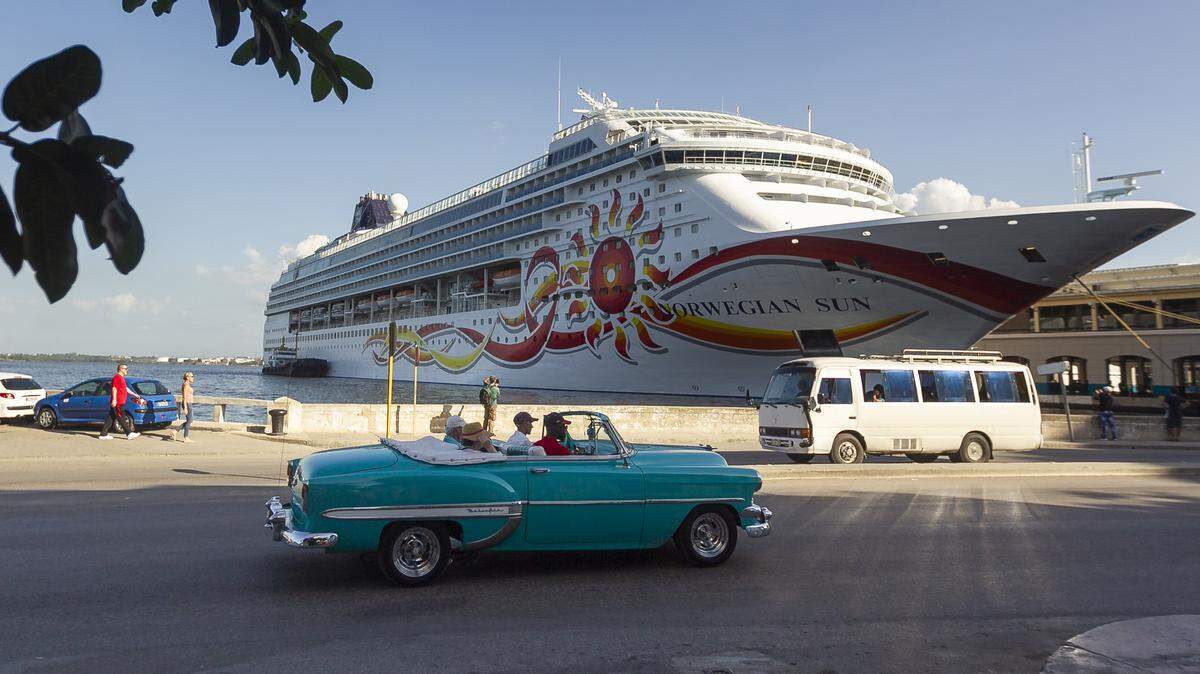
In 2022, Havana Docks won a historic ruling by a Miami federal judge, who ordered cruise lines Carnival, MSC, Royal Caribbean and Norwegian to pay over $400 million for using the docks and facilities that Havana Docks had built in the pre-Castro era at the port of Havana to transport American passengers.
But because Havana Docks’ concession expired in 2004 — before the cruise companies took U.S. visitors to Cuba between 2016-19 — a federal appeals court overruled the decision.
The Supreme Court will now decide whether that timeline affected Havana Docks right to recover damages.
Even a ruling in favor of Exxon and Havana Docks the plaintiffs might not settle the cases for good, as other aspects of the lawsuits are still under litigation. Still, a favorable decision could provide another point of leverage for the Trump administration, which has cut oil supplies to Cuba from Mexico and Venezuela and is pressuring Havana to engage in negotiations amid a worsening humanitarian crisis.
The administration had made it clear it sees both cases as significant for its foreign policy towards Cuba: It allowed the U.S. solicitor general’s office to send lawyers to the Supreme Court on Monday to argue in favor of Havana Docks’ and Exxon’s positions.
The U.S. State Department called attention to the hearings on social media.
“Today, the U.S. Supreme Court considers suits by U.S. nationals whose property was confiscated by the Cuban regime,” the State Department’s Bureau for Western Hemisphere Affairs said on X. “As the Administration wrote to the Court: ‘The United States has significant foreign-policy interests in encouraging democracy in Cuba by promoting accountability for the Cuban government’s wrongful seizures through Title III suits and in supporting compensation for U.S. victims of unlawful Castro-era expropriations.’”
The Supreme Court is expected to rule before it takes its summer break in June or early July.
The debate highlighted the complexities of interpreting statutory language and its implications for international law and foreign policy.
“Today’s SCOTUS arguments reflected the same issues that have confronted lower courts since 2019 – how to interpret the words that the United States Congress did or did not put to paper,” said John Kavulich, the president of the U.S-Cuba Trade and Economic Council, who has closely followed Helms-Burton litigation. “In some ways, the 1996 Libertad Act statute seems not to have been written as an executable document, but rather as a theoretical document and a political document.”
“Today,” he added, “a very active nine justices engaged each of the attorneys before them. Now, everyone waits for the decision.”
This story was originally published February 23, 2026 at 6:03 PM.