
Citing Cuba’s support for Russia in Ukraine, many U.S. allies shun island at U.N.
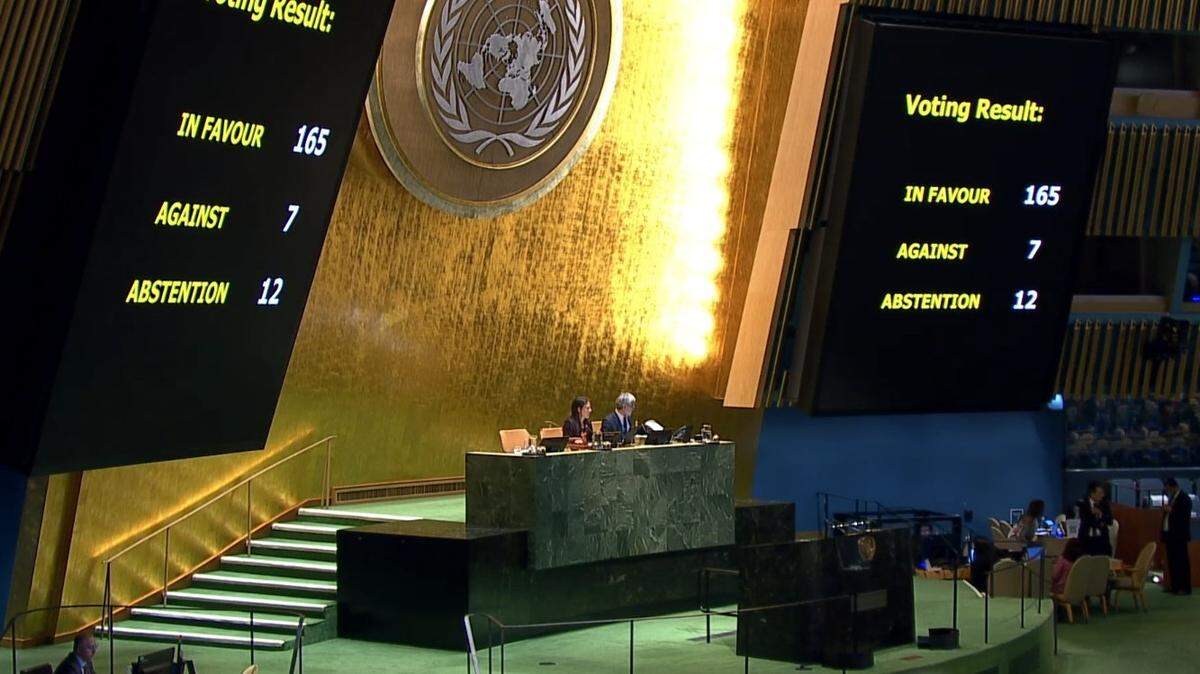
Following a U.S. push to challenge Cuba’s claims about U.S. sanctions, 19 countries abstained or voted against a Cuban resolution calling to end the U.S. embargo at the United Nations on Wednesday, a first at the global entity.
Most of the governments aligning with the United States were Latin American and European countries.
Argentina, Paraguay, Israel, Ukraine, Hungary and North Macedonia joined the U.S. in voting No to the resolution. After the vote, a representative of Ukraine accused the Cuban government of “complicity” and “involvement” in the Russian aggression against his country, claiming Cubans make the “largest group of mercenaries serving in the Russian army.”
Poland, Lithuania, Latvia, Estonia and the Czech Republic cited Cuba’s government turning “a blind eye” on the “large number of Cuban nationals participating in Russia’s war of aggression against Ukraine” to explain their abstention. Costa Rica, Ecuador, Albania, Bosnia-Herzegovina, Morocco, Moldova and Romania also abstained.
In remarks after the vote, a U.S. representative said the United States “was satisfied to see so many countries sent the regime a message that the international community will no longer tolerate its lies.” He accused the Cuban government of siding with U.S. adversaries and “actively supporting Russia’s war in Ukraine,” an allegation Cuban authorities deny.
Despite a higher number of abstentions than in previous years, a majority of nations – 165 – still voted in favor of lifting the decades-old embargo, citing concerns about unilateral sanctions. Last year, only the United States and Israel voted against a similar resolution, while Moldova abstained.
The vote follows a renewed diplomatic effort by the United States to get more countries to abstain or reject the Cuban resolution, to weaken what it sees as a sign of international support for the communist government in Havana.
“For decades, the illegitimate Cuban regime has used its annual anti-embargo resolution at the U.N. as a propaganda tool to distract from its own corruption, incompetence and brutal repression,” a State Department spokesperson told the Miami Herald. “The suffering of the Cuban people is not caused by the U.S. embargo but by the Cuban dictatorship’s failed Communist policies and human rights violations.
“The real reason Cuba’s economy suffers isn’t because of a lack of access to markets. It’s because the regime hides billions in overseas bank accounts instead of investing in electricity, infrastructure and the daily needs of its people,” the U.S. official said in reference to a Miami Herald investigation this year that revealed that a Cuban military conglomerate, GAESA, had $18 billion in assets last year.
Mike Waltz, the U.S. ambassador to the United Nations, made a similar point during the debate about the resolution on Tuesday, urging officials from other countries to “tell the regime you’ve seen the investigative reporting about Cuba’s military-controlled companies sitting on billions of dollars in offshore and overseas bank accounts, again while its own people’s needs are ignored.”
Also central to the State Department’s efforts to get other countries to abstain or reject the Cuban resolution this year are claims by Ukrainian intelligence that thousands of Cuban mercenaries are fighting for Russia in its war against Ukraine. The State Department mentioned them in a cable sent to dozens of U.S. missions with talking points for American diplomats to urge U.S. allies to oppose the resolution, Reuters reported earlier this month.
Last week, Cuba’s foreign minister, Bruno Rodriguez, said the Trump administration was exerting “intimidating and deceptive pressures” on countries in Latin America and Europe for them to change their vote.
“The United States government combines this policy of extreme pressure, an extraordinary, totally unusual, perhaps unprecedented display on this issue, with a slanderous, mendacious campaign of information poisoning,” he said, likely referring to social media publications by the State Department on the issue.
In his remarks ahead of the vote Wednesday, Rodríguez also accused the United States of implementing a “comprehensive plan of destabilization” using Cuban-origin operatives in other countries for the “speculative manipulation of the dollar exchange rate.”
Officials sparring
Despite a U.S. government shutdown, the State Department’s Western Hemisphere office was actively publishing on social media its rationale for urging other countries to reject the U.N. resolution. And Cuban diplomats had been actively responding with their own talking points.
At one point, U.S. Deputy Secretary of State Christopher Landau intervened to reply to Cuba’s handpicked president, Miguel Díaz-Canel, on X, where he said the U.S. was pressuring countries to change their vote fearing international rejection of “its genocidal and economically asphyxiating policy against #Cuba.”
In a post seen a million times, Landau, a former U.S. ambassador to Mexico, replied in Spanish: “Not even you believe your increasingly blatant lies. The only ‘genocide’ going on there is the one you commit against your own people, subjecting them to hunger and misery because of your failed communist policies that didn’t work in the USSR or in Cuba.
“There’s a reason your young people are escaping from that floating prison your Communist Party has turned the great Cuban nation into,” he added.
In what appeared as a scripted moment aimed at embarrassing Waltz – a former member of Congress and national security adviser to President Donald Trump who mistakenly included a journalist in a Signal chat where top U.S. officials discussed war plans — the Cuban foreign minister interrupted his speech to complain about Waltz.
“The U.S. representative is not just lying, but speaking rudely,” he said, before telling Waltz directly: “This is the United Nations General Assembly, it’s not a Signal chat nor the House of Representatives.”
“I am well aware of the location in which we are speaking,” Waltz replied. “And this is also not a communist illegitimate legislature in Havana. This is a place where we talk in facts. And the facts are the Cuban regime has undermined democracies in our hemisphere. It has oppressed its own people and it steals from its own people so that regime insiders can maintain their elite status.”
In remarks after the vote Wednesday, the U.S. representative called Rodriguez’s interruption a “shameful breach of decorum. It’s obvious the truth hurts.”
A symbolic vote
Despite the showdown, little will change following the vote on the non-binding resolution.
Since 1992, when Cuba started presenting the resolution calling for an end to the U.S. embargo, most countries have voted in favor. The vote, however, has had little practical effect, failing to change U.S. foreign policy on Cuba. Only Congress can lift the embargo, which is part of U.S. law. But the issue has given the Cuban government a diplomatic victory that it uses to reinforce its narrative that U.S. sanctions are the main reason for its economic troubles.
Earlier this month, Rodriguez said the embargo caused damages estimated at $7.5 billion between March 2024 and February 2025 and that if the sanctions had not been in place, Cuba’s economy would have grown by 9.2%.
The figures presented regularly by the government are believed to overestimate the financial cost of the sanctions because they include several estimates based on hypothetical situations, including, for example, estimated revenue from the sale of Cuban products to American consumers and savings on shipping costs. These year’s figures also included $2.5 billion in damages for the loss of workers to a migration wave Cuban authorities blame on the United States.
The U.S. embargo includes restrictions on Cuba’s access to the international financial system and organizations, as well as limits on trade and the acquisition of certain U.S.-made goods. Cuba is allowed to buy food, medicines, and other items in the United States following specific bureaucratic or financial parameters–for example, given Cuba’s poor payment record, the U.S. requires the Cuban government to pay in cash to buy agricultural products.
Economists agree that the sanctions are one of the factors that explains the country’s economic crisis. The sanctions make it more complicated and expensive for the island’s government and military to make financial transactions, buy U.S. technology or oil, for example. However, Cuban economists have questioned the government’s claims that the embargo is the leading cause of the financial debacle, pointing instead to the unproductive centrally planned socialist model as the main culprit.
“No government in history has ever made a communist economy work – even fellow socialist and communist states are urging Cuba to open its economy to its own people, allow its people to thrive,” Waltz said Tuesday. “And the only thing equal about communism and socialism is that everyone is equally miserable and poor.”
He cited trade figures showing that U.S. companies exported over half a billion dollars to Cuba last year.
“Colleagues, how is that a blockade?” Waltz said, using Cuba’s word for the embargo. “In fact, the Cuban regime can trade with any of you, with the entire world, with the rest of the Western hemisphere, with our friends in Canada and elsewhere. So, please stop repeating this propaganda that allows the regime to then go back and have an excuse for its own failures.”
Still, the final vote count shows that U.S. efforts were unable to cut through Cuba’s years of cunning diplomacy, mainly directed at developing nations, to whom Cuban authorities have offered scholarships, training, and doctors for hire.
Chance to take a jab at the U.S.
Officials from several countries who spoke at the U.N., for example, repeated many of the inaccurate claims Cuba made in the report accompanying the resolution, including that the embargo prevents Cuba from buying food and medicine in the United States and limits Cubans from accessing the internet. U.S. laws and regulations allows the export to Cuba of food, medicines, humanitarian donations and the provision of telecommunication services.
Over the years, countries have cited their rejection of extraterritorial sanctions and international sanctions outside the U.N. system to explain their vote. But that’s not the only dynamic at play.
For nations in the developing world, the vote has been an opportunity to jab at the United States on an issue that has traditionally carried little diplomatic weight. And it signals an undercurrent of resistance against U.S. dominance that has been on the rise. It was no coincidence that representatives of countries in the so-called “global south,” speaking on behalf of African nations, the Caribbean community, the Group of 77 plus China, and the Non-Aligned Movement, all spoke favorably about Cuba and condemned U.S. sanctions as “a breach of international law” on Tuesday.
For U.S. adversaries and competitors like Venezuela, Iran, Russia and China, whose representatives also defended Cuba, the resolution debate is another chance to complain about U.S. sanctions. For left-leaning governments at odds with the Trump administration — for example, in Brazil and Colombia — it was an opportunity to criticize U.S. tariffs and “interference” with sovereign nations.
Even U.S. allies have long maintained publicly that they support the Cuban resolution because their governments are against unilateral sanctions as a matter of principle, even if they agree with the U.S. government’s criticism of Cuba’s human rights violations. Companies from many European nations, Canada and Mexico, three of the U.S.’s closest partners, for example, have business interests on the island that have been affected by the embargo. Siding with Cuba on the resolution, the island’s number one issue on its agenda at the U.N., has helped European nations and Canada to maintain a better relationship with the Cuban government.
“We have firmly and continuously opposed any such measures due to their extraterritorial application and impact on the European Union in violation of commonly accepted rules of international trade,” a representative of Denmark said Wednesday, speaking on behalf of several European Union members. She warned the European Union might take counter measures in response to lawsuits against European companies filed in U.S. courts for allegedly trafficking in confiscated property in Cuba.
“We cannot accept that such measures impede our economic and commercial relations with Cuba,” she said.
But Cuba’s success has also resulted from the country’s oversized diplomatic presence in the United Nations system, which Cuban authorities have used to prevent international isolation.
Immediately after the vote, Cuba’s foreign affair ministry declared: “Victory for Cuba! The international community once again overwhelmingly rejected the U.S. economic blockade against Cuba.”
On the U.S. side, U.S. Miami Republican Rep. Mario Díaz-Balart highlighted instead “the growing list of countries who have changed their vote. The tide is turning as more countries see through the Cuban regime’s propaganda to stand with the Cuban people in their demands for freedom and to support shared security interests.”
This story was originally published October 29, 2025 at 1:35 PM.