
With eyes on Venezuela, Cuba asserts Raúl Castro is its leader and in charge of defense
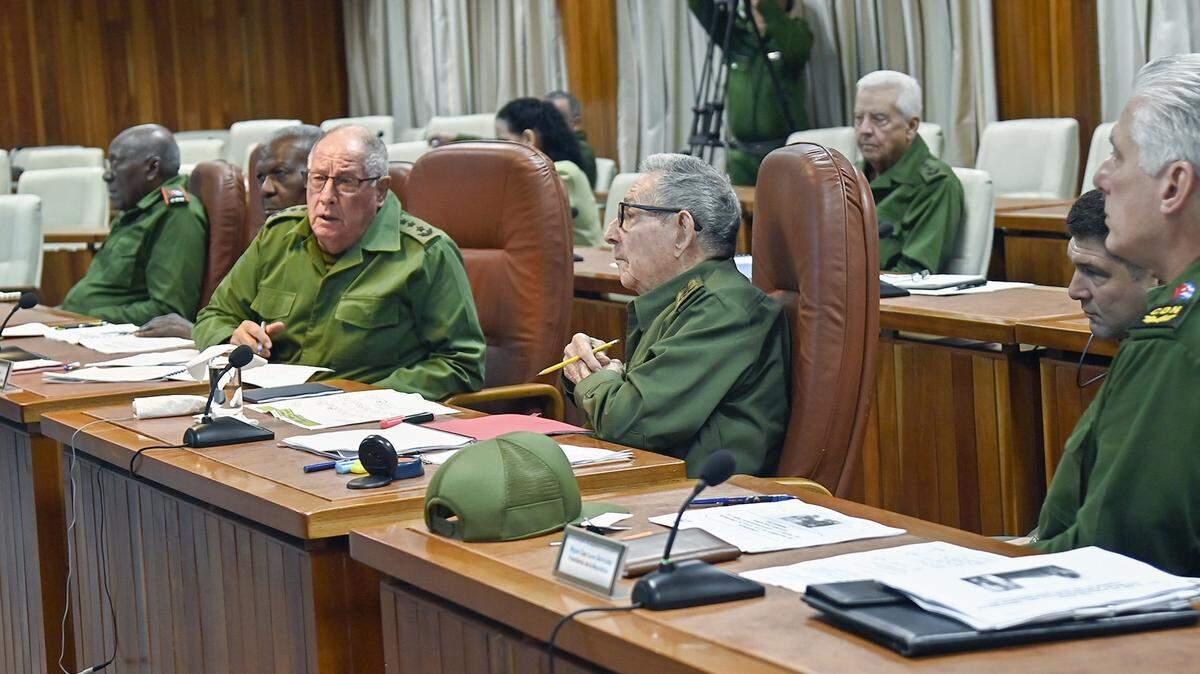
Cuba’s 94-year-old ruler Raúl Castro, who is officially retired, reappeared this week to preside over a rare national defense council meeting and reassert that he is Cuba’s ruler amid Havana’s increasing fears over chances of a U.S.-provoked regime change in Venezuela.
Looming heavily over the meeting, which took place on Wednesday but was not disclosed until Thursday, was the massive U.S. military deployment in the Caribbean and the possibility of an end to the Nicolás Maduro regime in Venezuela, which would leave the Cuban government without its closest ally in the region.
In what was likely an effort to reassure both local and international audiences that there is no power vacuum at this critical juncture, the ruling Communist Party’s newspaper, Granma, dispensed with any formalities and plainly said Castro was in charge of leading the country.
“The meeting at the Ministry of the Revolutionary Armed Forces was presided over by Army General Raúl Castro Ruz, chief at the head of the revolution, and President Miguel Díaz-Canel Bermúdez,” Granma said. Seated between the two was Castro’s grandson, Raúl Guillermo Rodríguez Castro, who is believed to have influence in the country as Castro’s right hand and personal security chief.
The Cuban Constitution says the president, who is also the head of the Council of State, should be the one presiding over the national defense council, which is the country’s governing body in cases of war and states of emergency. Castro has no formal official role since he handed the top party position as first secretary to Díaz-Canel in 2021.
There were no details of what was discussed. The report said the council’s members gathered for planning and “decision approvals.”
After rumors that he had been hospitalized, Castro appeared in a Communist Party event earlier this month. Even in retirement Castro continues to be the ultimate ruler of Cuba. But the government’s public acknowledgement on state media sends a message not just about his health, but also about the internal power dynamics at a time of great uncertainty.
Cuban authorities have signaled increasing concern over the buildup of U.S. military forces in the Caribbean in a counternarcotics operation that seems to be also aimed at putting pressure on Venezuelan strongman Nicolás Maduro to step down. Maduro remained in power after the Venezuelan people chose an opposition candidate, Edmundo Gonzalez, in the presidential election in July 2024. He has also been indicted in the United States on charges of narcotics trafficking.
For Cuba, the survival of a friendly government in Venezuela is crucial. Cuban leaders found in Hugo Chavez, and later in Maduro key political allies who kept the island afloat with subsidized oil.
And Cuban personnel could be at the center of any action against the South American country, where thousands of Cuban doctors are working, and Cuban intelligence agents are believed to be providing counsel and security to Maduro.
Cuban personnel are also spread throughout the power structures in Venezuela, opposition leader Maria Corina Machado said in a recent interview with U.S. government outlet Martí Noticias.
“It was a total surrender of national sovereignty,” said Machado, who received the Nobel Peace Prize last week. “Cuban agents infiltrated our intelligence agencies, the armed forces, identity agencies and key ministries. Venezuela continues to give oil to Cuba, which resells it while the Cuban people live in darkness.
“I’ve always said: it’s the same fight. As soon as we liberate Venezuela, we’ll continue for the freedom of Cuba and Nicaragua,” she added.
On Wednesday, President Donald Trump confirmed that he has allowed the CIA to conduct cover operations in Venezuela, and he said U.S. forces were also looking at carrying out land operations. U.S. assets in the Caribbean Sea and Puerto Rico—including around 10,000 troops, at least 10 ships, a nuclear-powered attack submarine, F-35 fighter jets, B-52 bombers, reconnaissance aircraft, Reaper drones and helicopters– are one of the largest military deployments in the Western Hemisphere in recent decades.
Cuba’s Ministry of Foreign Affairs has issued four statements condemning the U.S. military operation since it was announced in August. But Cuban officials have spoken cautiously, promising solidarity and support to Venezuela in vague terms.
“At a time when the empire and its misguided leader approve covert CIA operations against #Venezuela, we express our solidarity with that sister nation and, especially, with its President Nicolás Maduro,” Díaz-Canel said Thursday. “Today, #Cuba remembers more than ever the words of #Martí: ‘Give me ,Venezuela, something to serve, she has a son in me,’ and of #Fidel: ‘We must give everything for Venezuela.’”
On Friday morning, Díaz-Canel, other Cuban senior officials, and Pedro Infante Aparicio, the head of the Venezuelan National Assembly under Maduro’s control, held a rally in Havana to “reaffirm” Cuba’s “revolutionary brotherhood with Venezuela,” Cuban state media reported.
This story was originally published October 17, 2025 at 3:06 PM.