
‘We are living through the most difficult times,’ Havana activists tell U.S. diplomats
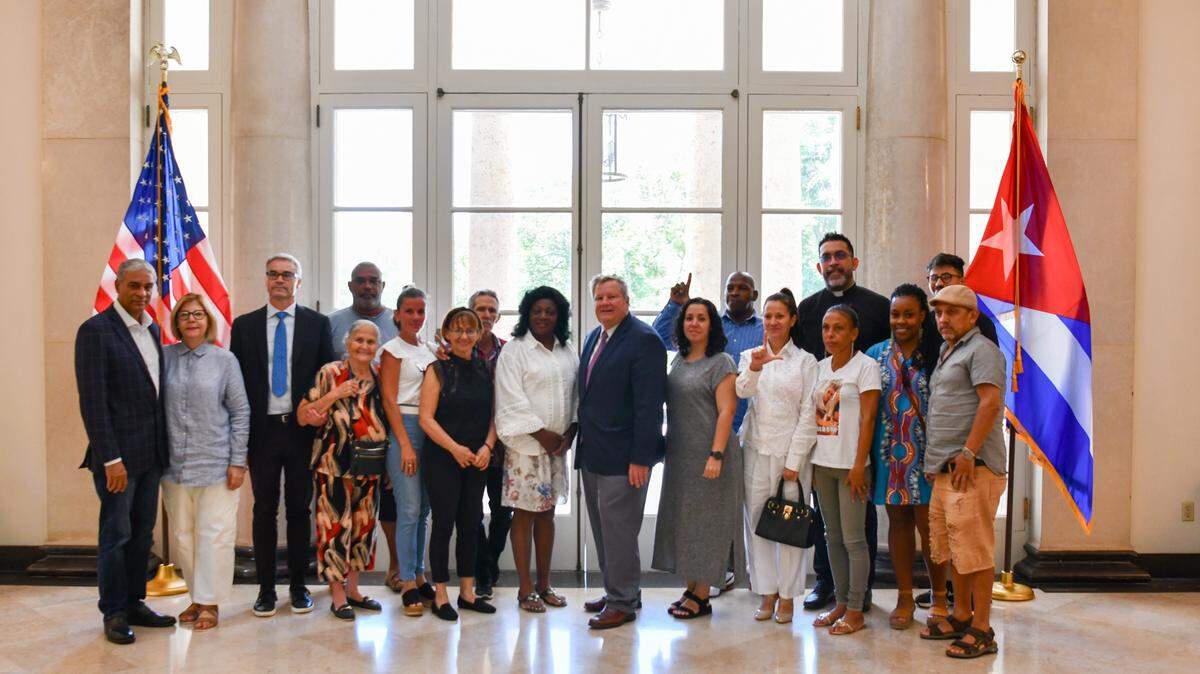
In an event marking another anniversary of the July 11 mass protests in 2021, the U.S. Deputy Secretary of State Christopher Landau told a gathering of Cuban activists in Havana on Tuesday that the Trump administration will continue advocating for the release of political prisoners on the island and is committed to supporting the Cuban people’s fight for freedom and democracy.
Landau addressed in Spanish a group of relatives of political prisoners, independent artists and journalists, religious leaders, former political prisoners and human rights activists gathered at the residence of the U.S. ambassador in Havana, Mike Hammer, via a video call from Washington.
In a video message in Spanish played at the start of the meeting, Secretary of State Marco Rubio, who was traveling to Asia and unable to join in, told the group that the July 11 protests marked “a change and a new era” and that the videos of the demonstrations had “inspired” Cuban exiles who “hope for freedom for Cuba.”
“You, who are there, who don’t give up, inspire us every day,” he said. “I know there is an enormous risk, that it is not easy to challenge a regime that does everything possible to punish you and your families. It is much easier to leave the country than stay there and fight for the future of a free and sovereign Cuba.”
In a rebuke of Cuban government leaders’ accusations that the ongoing economic crisis on the island is the result of U.S. sanctions, Rubio said his administration is aware Cubans are suffering shortages of medicines and blackouts, but said that is the result of “a regime that just does not know how to govern.”
Although the July 11 demonstrations were followed by a government crackdown and hundreds of arrests, since then, smaller protests have erupted regularly all over the country as the economy continues falling apart, and the government provides little response beyond calls to resist and renewed accusations against the United States.
In a recent Communist Party meeting last week, Cuba’s leader, Miguel Díaz-Canel, accused the U.S. of “betting on a political and social crisis that leads to an uprising during the summer” in a veiled acknowledgment of growing discontent among the population.
Several of the hundreds of Cubans arrested during the 2021 protests remain in prison, some serving harsh sentences. A few were released, thanks to a deal with the Vatican and the Biden administration, but then were sent back to prison, including prominent Cuban opposition leader José Daniel Ferrer. His family has accused the Cuban government of torturing him.
Landau called on the Cuban government to release the political prisoners and expressed concern in particular for the situation of Ferrer, longtime opposition member Felix Navarro, who is also in poor health, and rapper Maykel Castillo, known as Maykel Osorbo, who recently staged a hunger strike.
Cuban participants advocated for the release of the political prisoners and expressed deep concerns about the human rights situation on the island, a crackdown on freedom of speech and internet restrictions. Berta Soler, the leader of the dissident group Ladies in White, said she was particularly worried about Ferrer and increased repression and limitation of movement of the group’s members.
“We are living through the most difficult times for the Cuban nation. It’s a country that is completely destroyed, as if devastated by war,” said Elsa Morejón, a Cuban religious and human rights activist and the wife of Oscar Elías Biscet, a prominent Cuban dissident who was also in attendance.
When Landau asked those in the room what the U.S government could do to provide more humanitarian aid to alleviate scarcities for the Cuban people “without enriching the government,” Morejón said she favored the distribution of more humanitarian aid through churches, “but the greatest help would be freedom,” she quipped.
Although meetings between U.S. diplomats and Cuban activists have not been uncommon in the past, Tuesday’s event occurred at a time of heightened diplomatic tensions.
Several dissidents and independent journalists were arrested or placed in home detention so they could not attend the 4th of July celebration at the U.S. Embassy in Havana, and there were concerns that Cuban authorities would prevent some of the people invited from attending Tuesday’s event. Hammer acknowledged during the meeting that some attendees would likely face retaliation.
At various times, the U.S. officials praised the Cubans in the room for their courage.
“It is very easy for us to express ourselves about what is happening there on the island, but you are there, experiencing it. It moves me that you have overcome your fear,” Landau said. “You are writing your personal stories but also the history of your country.”
Relations between the two countries are at their lowest point in a decade.
After coming into office in January, President Donald Trump and Rubio quickly rolled back last-minute actions by the Biden administration to ease sanctions against Cuba and its military. A new presidential memorandum signed last week ordered the expansion of a blacklist of companies with links to the Cuban armed forces. It also threatened sanctions on foreign companies doing business with military-owned companies. The State Department has also expanded visa sanctions to officials linked to the Cuban medical official missions abroad, and bilateral talks on migration and other topics appeared to have been put on pause.
Cuba was also added to a list of countries whose nationals face restrictions on entering the United States.
Cuban officials have also been at odds with Hammer, the U.S. ambassador in Havana, whose unconventional approach of traveling around the country to meet activists and ordinary people and posting about it on social media has proven popular with Cubans and an irritant for the government.
Both Rubio, a Cuban American, and Hammer have been at the receiving end of vitriolic comments from top Cuban officials, state media and even the unofficial Cuban first lady, Lis Cuesta, who called the ambassador “shameless” in a post in X. The Foreign Ministry made an official protest.
In two X publications on the day of Ferrer’s arrest in April, Carlos Fernández de Cossío, Cuba’s vice foreign minister, suggested that the dissident was sent back to prison in retaliation for Hammer’s behavior.
“What is the conduct of the U.S. government when it finds that a foreign diplomat is inciting U.S. citizens to act against the U.S. government, to disrespect the law, to violate terms of conditional release or parole?” he wrote. “How do U.S. law enforcement agencies respond to such citizens?”
This story was originally published July 8, 2025 at 9:17 PM.