
Cubans tested to the limit as earthquake, hurricanes and total blackout hit within days
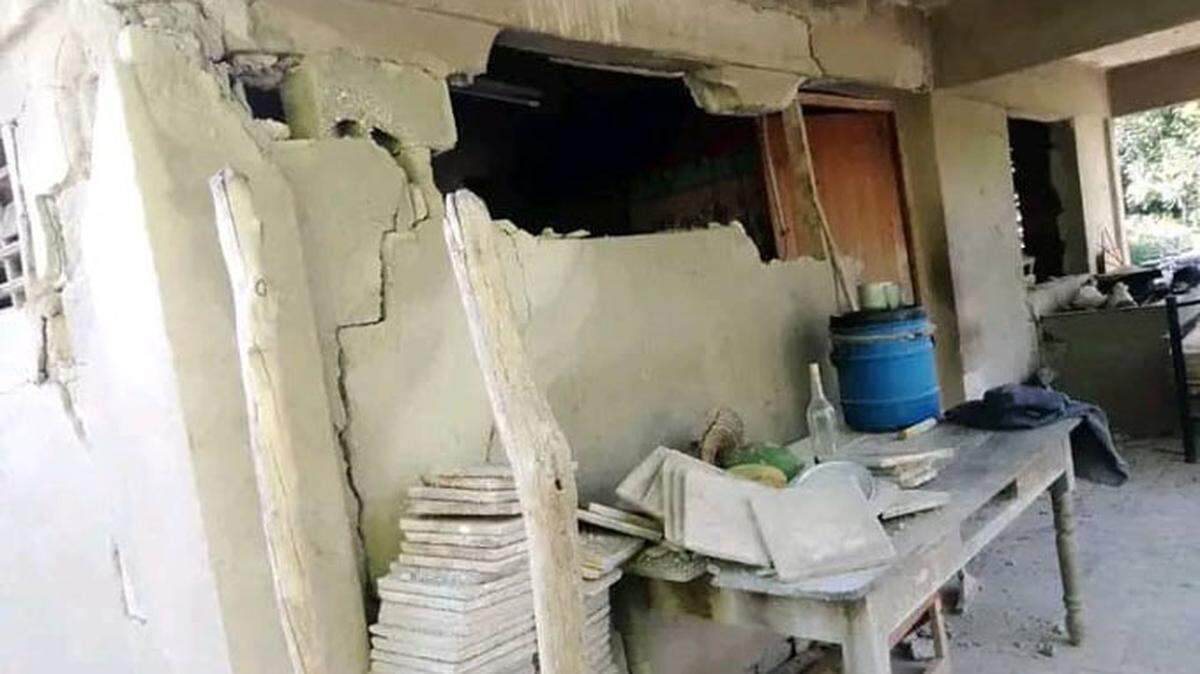
Cubans have been grappling with several crises in rapid succession in the past three weeks after the island’s eastern region was hit Sunday with a powerful earthquake even as the country was still reeling from two hurricanes that brought death and devastation.
A 6.8 magnitude earthquake in the ocean 20 miles off Pilón, a town on the southern coast of the province of Granma in eastern Cuba, shook the region on Sunday minutes before noon, leaving no casualties but at least two children, among them a five-year-old, and two adults injured, Cuban state media said.
The strong tremor followed a magnitude 5.9 earthquake earlier on Sunday morning that the United States Geological Survey said occurred 21 miles south of the nearby municipality of Bartolomé Maso, also in Granma province.
Cuba’s National Center for Seismological Research reported Monday morning that it had detected 885 tremors – including the two biggest ones - in the area in the past 24 hours.
Eastern Cuba is in an active seismic zone in the Caribbean that is responsible for most of the tremors felt on the island. In 2020, the Center reported a 7.7 magnitude earthquake west southwest of Cabo Cruz, in Granma province, but it happened at sea and did not cause damage.
The country’s leader, Miguel Díaz-Canel, urged residents in Granma to remain in open areas and follow earthquake protocols. Videos circulating on social media show panicked residents in Pilón left their houses Sunday to take refuge in the nearby mountains.
Cuban authorities have yet to provide a detailed assessment of the damage caused by the earthquakes However, images shared by state media and social media accounts show several collapsed homes, and houses, buildings and schools with cracks or crumbled walls.
Videos and photos show extensive damage in Pilón and cracks in the 1871 lighthouse in Cabo Cruz.
The earthquakes put additional strain on a population already dealing with multiple crises just days apart.
On the eve of Oct. 18, the government declared an energy emergency, citing a lack of oil and the diminished generating capacity of its old energy infrastructure as culprits of daily extended blackouts that had paralyzed the economy. The following morning a failure at a major power plant caused the entire electrical grid to collapse.
Electricity had not been restored when Hurricane Oscar caused life-threatening flash flooding in the eastern province of Guantánamo, killing at least eight people on Oct. 20. Authorities have not said if two people declared missing have been found.
Cuban authorities tried and failed for several days to get the power grid back on. Then, last Wednesday, Hurricane Rafael intensified to a Category 3 and knocked out the country’s electrical grid again, as it destroyed homes, hospitals, warehouses, critical infrastructure and crops in western Cuba.
The series of disasters have taken a toll on Cubans who have had to live without electricity and other basic services for several days at a time, struggling to preserve what little food they can get in a country plagued with shortages.
Many people in San Antonio del Sur and Imías, two of the towns hardest hit by Hurricane Oscar in Guantanamo, lost their homes and possessions to flash flooding and landslides, and blamed the government for the lack of warning and slow recovery response.
The flooding damaged the aqueduct carrying water to Imías, and in rural areas, residents have only been able to get “some” water from “easy access tanks” or bottles provided by the government, said Yean Martínez Terrero, the vice president of the local defense council.
Aerial images shared by the Cuban television of the western provinces of Artemisa and Mayabeque, ravaged by Hurricane Rafael, showed significantly more damage than previously reported to houses, government buildings, warehouses, crops and the electrical grid. Cuban state television also reported significant damage to some industrial facilities used in joint ventures between the Cuban government and foreign companies.
In Havana, authorities almost doubled the initial count of homes affected to 850. Only 20% of the population has water service, the province’s civil defense president, Liván Izquierdo, said in a government meeting Sunday.
In the westernmost province of Pinar del Río, most residents have remained without power since Wednesday, after Rafael knocked down the pylons for six high-voltage lines that distributed electricity from nearby Artemisa. The official news outlet Cubadebate reported that attempts on Monday to connect the province to the national grid failed.
In the province of Artemisa, only 17% of residents have water service, Gladys Martínez Verdecia, the province’s civil defense president, said in the government meeting on Sunday. A local education official said 229 schools in the province were affected by the hurricane and that classes have been suspended until “conditions” allow them to reopen.
In Playa, a Havana neighborhood, residents cheered when power was restored on Sunday. A few minutes later, it was gone again, and residents spent the night in the dark.
In Nuevo Vedado, a leafy neighborhood where independent journalist Yoani Sánchez lives, residents had no electricity for more than 100 hours until it came back on Sunday, she said.
“The little that people had to eat has run out or spoiled, and inside each house, the drama is immense,” Sánchez said.
The government has responded to protests of the dire conditions with the arrest of at least 23 people who participated in demonstrations since Oct 18, when the power grid first collapsed. Eight were arrested after protesting in Encrucijada, a town in the central province of Villa Clara, according to Justicia 11J, an organization tracking detentions of anti-government protesters.