
Hurricane threatens Cuba, still recovering from Oscar and collapse of electrical grid
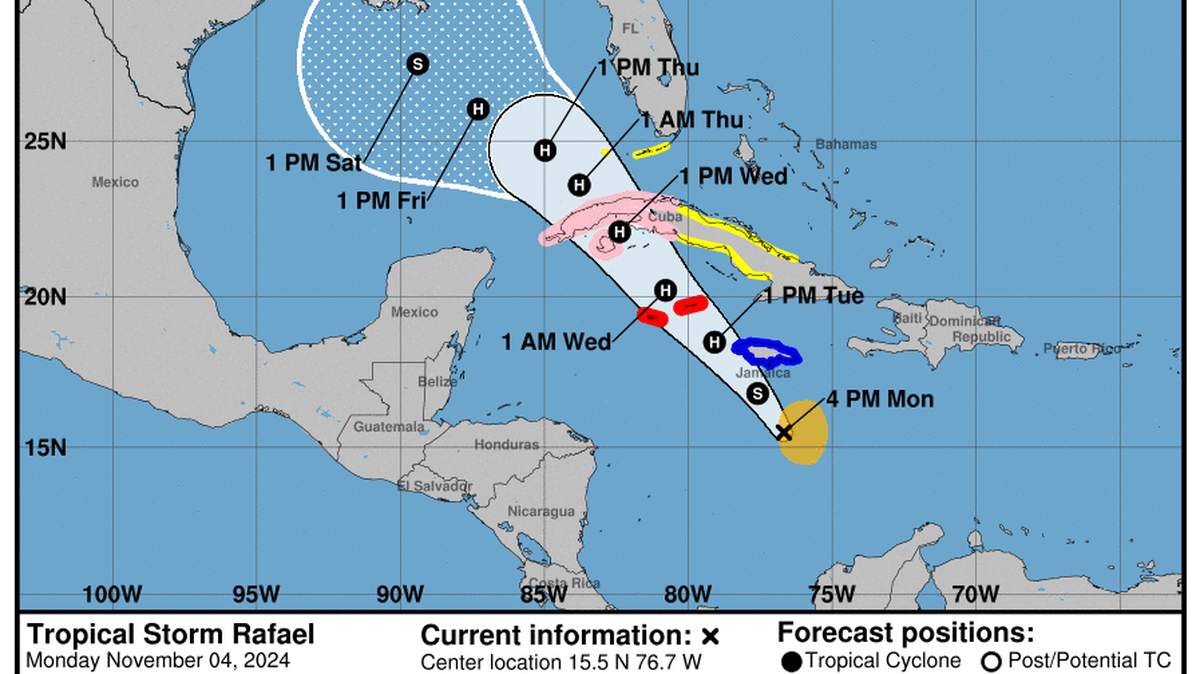
Cuba is bracing for yet another storm, just days after Hurricane Oscar wrought havoc in the eastern province of Guantanamo and the country’s entire grid collapsed last month.
Civil defense authorities issued an alert Sunday for central and western Cuba as tropical storm Rafael is expected to strengthen and cross western Cuba as a Category 1 hurricane as soon as Wednesday.
About 21,000 people will need evacuation in the island’s westernmost province, Pinar del Río, which is expected to get a direct hit if the hurricane continues its predicted path, Lt. Col. Noel Lozano, head of the Civil Defense in Pinar del Río, said.
During the weekend, authorities also ordered the evacuation of more than 37,000 people in the same areas hit harder by Hurricane Oscar in Guantánamo, like San Antonio del Sur, due to heavy rains pounding the area.
With the country still reeling from collapse of the electrical grid and several power station units out of work, causing daily blackouts 10 to 12 hours long outside Havana, another hurricane will bring additional strain on an island already facing a dire economic situation.
There is nothing similar to a Home Depot store in Cuba where people can buy hurricane preparation supplies. Most Cubans depend on relatives abroad for basic supplies like candles, batteries and flashlights. In a country where state monthly pensions about $5 and many professionals working for the state earn just $15 a month, food is scarce and expensive.
Cuban state media have extensively covered the evacuations in Guantánamo and preparations ahead of the hurricane hit, following widespread criticism about the government’s lack of warning and slow response to the floodings brought by Hurricane Oscar that devastated San Antonio del Sur and Imías, two municipalities in Guantánamo.
Eight people died, and two are missing, Cuban authorities said in their latest update. According to official preliminary assessments, more than 12,000 homes were damaged in the municipalities of Baracoa, Maisí, San Antonio del Sur and Imías, and there is extensive damage to almost 50,000 acres of various crops.
Some residents in San Antonio del Sur and Imías, two rural areas near mountains and rivers prone to flooding, said they were caught off guard because they didn’t know a hurricane was coming. Oscar rapidly evolved from a tropical storm to a hurricane, but to complicate matters, the island’s electrical grid collapsed on Friday, Oct. 18, and when the storm hit that Sunday, residents did not have electricity or phone service.
Local authorities carried out last-minute evacuations that Sunday, but some residents in San Antonio del Sur were moved to a school in an area still prone to flooding, Runielbis Samón Laffita, a San Antonio resident, told Diario de Cuba, a Cuban news outlet based in Spain.
Twenty-nine children were taking refuge in the school. When the water started coming in early morning Monday, no one was there to help them, Samón Laffita told the Cuban leader Miguel Díaz-Canel during his visit to the town days later, in an exchange caught in a viral video.
“The Civil Defense authorities told us that there would be a support group because everyone knew this was a flood zone,” Samón Lafitta told Diario de Cuba. “But there wasn’t even a person on duty to warn us that the river was rising and they didn’t have any transportation to take us out of the place if that happened. When we realized it ourselves, it was impossible to leave that place because the level of the Sabanalamar River had risen a lot.”
Samón Lafitta saved the kids, including his five children, with the help of another man, he said.
On Monday, members of the Cuban military and the Ministry of Interior also carried out emergency rescue operations to save people trapped in the waters. However, in the immediate aftermath, the government provided little aid to residents in San Antonio del Sur and Imías because access was cut off by land.
It is unclear why the Cuban military, which is in charge of the Civil Defense and whose Eastern Army is headquartered in that region, was not more rapidly deployed to provide food and water to those in need. But local media reported that just one military helicopter had been evacuating patients and delivering food to the area.
In the meantime, activists, members of religious congregations and artists reached these remote areas on foot and delivered food and water bought in private stores with donations raised across the country and abroad.
After road connections to these towns in Guantánamo were restored, and following donations from UNICEF, a U.N. agency, the government of Mexico and others, Díaz-Canel said the government had provided 300 mattresses and a food combo “with 10 products” to the people affected.
After a slow response, Cuban authorities have been in damage-control mode. After his first visit went south when he failed to project empathy and told an affected resident, “No one was responsible for what happened here,” Díaz-Canel returned to the area on a second visit surrounded by government officials and the head of the Cuban armed forces, Gen. Álvaro López Miera.
Cuban state media increased coverage of recovery efforts, and Díaz-Canel brought other government officials to his regular podcast to praise the government response to Hurricane Oscar in Guantánamo.
But notably absent in tours and media appearances in the past days has been the 93-year-old Gen. Ramón Pardo Guerra, the chief of the Civil Defense.
On Tuesday, local news outlets reported he visited Ciénaga de Zapata, a swampy, less populated area in the Matanzas province, to check preparations ahead of the hurricane threatening the island.
“Prevention is now the essential thing,” he said.
This story was originally published November 4, 2024 at 5:43 PM.