
Experts can’t agree on cause of Havana Syndrome – or even if it’s real. Here’s what they say
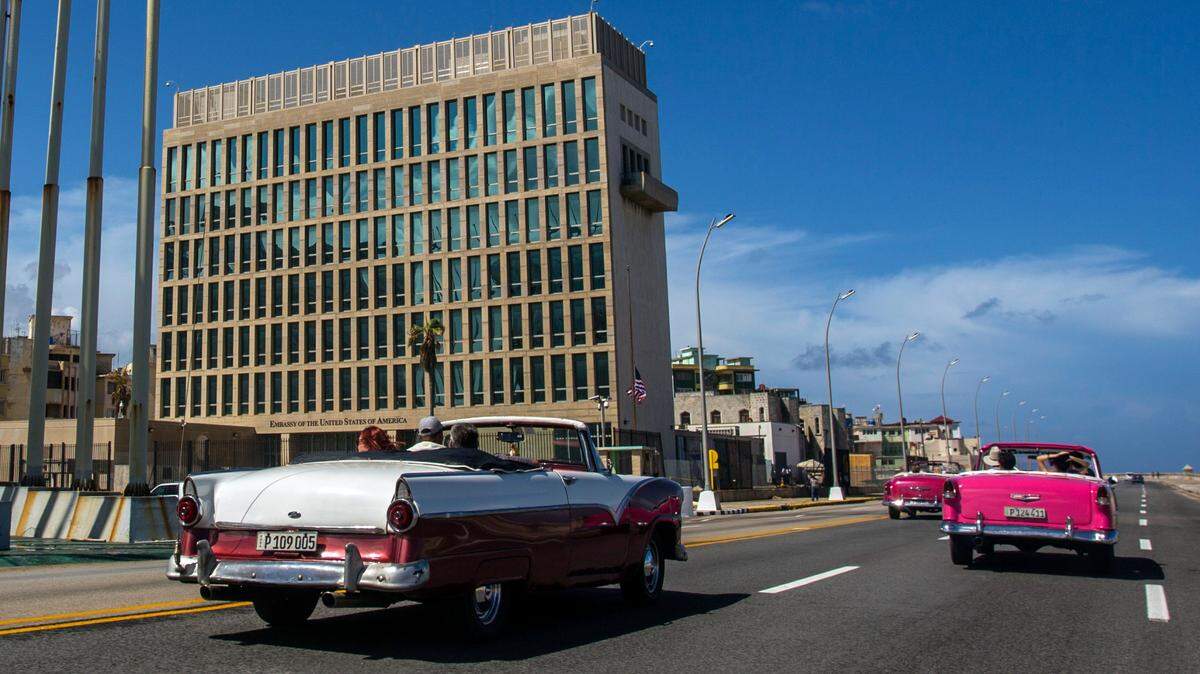
The latest assessment by seven U.S. intelligence agencies published in March concluded that “there is no credible evidence that a foreign adversary has a weapon or collection device that is causing” Havana Syndrome.
The U.S. government presented the assessment as the most comprehensive analysis among several investigations into the mysterious incidents first reported among U.S. officials stationed in in Havana in late 2016.
The agencies’ report cast doubt on previous findings that the symptoms associated with Havana Syndrome— including headaches, tinnitus, balance issues and cognitive problems — follow a similar pattern related to brain injury, as doctors who first evaluated those affected in Havana concluded.
Read more: ‘Knife in the back’: Havana Syndrome victims dispute report dismissing their cases
But experts and intelligence analysts have reached contradictory conclusions over the years, partly because they had access to different medical records and followed different methodologies. Even the agencies writing the March intelligence report had differing levels of confidence in what they wrote.
Many of the studies have been shrouded in secrecy and have only been partially released.
Here’s what different teams that studied Havana Syndrome have said.
University of Miami findings
The Miami doctors who first evaluated U.S. diplomats and CIA officials shortly after they felt sick in Havana — in incidents those affected said involved experiencing pressure or noises from a precise direction — found the individuals presented a “triad” of neurological, cognitive and emotional symptoms which they described as an “acquired neurosensory dysfunction.” In particular, the 25 patients they studied showed “abnormalities in the vestibular system” of the inner ear that detects the body’s position.
They wrote about their findings in a study published in the Laryngoscope Investigative Otolaryngology journal in December 2018.
University of Pennsylvania findings
Another team of doctors at the University of Pennsylvania who examined 21 patients with chronic symptoms concluded they suffered from mild traumatic brain injury — a concussion — even though none had suffered a blow to the head. They published their findings in the Journal of the American Medical Association in March 2018.
In a later study published in July 2019, UPenn doctors abandoned the concussion theory but found changes in the brain of 40 people who were affected while stationed in Havana.
The CDC report
The “CUBA Unexplained Events Investigation,” a two-year study conducted by the Centers for Disease Control and Prevention on U.S. embassy staffers in Havana, published in 2019, provided a definition to determine if someone might be affected by Havana Syndrome.
But after reviewing records for 95 people, the CDC ended with no clear conclusion.
“The evaluations conducted thus far have not identified a mechanism of injury, process of exposure, effective treatment, or mitigating factor for the unexplained cluster of symptoms experienced by those stationed in Havana, Cuba,” the report says. The CDC blamed the lack of a conclusion on the “inconsistency” of the data.
National Academies of Sciences report
A 19-person committee that investigated the clinical data of the victims for the National Academies of Sciences, Engineering and Medicine and the State Department concluded that the set of symptoms was “unlike any disorder in the neurological or general medical literature” and is “consistent with the effects of directed, pulsed radiofrequency energy,” most likely microwaves.
“The absence of reporting of a heating sensation or internal thermal damage may exclude certain types of high-level R.F. energy,” the document, published in 2020, says.
The authors noted that “each agency and organization that has reviewed these cases during the past several years has had available to them different sets of data… As a result, experienced investigators from different organizations logically may reach different conclusions based on their own data sources and limitations.”
The intelligence community experts’ panel
An expert panel convened by the Office of the Director of National Intelligence and the CIA concluded that commercially available devices known as directional loudspeakers or acoustic lasers are the most plausible technology capable of causing the symptoms and sensations associated with the Havana Syndrome incidents.
The report says the devices that may have been used to target U.S. personnel in Havana and other places could use commercial off-the-shelf technology, are easily portable and concealable, and can be powered by electricity or batteries.
A summary of the panel’s findings was released in February 2022, also stating that pulsed electromagnetic energy, particularly in the radiofrequency range, and ultrasound could cause the brain injuries and inner-ear disorders seen in many of those affected, although information gaps exist.
The JASON report
A 2021 report written by JASON, a group of elite scientists founded during the early days of the space race to advise the U.S. government, concluded that “85-90% of the reported incidents are consistent with common and known symptoms of pathophysiological or environmental origins; the remainder appear more complex and defy a straightforward explanation at present.”
They also said they found “no compelling evidence” of mild traumatic brain injury in the medical data they reviewed and that the medical data “are not sufficient to infer a novel medical syndrome.” However, they acknowledged a number of limitations in the records they were handed.
The group, which the State Department tasked to do the study, also did not believe a directed-energy device using radiofrequency could have produced the injuries in the Havana Syndrome cases.
“It is JASON’s judgment that, on the basis of available reports of events, related data, and health evaluations, it is not possible to conclude at this time that these events are the result of intentional attacks that cause physical harm,” the report concluded.
The March intelligence assessment
A U.S. Intelligence Community assessment written by seven U.S. intelligence agencies, including the CIA, released last month largely endorsed the conclusions reached by JASON.
“Most I.C. agencies judge it is very unlikely a foreign adversary played a role, although confidence in the judgment related to this line of inquiry varies,” the report says. One agency “abstained” from subscribing to that conclusion, and another one expressed “low confidence” in it, citing gaps in intelligence collection.
The report also concludes that “there is no credible evidence that a foreign adversary has a weapon or collection device that is causing” the Havana Syndrome. But two of the agencies involved did not fully support this conclusion because “they judge that radiofrequency (R.F.) energy is a plausible cause” for the incidents.
The agencies also mentioned that the JASON review of medical data collected from yet another unpublished study by the National Institutes of Health “does not convey a consistent set of physical injuries, including neurologic injuries” such as mild traumatic brain injury.