
Cuban leader’s Mexico trip highlights challenges for Biden’s foreign policy in the region
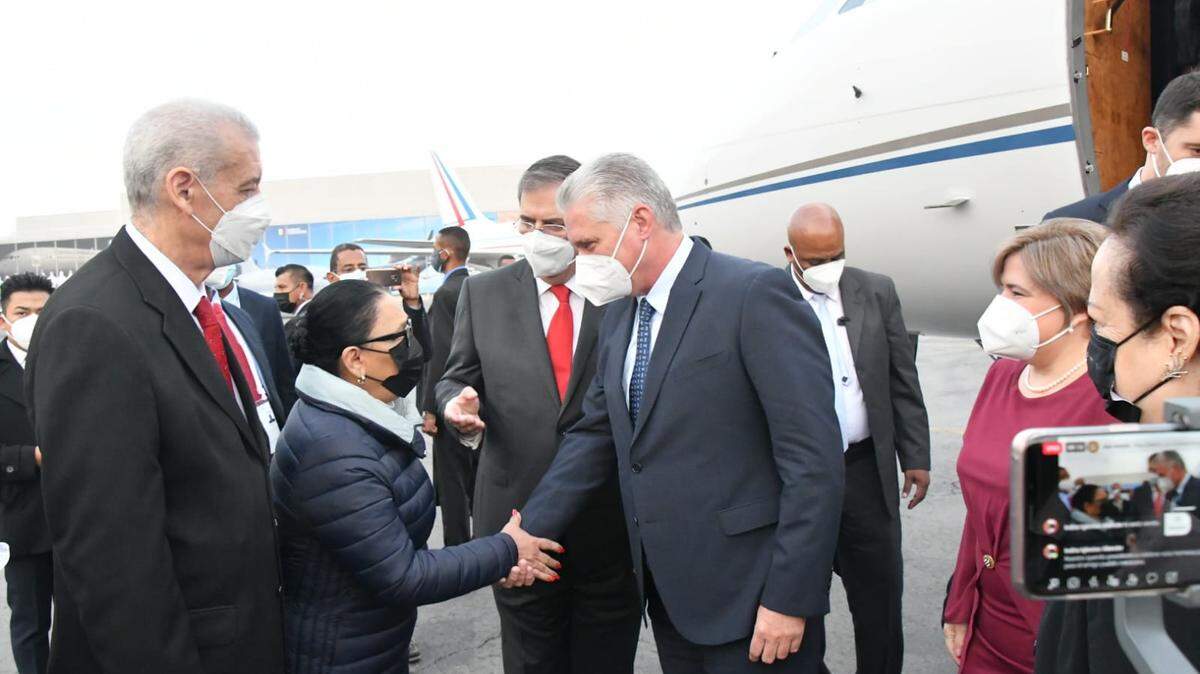
Cuban leader Miguel Díaz-Canel’s presence as guest of honor in Mexico’s independence day celebrations Thursday showcases the challenges that the U.S. faces in gaining regional support for its policy toward Cuba.
Sitting next to Mexican President Andrés Manuel López Obrador, Díaz-Canel participated in a military parade on Thursday and gave a speech in which he blasted the U.S. embargo and denounced an alleged disinformation campaign against his government.
“The decision to invite us has an immeasurably greater value at a time when we suffer the ravages of a multidimensional war, with an opportunistically intensified criminal blockade,” he said. “We are facing an aggressive campaign of hatred, misinformation, manipulation, and lies mounted on the most diverse digital platforms, which ignores all ethical limits.”
The island’s authorities recently issued a decree that makes it a crime to criticize the government on social media.
In his speech, López Obrador also pressed the Biden administration to lift the economic embargo against Cuba “because no state has the right to subdue another people, another country,” he said. He also called on Cuban Americans to leave “party and electoral interests behind” and seek reconciliation.
The prominent role given to Díaz-Canel has raised eyebrows in Washington, “because it appears to be an effort to confer legitimacy on a leader from whom others are intentionally keeping their distance”, said former U.S. diplomat Eric Farnsworth, vice president of the Council of the Americas.
A State Department spokesperson did not say if the Biden administration had asked the Mexican government to address human rights violations in Cuba but said the U.S. was committed “to continuing to work with our democratic partner, Mexico, on addressing all pressing issues in the region.”
“It is important for the international community as a whole to speak up in support of the Cuban people, to condemn the Cuban government’s crackdown on peaceful protesters, and to call on the Cuban government to respect the human rights and fundamental freedoms of the Cuban people,” the official said.
Lopez Obrador’s invitation to the Cuban leader generated criticism among the Mexican opposition and Cubans, on and off the island, who have denounced Díaz-Canel’s role in the repression of the anti-government protests that shook the island in July.
“It is unacceptable that a dictator who locks up dozens of Cuban citizens has the leading role in the celebrations,” Mexico’s former president, Felipe Calderón, posted on Twitter.
“Eat and go,” National Action Party Senator Lilly Téllez tweeted, a reference to a phone call in which former President Vicente Fox asked the late Fidel Castro to leave Mexico quickly after participating in the Summit of the Americas in 2002.
The political climate is much different now, and López Obrador, who represents a left-wing party group, has used his support for Cuba to emphasize sovereignty as a key message of his government. Farnsworth believes the invitation to Díaz-Canel is “probably less a ‘message’ to Washington than an expression of the president’s own personal proclivities and also a way to offer something to Mexico’s political left that will maintain the government’s freedom of action in domestic economic affairs.”
But the whole affair is another example of the Biden administration’s struggles to fulfill its foreign-policy goals and garner regional support to denounce the Cuban regime’s human-rights record.
“The administration understands that it cannot count on Mexico, or many other Latin American countries, to join the U.S. in pressuring the Cuban regime to improve its human rights record,” said Michael Shifter, president of Washington-based Inter-American Dialogue. “That is today’s sad and unfortunate reality of inter-American politics.”
Biden was also invited to the independence day commemoration but sent Secretary of State Antony Blinken instead.
For Lopez Obrador, “principles of non-intervention and protection of national sovereignty take precedence over everything else, at least rhetorically,” Shifter said. “For the Biden administration, this is very disappointing and frustrating, but it is a reality that it has to deal with and obviously with Mexico, in particular, there are many other fundamental interests of the United States at stake that must be weighed.”
Although López-Obrador has collaborated with the immigration policies of the Trump and Biden administrations, there has been friction in other areas, including his support for the Cuban regime and criticism of the Organization of American States.
“It is dismaying that López Obrador overshadows the day of the Grito de Dolores by inviting the puppet of Raúl Castro to the celebrations in Mexico,” tweeted Florida U.S. Sen. Marco Rubio in Spanish.
When announcing that Díaz-Canel would be a “guest of honor,” López Obrador stressed that his country has had “friendly relations with the people of Cuba for a long time.” A day after the anti-government demonstrations on the Caribbean island, the Mexican president had called for the end of the U.S. trade embargo.
“The truth is that, if you want to help Cuba, the first thing you should do is suspend the blockade against Cuba, as most countries have asked. That would be a truly humanitarian gesture. No country in the world should be fenced off, blocked; that is the most contrary thing there can be to human rights,” he said.
In addition to meeting with his Mexican counterpart, Díaz-Canel will participate in the Sixth Summit of the Community of Latin American and Caribbean States on Saturday. Member countries will discuss López Obrador’s proposal to replace the OAS with an “autonomous body,” an open challenge to the United States’ role in that organization.
The Cuban leader traveled to Mexico accompanied by General Luis Alberto Rodríguez-López Calleja, the former son-in-law of Raúl Castro in charge of the military conglomerate GAESA, who faces U.S. sanctions. Cuban state media identified López-Calleja just as “an advisor to the president.”
The trip to Mexico allows Díaz-Canel to show that his government is not isolated despite criticism from the international community of the repression unleashed against July 11 protesters. Raúl Castro, several generals, and government officials sent off Díaz-Canel at the airport, indicating the trip’s importance for Cuban diplomacy.
“On the day of the Grito de Dolores, Mexico’s national holiday, it is an honor to arrive in the beloved Aztec land, to Cuba owes, loves, and respects so much,” Díaz-Canel wrote on Twitter. “Long live Mexico.”
Cubans residing in that country have called to demonstrate against the presence of the Cuban leader.
This story was originally published September 16, 2021 at 4:59 PM.