
‘We Cubans have lost ground in Miami’: Protesters demand reinstatement of parole program
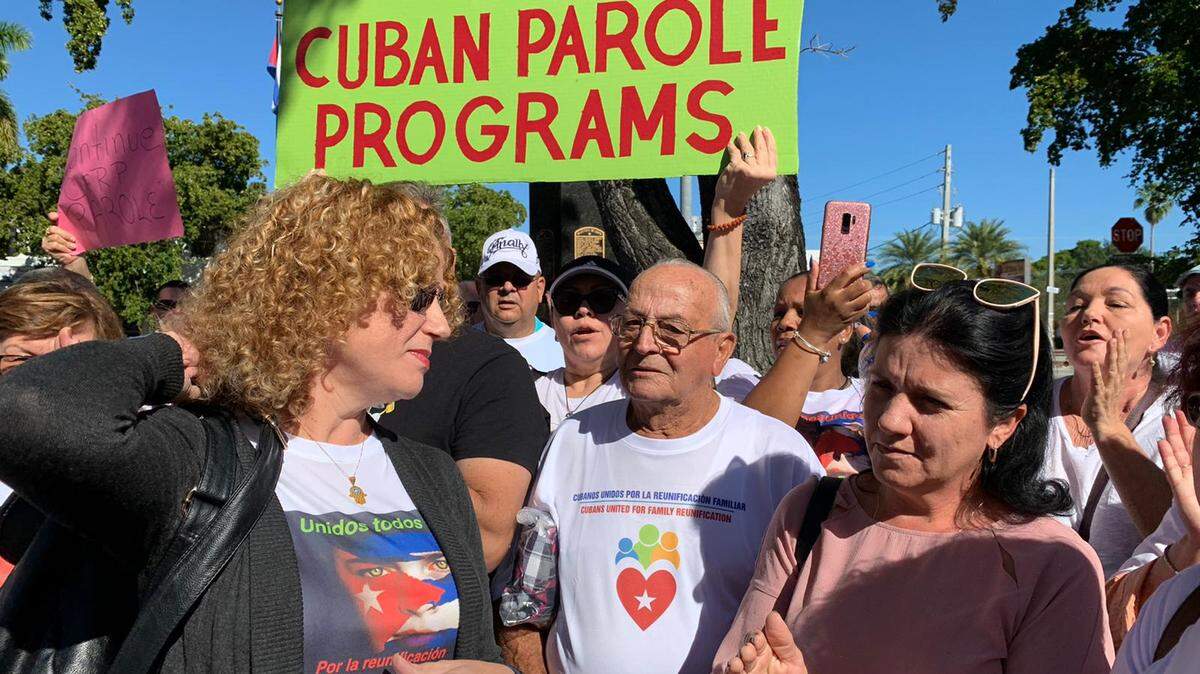
Miami resident María del Carmen Nieto woke up early Sunday morning with a mission in mind: fight for her son.
She was one of more than a 100 protesters who gathered this weekend at the Cuban Memorial Park, located at 999 SW 13th Ave., to demand the government reinstate the Cuban Family Reunification Parole Program, which came to a sudden halt in September 2017, after about two dozen employees in the U.S. embassy in Havana experienced serious illnesses, and the Trump administration withdrew nearly 60% of the diplomatic personnel in the island.
The discretionary program, which began in 2007, allows certain eligible citizens and residents to apply for their loved ones to come to the U.S. Under the parole, U.S. Citizenship and Immigration Services had been allowed to grant least 20,000 visas for Cuban nationals per year.
Nieto said both of her son’s parents live in the U.S. and that he had already started the process to leave the island before the program’s suspension. Her son had been interviewed and had even left school in preparation for his travels. But now, she said, he’s stuck.
“My child is in limbo: he cannot study, he cannot work, he is alone in Cuba,” she said.
According to documents obtained by el Nuevo Herald, much like Nieto’s, thousands of families have been waiting for the promised reunification for years.
Because the U.S. embassy in Havana remains understaffed, the American government decided to transfer the immigrant visa appointments for Cubans to Bogotá, Colombia, and then to Georgetown, Guyana, last June, but the backlog persists.
Jorge Jardines, a Cuban-American who has his wife and daughter in Cuba and has been waiting for reunification for 4 years, said he’s not involved with the parole program but decided to protest anyway because of the conditions in Guyana.
“The US embassy in Guyana does not have the capacity to handle the migration flow of Cubans because it is a small place,” he said.
The leaders of Facebook groups, through which Cubans have come together to support and advise each other, organized Sunday’s event. Many of the demonstrators wore t-shirts with photos of their children, grandchildren and siblings who they have not seen for years.
Gretel Moreno, one of the coordinators, said she hopes the immigration authorities process the cases soon, even if they need to conduct the interviews via Skype.
“We want the U.S. diplomatic personnel to be safe first, but we ask that the paralysis of the reunification program of our families be resolved,” Moreno said.
The group on Sunday was loud and voluminous, but some thought it could’ve been a larger protest.
Yanet Martínez, who is claiming her sister, said it was “inconceivable” that despite it being held on Calle Ocho, which she called “the heart of the Cubans,” passersby had no notion of these Cubans’ battle.
“We should all be shouting: ‘yes to family reunification’,” she said. “We Cubans have lost ground in Miami.”
Members of Congress under pressure
Erney Díaz, one of the protesters, urged other Cubans on Sunday to punish their elected officials by voting them out of office because “they have not responded to our demands.”
He said he’s an American citizen, Donald Trump supporter and democracy believer, but he’s feeling “disenchanted”. Díaz has written letters and sent Twitter message to members of Congress, but has gotten radio silence.
He recalled a Nov. 19 vote in which Cuban-Americans sitting on the Miami-Dade Commission rejected a resolution supporting a bill in Congress that would restore the parole program.
“What can be said about these characters who claim to represent us and despise us like that? Didn’t they or their parents come from Cuba? Do they no longer remember what it is to live in dictatorship?” he wondered. “Instead of getting on the right side, they put their political interests first.”
In an article recently published by el Nuevo Herald about the program’s interruption, Congressman Mario Díaz-Balart said he would continue to “seek answers” and work with the Trump administration “to find a solution.”
Meanwhile, democrats like Debbie Mucarsel-Powell and Donna Shalala, tried to rescue the program by introducing the Cuban Family Reunification Act to the House of Representatives Oct. 28. Díaz-Balart said he opposed the bill because it doesn’t do enough to ensure the safety of State Department personnel in Cuba and requires too fast of a turnaround for the State Department to process visas.
No politician attended Sunday’s rally.
Protester Enriqueta López made it clear that the group is not asking the government for economic assistance.
“What we want is for this endless wait to be over, for our children to be free with us in this country,” López said.