He swore he wouldn’t give in to Trump, but Colombia’s imminent ruin forced Petro’s hand
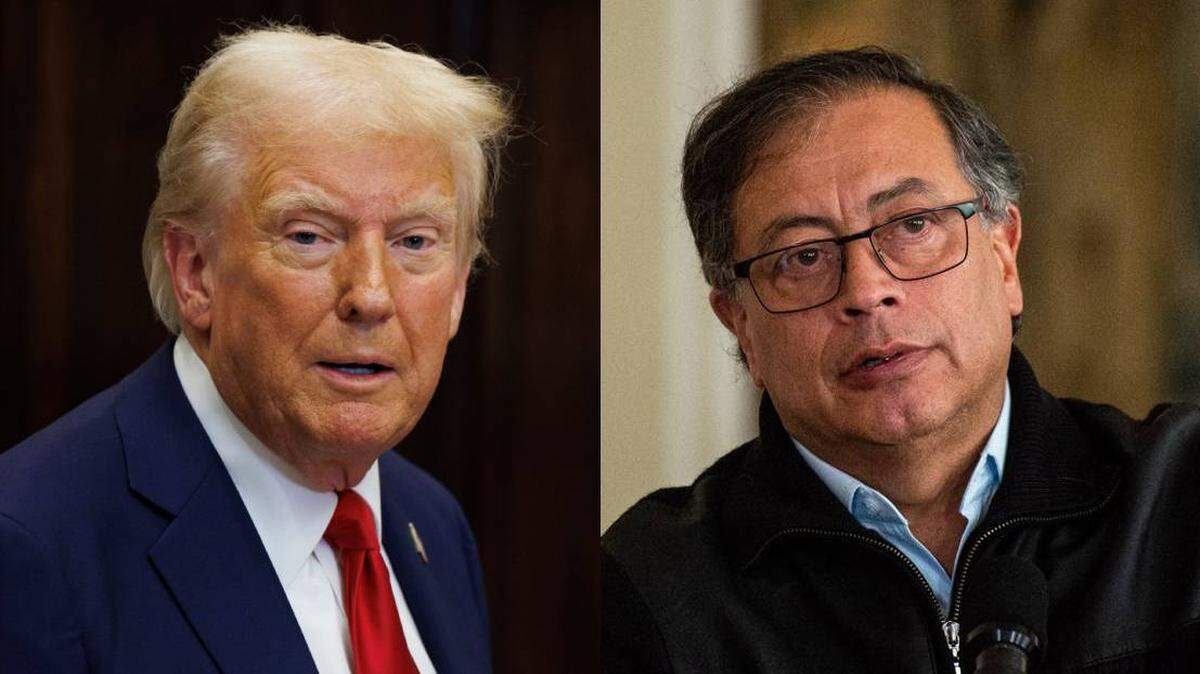
Colombian President Gustavo Petro asked President Donald Trump to sit down with him and talk things over a glass of whiskey, called him an outright racist in rambling social media posts and pledged to never yield to Washington’s pressure even if the economic sanctions being threatened led to his overthrow.
“With your economic strength and arrogance, you can try to carry out a coup d’état.... But I will die within my law. I resisted torture and I will resist you,” the former guerrilla said Sunday in his X account following Trump’s announcement that he would impose a 25% punitive tariff on all Colombian products. “You will kill me, but I will survive in my people, who were here before yours came into being in the Americas. We are peoples of the winds, the mountains, the Caribbean Sea and of freedom.”
And yet late Sunday, after hours of online bluster, Petro backed down, the prospect of a trade war with the U.S. proving too frightening to contemplate. Setting himself up for ridicule, the leftist president swallowed his pride and allowed his foreign ministry to unceremoniously announce that U.S. flights carrying deported Colombian immigrants will be allowed to land after all. Petro’s rejection of deportation flights earlier Sunday had led to the dramatic, albeit short-lived, diplomatic showdown.
“The government of Colombia has agreed to all of President Trump’s terms,” the White House said late on Sunday, before announcing that the decision to introduce punitive tariffs were being placed on hold.
The fact that frantic diplomatic officials and business leaders managed to convince Petro to turn back from the abyss highlights the degree to which the Colombian economy is dependent on exports to the United States.
The U.S. is Colombia’s largest trading partner. Trade between the two countries reached almost $40 billion in 2020, primarily in Colombian exports of oil, coffee and flowers.
Colombia also receives substantial U.S. aid. In 2023, it received $90 million in security assistance and more than $1.5 billion to support a peace accord between the government and the guerrilla known as the Revolutionary Armed Forces of Colombia, or FARC. The U.S. has provided another $958 million to help Colombia deal with the influx of migrants from neighboring Venezuela.
Reacting to Sunday’s events, representatives of Colombia’s main exporting industries told local media that a trade war would have had crippling consequences for the economy and would have led to the loss of tens of thousands of jobs.
“We just went through a nightmare, a huge nightmare,” said Augusto Solano, president of the Colombian association of flower exporters, Asocolflores, in a radio interview. “We are in the midst of our exporting season and if we have had any interruption in the chain of logistics, the repercussions for us would have been devastating.”
Currently in full swing preparing for Valentine’s Day and Mother’s Day in the U.S., Colombia’s flower industry is responsible for hundreds of jobs in South Florida, the main entry point for its products into the United States. A 25% tariff on Colombian imports, which Trump said would increase to 50% within a week, would have forced U.S. wholesalers to turn to flowers from other countries, potentially leaving tons of flower shipments to rot.
Solano’s sentiment was shared Monday morning by other industry leaders and by former diplomatic officials who saw the cavalier way in which Colombia’s economic lifeline was being discussed — and potentially ruined — on social media as highly irresponsible.
“The truth is that one looks back to yesterday and sees that it was one of the most absurd and ridiculous days in the history of our country,” said former defense minister Juan Carlos Pinzón, a former Colombian ambassador to the U.S. “Our country was being shoved into a problem of unusual gravity due to the lack of responsibility, the lack of care, the absence of diplomacy and for not thinking of the impact it would have on people but rather on how to promote ideologies.”
The diplomatic crisis began Sunday morning after Petro announced through social media that he had denied entry into Colombia to two U.S. military flights carrying deported Colombian nationals. “A migrant is not a criminal and must be treated with the dignity that a human being deserves,” Petro said. “That is why I returned the U.S. military planes that were carrying Colombian migrants.”
Trump’s reaction came just a few hours later through his TruthSocial account: The U.S. would inmediately impose a 25% tariff on all Colombian products — to rise to 50% in a week — and close down the visa section in the U.S. Embassy in Bogota.
“I was just informed that two repatriation flights from the United States, with a large number of Illegal Criminals, were not allowed to land in Colombia,” Trump wrote. “Petro’s denial of these flights has jeopardized the National Security and Public Safety of the United States, so I have directed my Administration to immediately take the following urgent and decisive retaliatory measures.”
Trump also said the U.S. was imposing an immediate travel ban and visa revocation to “Colombian Government Officials, and all Allies and Supporters.”
Petro responded at first by offering up his own presidential plane to pick up migrants in the U.S.. Then he struck back, slapping a 25% tariff on all U.S. imports, with his own warning: “You will never dominate us.... If you know someone who is stubborn, it’s me, period.”
While announcing that his administration would also impose banking and financial sanctions on Colombia, Trump warned even harsher treatment could follow: “These measures are just the beginning. We will not allow the Colombian Government to violate its legal obligations with regard to the acceptance and return of the Criminals they forced into the United States!”
While Colombia’s decision to allow the flights to enter the country seems to have defused tensions for now, Petro did go back to social media Monday morning and criticized Trump’s immigration policy.
“The solution to illegal migration is not simply to deport people and criminalize them. It is to act on the real causes of migration: the wealth gap and the causes of Latin American poverty. Remove the spreads from Latin American debt and you will see how Latin America grows and stops expelling its population,” Petro wrote on his X account.
“In international relations, we must be clear about one principle: We can reach agreements that benefit people, we can freely discuss at diplomatic tables, and disagree if necessary, but we can never accept that conditions are imposed on us,” he added. “Diplomacy is not about subordinating people or bringing them to their knees. Diplomacy must be frank and free, but always among equals.”
Miami Herald reporter Nora Gámez Torres contributed to this story.
This story was originally published January 27, 2025 at 3:49 PM.