Trump holds off tariffs against Colombia after Petro backtracks on deportation flights
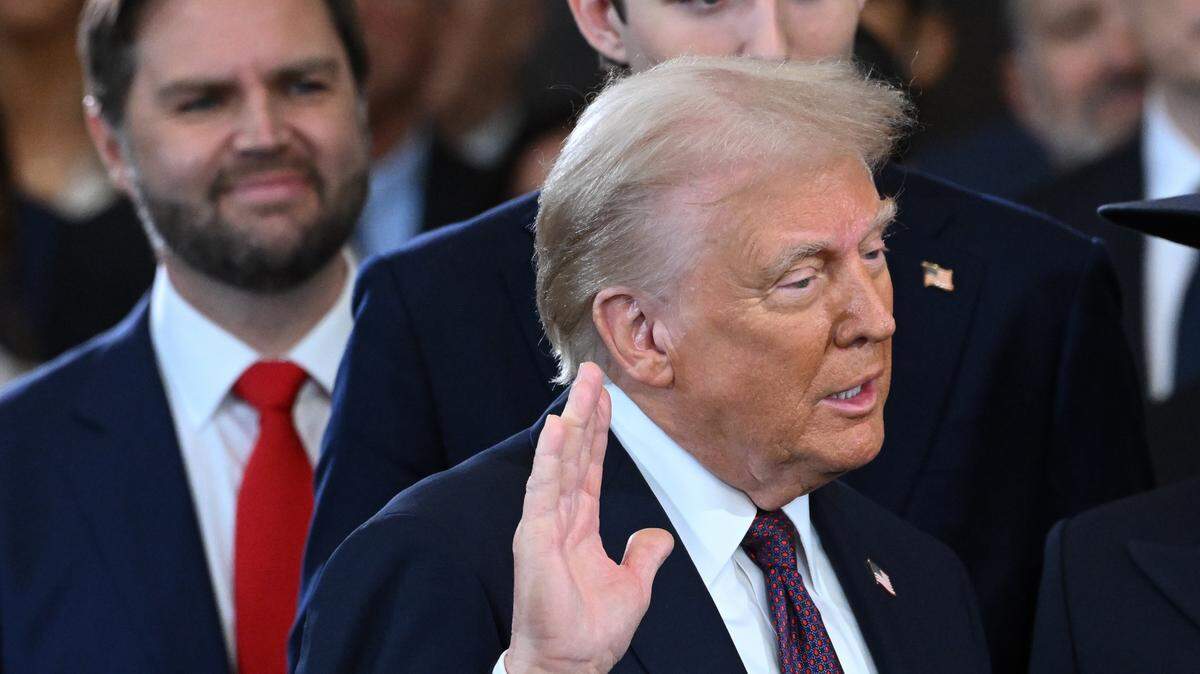
President Donald Trump’s first trade war started Sunday close to home — not with Mexico, despite repeated threats to impose tariffs on the southern neighbor, but with Colombia.
But the threat of Americans having to pay more for Colombian coffee was short-lived. After Trump and Colombia’s president Gustavo Petro slapped tariffs on each other’s countries following Petro’s initial refusal to allow two U.S. military flights carrying deported Colombian migrants to land in his country, “the government of Colombia has agreed to all of President Trump’s terms,” the White House said late on Sunday.
The White House said the Colombian government agreed to the “unrestricted acceptance of all illegal aliens from Colombia returned from the United States, including on military aircraft,” White House Press Secretary Karoline Leavitt said in a statement. Leavitt also said the tariff and sanctions will be “held in reserve, and not signed, unless Colombia fails to honor this agreement.”
The White House said that visa sanctions against Colombian government officials announced earlier on Sunday will be enacted until the U.S. government is able to send the first flight with Colombian migrants.
The high-stakes affair evolved rapidly during the day.
Petro appears to have irked Trump when he announced at 3:41 a.m., that he did not allow two U.S. military jets loaded with deported Colombian nationals, already in flight, to land in his country.
“A migrant is not a criminal and must be treated with the dignity that a human being deserves,” Petro said. “That is why I returned the U.S. military planes that were carrying Colombian migrants,” he added without detailing when it happened and how many Colombians were on the aircraft.
Hours later, Trump announced immediate reprisals against the South American nation on his TruthSocial website: A 25% tariff on all Colombian products — to rise to 50% in a week — and the shutting down of the visa section in the U.S. Embassy in Bogota.
“I was just informed that two repatriation flights from the United States, with a large number of Illegal Criminals, were not allowed to land in Colombia,” Trump wrote. “Petro’s denial of these flights has jeopardized the National Security and Public Safety of the United States, so I have directed my Administration to immediately take the following urgent and decisive retaliatory measures.”
Trump also said the U.S. was imposing an immediate travel ban and visa revocation to “Colombian Government Officials, and all Allies and Supporters” in reaction to Petro’s refusal to let the two U.S. flights land.
The former guerrilla-fighter-turned-president responded at first by offering up his own presidential plane to pick up migrants in the U.S.. Then, he struck back, slapping a 25% tariff on all U.S. imports, with his own warning: “You will never dominate us... So if you know someone who is stubborn, it’s me, period.”
While announcing that his administration will also impose banking and financial sanctions on Colombia, Trump warned even harsher sanctions could follow: “These measures are just the beginning. We will not allow the Colombian Government to violate its legal obligations with regard to the acceptance and return of the Criminals they forced into the United States!”
In a statement on X, Secretary of State Marco Rubio said Petro had authorized the flights and then canceled his authorization when the planes were in the air.
“As demonstrated by today’s actions, we are unwavering in our commitment to end illegal immigration and bolster America’s border security,” Rubio said.
On Sunday evening, the State Department said that after Petro’s refusal, “Secretary Rubio immediately ordered a suspension of visa issuance” at the U.S. embassy in Bogota. “Secretary Rubio is now authorizing travel sanctions on individuals and their families who were responsible for the interference of U.S. repatriation flight operations. Measures will continue until Colombia meets its obligations to accept the return of its own citizens.
“America will not back down when it comes to defending its national security interests,” the statement added.
In a post on X, U.S. Customs and Border Protection said it had already begun enforcing the travel ban on Colombian officials in coordination with the State Department. The agency said it was taking “decisive” measures, including “enhanced inspections of flights, private aircraft and cargo to and from Colombia” and denying boarding to “flagged visa holders.”
The clash posed a test for Trump’s deportation agenda, which relies on the cooperation of countries in the Western Hemisphere, a region his administration has vowed to lift from the diplomatic back-burner to counter China’s growing influence.
The sweeping retaliatory measures risked damaging the relationship with a nation considered the closest U.S. security partner in Latin America and the Caribbean and a key global partner for NATO.
But the stakes were high for Colombia as well. The United States is Colombia’s most significant trade and investment partner, with more than $39.3 billion in bilateral goods and services trade in 2022, according to the State Department.
Colombia also receives substantial U.S. aid. In 2023, it received $90 million in security assistance and more than $1.5 billion to support a peace accord between the government and the guerrilla known as the Revolutionary Armed Forces of Colombia, FARC. The U.S. has provided another $958 million to help Colombia deal with the influx of migrants from neighboring Venezuela.
“President Petro is playing a very dangerous game,” said Eddy Acevedo, chief of staff and senior advisor at the Woodrow Wilson International Center for Scholars. “As he continues to antagonize not only the United States, but important allies like Israel, there could be detrimental consequences including leveraging the U.S.-Colombia Free Trade Agreement, cutting all foreign aid, decertification on drug cooperation, removing the non-NATO-ally designation, and much more.”
The left-leaning Petro, known for his late-hour, testy statements on social media, is feeling domestic pressure for a new wave of violence at home, fueled by guerrilla infighting. In recent days, he had been railing against Trump’s deportation plans, a subject popular with his supporters.
Petro’s criticism of the U.S.’s tough new immigration stance started on Wednesday during a three-hour visit to southeastern Haiti. Before heading back to Colombia, he said that there would be no America without Blacks, Mexicans or others of Hispanic origin.
But on Sunday, he openly confronted Trump in a lengthy X statement comparing himself with Aureliano Buendía, the idealistic colonel who fought countless battles in the mythical town of Macondo in the novel “One Hundred Years of Solitude,” the masterpiece by Colombian Nobel-laureate Gabriel García Marquez.
“Trump, I don’t really like traveling to the U.S. It’s a bit boring,” he said. “I don’t like your oil, Trump. You are going to end the human species because of greed. Maybe one day, over a drink of whiskey that I will accept despite my gastritis, we can talk frankly about this, but it’s difficult because you consider me an inferior race and I am not, nor is any other Colombian.
“So if you know someone who is stubborn, that’s me, period. You can try to carry out a coup with your economic might and your arrogance. But I resisted torture and I resist you. I don’t want slavers next to Colombia. Overthrow me, President, and the Americas and humanity will respond.”
Amid the literary prose, there was another warning: “Colombia now stops looking north... I am informed that you put a 50% tariff on the fruits of our human labor to enter the U.S. I do the same.”
In another post, he advised the 15,660 Americans living illegally in Colombia to take steps to legalize their status, though he assured his social media audience that he would never be seen burning a “gringo flag or doing a raid to return the illegals in handcuffs to the US. True libertarians will never attack human freedom. We are the opposite of the Nazis.”
Petro’s defiance might be a sign of a larger revolt brewing in Latin America, where other governments, many from left-leaning parties, have criticized Trump’s policies, especially his plans to deport millions of immigrants.
The deportations of undocumented immigrants from the U.S. began shortly after Trump took office Monday and signed several executive orders to stop illegal entry into the United States, especially through the Mexican border.
During his presidential campaign, Trump said he would order mass deportations in addition to eliminating programs that were implemented during the Biden administration, including humanitarian parole for Cubans, Haitians, Nicaraguans and Venezuelans.
On Saturday the Brazilian government complained about the treatment of 80 immigrants deported from the United States, saying Brazilian immigrants returning to their country had been handcuffed while on the U.S. planes that transported them.
Brazilian Justice Minister Ricardo Lewandowski ordered Brazilian authorities to ask U.S. agents in charge of transporting and guarding immigrants to “immediately” remove the handcuffs after a plane carrying Brazilians made a stopover in Manaus last Friday.
Petro’s warning that Colombia will open “to the world” has already raised concerns among experts who are worried the region might continue gravitating further away from the U.S. and towards China and other foreign powers.
While Trump’s “aggressive tactics are bound to produce short-term victories because it’s very costly to stand up to the United States, countries across the region seeing that they will conclude that it’s in their interest to be less exposed to Trump because it is highly unpredictable,” said Oliver Stuenkel, an associate professor at the School of International Relations at Fundação Getulio Vargas in São Paulo and a visiting scholar at the Carnegie Endowment in Washington DC.
“There is also not much the U.S. is willing to put on the table to attract countries to align with Trump, as he’s using a lot of the sticks but few carrots,” he said. “So I expect China to be more influential as a consequence of Trump’s current strategy in Latin America.”
This story was originally published January 26, 2025 at 2:25 PM.