
Argentine prosecutor seen as the 86th victim of decades-old, unsolved terror attack
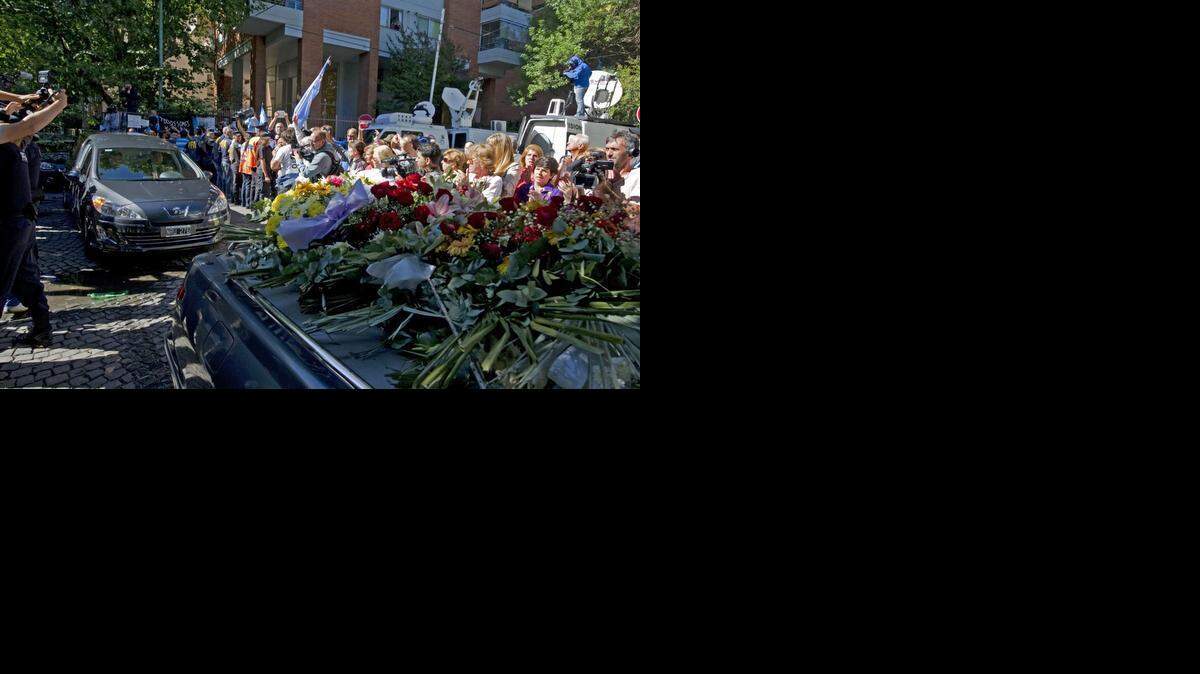
For a decade, Alberto Nisman had been trying to unravel Latin America’s deadliest international terror attack — the brazen 1994 bombing of the Jewish community center in the heart of Buenos Aires that killed 85 people.
On Wednesday, the crusading, 51-year-old prosecutor was laid to rest in a Jewish cemetery just a few yards away from many of the victims he was championing.
It’s a fitting burial spot, said Sarah Guterman, whose 28-year-old daughter died in the bombing of the Argentine Israelite Mutual Association, or AMIA, 20 years ago.
“He lost his life because of the AMIA case,” she said. “He’s just the latest victim.”
Nisman was found sprawled in his bathroom with a gunshot to the head on Jan 18. His death came just hours before he was to testify before congress that President Cristina Fernández de Kirchner was allegedly trying to cover up Iran’s involvement in the AMIA bombing.
Since then, there have been few answers, even as his death has echoed from Washington to Teheran, cast a pall over Kirchner’s final months in office and sown doubts about the institutional stability of a country that returned to democracy in 1983.
When Nisman’s body was found, lying atop the small revolver that reportedly killed him, investigators and Kirchner initially said it was a suicide. Since then theories have multiplied. The president has suggested rogue intelligence officers might have been involved or that Nisman was “induced” to kill himself. Investigators concede that murder is a possibility.
But that leaves investigators with something more akin to a macabre magic act than a crime scene. According to reports, Nisman was found inside his locked bathroom on the 13th floor of an apartment complex that was surrounded by at least 10 bodyguards. No one was seen entering or exiting his residence. While the security guards have been put on leave pending investigation, and the assistant who lent him the revolver has been grilled, there are no firm suspects.
Yet no one seems to believe he willingly killed himself.
Guterman and other AMIA victims met with Nisman on occasion to discuss the case. She said he often talked about threats to his life and worried that his daughters might not be safe.
“He was a very nervous and impatient person, and when he got something into his head he would pursue it,” she said. “But there was nothing about him that suggests he would be prone to suicide. His family, all of Argentina, and I believe the entire world, does not believe that he committed suicide.”
But if it wasn’t his hand on the trigger, whose was it?
The AMIA case provides any number of suspects and motives.
Since taking over the case in 2005, Nisman had been pursuing the theory that the bombing was masterminded in Iran and approved in a secret 1993 meeting attended by Supreme Leader Ali Khamenei, President Akbar Hashemi Rafsanjani, Foreign Minister Ali Velayati and Intelligence Minister Ali Fallahian.
In 2007, Interpol issued arrest warrants for seven officials, including Mohsen Rabbani, who was Iran’s cultural attaché in Buenos Aires at the time of the attack.
Douglas Farah, a former journalist and the president of IBI Consulting, talked to Nisman on occasion about the case.
“What he told me, and it has stuck with me long after he said it, was that… as soon as he really started digging in on the Iranians he would get threats and surveillance photos of his daughters at school,” Farah said. “He saw that as the primary threat writ large.”
Even so, Farah said the Iranians are savvy enough to know that such an operation would undermine their geopolitical goals, including ongoing rapprochement talks with Washington. And it’s not that Nisman’s death buried the investigation. He had talked about it extensively in the media and, if anything, the events of Jan. 18 have only given it more visibility.
Closer to home, many see meaning in the timing of his death: It’s clear that Nisman intended to drag Kirchner over the coals if he had ever made it to his congressional appointment the following day.
Nisman was brought on to the case by former President Nestor Kirchner — Cristina’s husband — in 2005. In an interview with TN television three days before his death, Nisman said Iran had offered the government $4 billion during Nestor’s administration in exchange for absolving the officials.
But when Cristina assumed power in 2007 there was a “radical change,” Nisman said. “There was an alliance with terrorists,” he added.
In his telling, the president and her allies agreed to exculpate Iran for its alleged role in the bombing in exchange for an oil-for-grain deal that Argentina needed to cover its energy deficit.
At the heart of that negotiation was a 2013 agreement to form a joint truth commission to investigate the AMIA attack. The government said the deal would help get to the bottom of the case, but others saw it as a way to undermine Nisman’s investigation.
“The memorandum was signed in 2013 and they couched it as the beginning of negotiations to un-block the investigation,” Nisman said. “That’s a big lie... The signing of the memorandum was the end of a process [granting] impunity.”
Citing wiretapped phone calls, Nisman said Kirchner representatives were talking directly to Rabanni, the former cultural attaché who is wanted by Interpol.
“I have wiretaps of people talking about a pact of impunity on one hand and the need to separate these people [the Iranian suspects] from the case,” Nisman said. “But that wasn’t enough — they also wanted to create false leads.”
By talking to Rabanni, Argentina was not only negotiating “with a state that protects terrorists but with the terrorists themselves,” he said.
Iran and Kirchner have long denied those claims. And the president has her own theories about Nisman’s demise. Four days after his body was found — and three days after she speculated he had committed suicide — Kirchner suggested that rogue intelligence officials had killed him. In a webpost, she said Nisman had been fed false information by members of the Intelligence Secretariat who were trying to discredit her administration.
Nisman and his handlers, she claims, knew the case would never hold up in court.
“They used him while he was alive but then they needed him dead,” she wrote. “It’s just that sad and that terrible.”
Shortly afterward, she dissolved the spy agency.
Nisman’s ties to the intelligence community were no secret. When he took over the AMIA investigation in 2005, evidence had disappeared and the case seemed irremediably tainted. The presiding judge, Juan Jose Galeano, had been impeached after he was filmed offering one of the star witnesses $400,000.
“When Nisman inherited the investigation a lot of the evidence was not to be found,” said Dina Siegel Vann, director of the Latino and Latin American Institute at the AJC —Global Jewish Advocacy. “He had to go into a diminished body of evidence and he really had to rely on other intelligence services.”
Nisman’s critics have made much of this, suggesting that his investigation was being controlled by the CIA and Israel’s Mossad. They claim both services were interested in skewering Iran and punishing the socialist Kirchner administration, and so they helped shape the inquiry.
“There is not doubt that he had ties to the CIA and Mossad,” said Santiago Canton, the head of the Robert F. Kennedy Center for Justice and Human Rights. “But that doesn’t mean they weren’t telling him the truth.”
For those seeking closure in the AMIA case the truth seems like a distant dream. In many ways the original bombing investigation has been overwhelmed and overshadowed by the questions it raised, said Sergio Widder, the head of the Latin American Office of the Simon Wiesenthal Center in Buenos Aires.
As a result there are now four AMIA cases: the original bombing, the investigation into the cover up orchestrated by the judge and members of the Carlos Menem administration, Nisman’s allegations about Kirchhner, and now Nisman’s death.
“Unlike any other case, this one keeps getting less transparent, and now, with the death of prosecutor Nisman, what we have is even more confusion,” Widder said. “With every passing day we have less and less clarity.”
Even so, others are hopeful. Nisman’s investigation was advanced and he had others working on his team, said Siegel Vann. What is needed is the political will to see the case through.
“It’s in Argentina’s best interest to makes sure this case is finally solved,” she said, “because its reputation, credibility, and the viability of the society and its democracy are at stake here.”
But the government’s initial reaction hasn’t been promising. Even before evidence was fully gathered, Kirchner and her allies seemed intent on muddying public opinion by declaring it a suicide and then advancing their own pet theories, said Canton with the RFK Center.
“It’s unfortunate and irresponsible for the government to be speculating,” he said. “Until there is hard evidence everything is on the table and anything is possible.”
It’s not just Argentina that has concerns about transparency.
On Thursday, U.S. Sen. Marco Rubio, chairman of the Foreign Relations Committee’s Subcommittee on the Western Hemisphere, urged Secretary of State John Kerry to push Argentina to accept an international and independent investigation into Nisman’s death.
“The stakes of the case and its implications extend well beyond Argentina and involve the international community, and more importantly U.S. national security,” Rubio said in a letter. “Mr. Nisman’s investigation into the AMIA Jewish community center identified Iranian intelligence agents and their modus operandi for infiltrating a country and carrying out their operations.”
For Guterman, justice is personal. Her only daughter, Andrea Judith, had just stepped into the AMIA building on that July 18, 1994 to look at a job board when the blast rocked the city. Along with the dead there were more than 200 injured.
Since then, families of the fallen have grown old and some have died waiting for closure. There are fewer people attending the meetings of AMIA victims, said Guterman, who is 73.
“Justice keeps getting further and further away from the 85 victims,” she said. “Hopefully justice won’t abandon Mr. Nisman.”
This story was originally published January 30, 2015 at 3:53 PM with the headline "Argentine prosecutor seen as the 86th victim of decades-old, unsolved terror attack."