Bolivia reopens roads, but there’s a warning about economic crisis
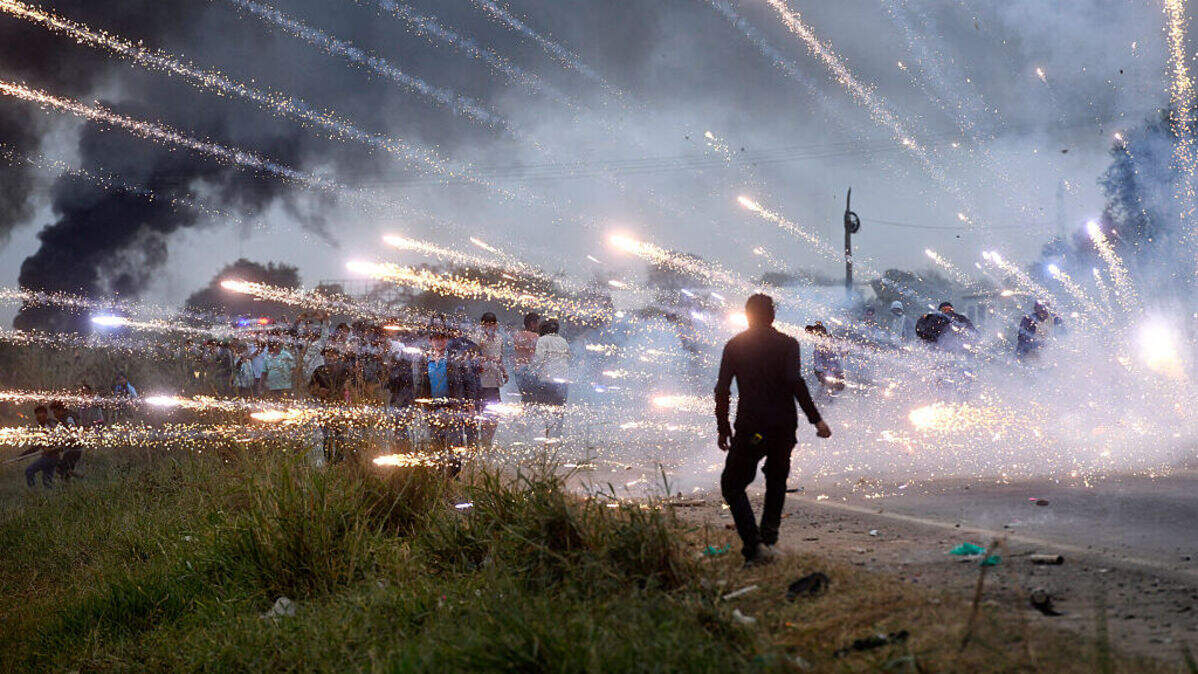
Traffic is gradually returning to Bolivia’s highways after President Rodrigo Paz declared a state of emergency and deployed military and police forces to dismantle roadblocks that had paralyzed large parts of the country for more than seven weeks.
But while the immediate crisis appears to be easing, analysts warn the political and economic tensions threatening Bolivia’s stability remain far from resolved.
The government reported significant progress in reopening transportation routes over the weekend. According to Bolivia’s highway authority, active roadblocks fell from around 50 to just 12, with most of the remaining closings concentrated in Cochabamba, the political stronghold of former President Evo Morales.
Authorities said routes linking La Paz and El Alto to Chile and Peru have largely reopened, allowing long-delayed shipments of fuel, food and medical supplies to resume. Passenger bus services also began operating again in several major cities.
Yet the temporary normalization has done little to calm fears of renewed unrest.
Supporters of Morales announced Monday that they would pause their mobilizations in what they described as a temporary truce, but made clear the confrontation is far from over.
“This struggle will continue,” said union leader Isidro Auca. “The battle is not over.”
Morales, speaking alongside leaders of the Six Federations of the Tropic of Cochabamba, echoed that message.
“For now, it is a pause,” Morales said, insisting his movement had not surrendered.
The protests began in early May, initially driven by labor unions, miners, teachers and indigenous groups demanding government action on Bolivia’s worsening economic crisis. Morales loyalists later joined the demonstrations, escalating demands to include Paz’s resignation.
The roadblocks caused severe shortages of fuel, food and medical oxygen, particularly in La Paz and El Alto, and left at least 16 people dead, including 13 who reportedly died after being unable to receive timely medical care because of blocked roads. Government estimates place economic losses at more than $3 billion, roughly 7% of Bolivia’s $40 billion GDP.
For Carlos Sánchez Berzaín, former Bolivian defense minister and director of the Miami-based Inter-American Institute for Democracy, the state of emergency has produced only temporary relief.
“This may normalize things for a moment, but it will worsen again,” Sánchez Berzaín said in an interview. “What we are seeing is a truce.”
He argues the deeper problem is the enduring influence of “21st-century socialism,” a Venezuelan-inspired political movement promoted by the late Hugo Chávez that reshaped much of Latin America’s left over the past two decades. In Bolivia, Sánchez said, many figures tied to that movement — including officials in the judiciary, security forces, bureaucracy and prosecutorial system — still control the real levers of power, even after Paz, then an opposition figure, won the presidency in late 2025.
According to Sánchez, Paz won the presidency but not full control of the Bolivian state.
“Rodrigo Paz has taken control of the government, but not of power,” Sánchez said. “Power remains in the hands of what I call the plurinational narco-state built under twenty-first-century socialism.”
That, he said, has left Paz governing from a structurally weak position, unable to fully implement reforms or dismantle the machinery built during the Movement for Socialism (MAS) era under Morales.
“His entire plan now is just to remain in government,” Sánchez said.
That diagnosis is echoed, though in less ideological terms, by Evan Ellis, a Latin America expert at the U.S. Army War College, who sees the state of emergency as useful in the short term but insufficient to address deeper instability.
“In the short term, yes, this likely calms things down,” Ellis said. “The military now has a legal framework to act, and after seven weeks of disruption, most actors understand things cannot continue this way.”
But Ellis warned Bolivia remains trapped in multiple overlapping crises.
Economically, the government has made promises to numerous social groups — including salary increases, infrastructure spending and subsidies — despite limited fiscal capacity.
“When the country is broke and you continue making promises to groups that used disruption to gain concessions, that creates frustration among everyone else,” Ellis said.
Bolivia is already suffering its worst economic crisis in four decades, with rising inflation, declining foreign reserves and mounting public anger over fuel shortages and higher prices.
Politically, Paz faces pressure from both right and left.
On the right, critics accuse him of indecisiveness and of failing to fully dismantle structures inherited from MAS. On the left, labor unions and indigenous organizations increasingly believe aggressive street mobilization works.
“They held the country hostage and got concessions,” Ellis said. “That teaches them pressure brings results.”
At the center of Bolivia’s political paralysis remains one man: Evo Morales.
The former president, who governed Bolivia from 2006 to 2019, remains entrenched in Chapare, a coca-growing region in central Bolivia where loyalists have effectively shielded him from arrest since October 2024.
Morales faces multiple legal cases, including an arrest warrant related to aggravated human trafficking stemming from allegations involving a minor with whom he allegedly fathered a child while president. He denies wrongdoing.
The government accuses Morales of financing and encouraging the roadblock protests to destabilize Paz’s administration and force a return to power.
Sánchez Berzaín argues Morales’ continued freedom symbolizes the state’s weakness.
“If the president cannot arrest Evo Morales, then there is no government,” he said. “When a power greater than the state exists inside a country, sovereignty disappears.”
Ellis believes removing Morales would be politically and operationally difficult, but not impossible.
He noted that Bolivia’s police and parts of the military remain deeply penetrated by figures loyal to Morales, particularly in Chapare.
“The issue is not whether the military would stage a coup,” Ellis said. “The issue is whether certain elements can be trusted not to sabotage operations.”
According to Ellis, Paz may increasingly view Morales’ removal as essential to stabilizing the country.
“If he solves the Evo problem, many of the other problems become manageable,” Ellis said. “If he doesn’t, none of them are.”
The Organization of American States (OAS) has backed Paz’s government, condemning the roadblocks and reaffirming support for Bolivia’s constitutional order.
“We support the constitutionally elected government of Bolivia,” OAS Secretary General Albert Ramdin said Sunday. “We cannot support any disruption of constitutional order.”
Still, analysts say Bolivia’s current calm may prove deceptive.
The country’s instability reflects long-standing structural weaknesses: fragile institutions, deep regional divisions, weak rule of law and intense political polarization.
Ellis noted that Bolivia’s turmoil may represent less an anomaly than a return to historical patterns.
“Bolivia has often been difficult to govern,” he said. “In some ways, the Morales years were the exception.”
This article was supplemented with El Nuevo Herald’s wire services.