Fujimori nears presidency as Peru’s deep divide reopens
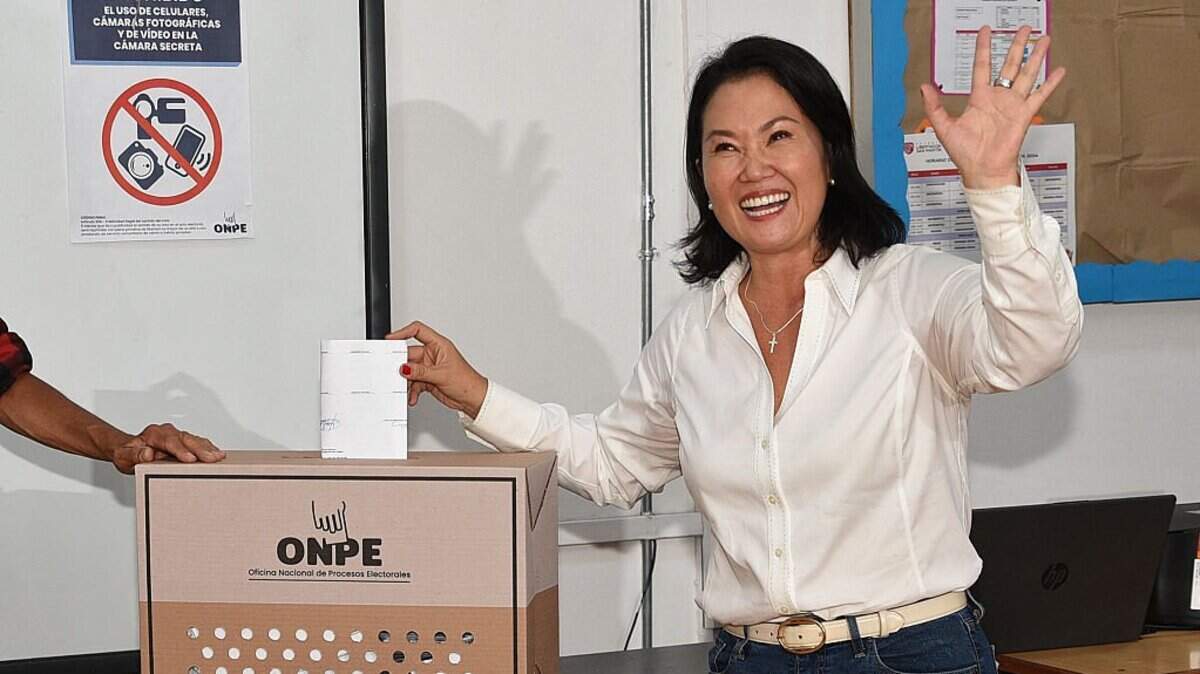
Peru appeared on the verge Tuesday of returning the Fujimori political dynasty to power, as conservative candidate Keiko Fujimori expanded her razor-thin lead over leftist challenger Roberto Sánchez in a deeply polarized presidential runoff.
With 98.94% of ballots counted, Fujimori held 50.07% of the vote, or 9.11 million ballots, compared with 49.92% for Sánchez, who had secured 9.08 million. The gap stood at roughly 29,000 votes, while about 200,000 ballots remained under review amid legal challenges and disputed tally sheets.
Although electoral authorities may take weeks to certify the final outcome, Fujimori’s widening edge suggests that, on her fourth attempt, she may finally claim the presidency after three painful near-misses.
If confirmed, her victory would mark one of the most consequential political comebacks in modern Peruvian history.
The election once again laid bare Peru’s enduring political fracture: a nation divided between supporters of fujimorismo—the movement built around former President Alberto Fujimori’s polarizing legacy—and a broad coalition determined to prevent that family’s return to power.
As Fujimori’s lead slowly widened in the past few days, Sánchez intensified his efforts to rally supporters, questioning the integrity of the vote review process and framing the dispute as a broader fight for democratic legitimacy. Over the weekend, the leftist candidate traveled to the Andean region of Cusco—one of his strongest electoral bastions—where he met with supporters and voiced concerns about the recount.
Addressing a crowd in the town of Combatapa, Sánchez accused his opponents of trying to undermine the popular will and called on Peruvians to remain mobilized. “Today we are fighting democratically, with the strength of the people’s vote, for the recovery of democracy,” he said Sunday from a balcony overlooking the town square. He has also encouraged supporters to “defend the people’s vote,” as peaceful demonstrations continued in Lima against the electoral authorities.
More than 27.3 million Peruvians were eligible to vote in a contest shaped as much by history as by policy. At its core, the race became a referendum on two competing visions of authority, each tied to leaders accused of undermining democratic institutions.
Hovering over the campaign were the shadows of two attempted ruptures of democracy, separated by three decades. In 1992, Alberto Fujimori successfully carried out a self-coup, dissolving Congress and consolidating executive power. In 2022, then-President Pedro Castillo attempted his own dissolution of Congress, but his move collapsed within hours and ended with his arrest.
The runoff effectively turned into a battle between those two legacies.
Sánchez, a former minister and one of the more durable figures in Castillo’s turbulent administration, emerged as the standard-bearer of Peru’s resurgent left. He drew strong support from rural and lower-income voters who believe Castillo never received a fair chance to govern and was instead blocked by entrenched political and economic elites.
He has promised to seek Castillo’s release from prison, portraying it as a form of political justice. His supporters view Castillo as a victim of elite sabotage. His critics argue that his failed move against Congress was an unmistakable attempted self-coup.
For her part, Fujimori leaned heavily into the legacy of her father.
She has campaigned on restoring order to a country exhausted by years of institutional paralysis, promising tougher security policies, economic stability and renewed support for mining and private investment. Her message resonated with voters frustrated by chronic instability and the collapse of governability.
Peru’s political dysfunction has become staggering. The country has cycled through eight presidents and 21 prime ministers in the last decade. In just five years, more than 170 ministers have rotated through government, eroding institutional continuity and public confidence.
As central authority weakened, influence increasingly shifted to Congress, regional power brokers, the judiciary and criminal organizations, including illegal mining syndicates and extortion networks.
Fujimori argues she can reverse that decline.
Her party, Popular Force, will hold 22 of 60 seats in Peru’s newly restored Senate, giving her substantial leverage and making her significantly less vulnerable to the impeachment battles that have repeatedly toppled recent presidents.
That prospect reassures many in Peru’s business sector.
Investors largely view a Fujimori administration as market-friendly and predictable. She has pledged to preserve Peru’s liberal economic model, introduced under her father in the 1990s, which helped transform the country into one of Latin America’s fastest-growing economies. Her likely economic team includes veteran technocrats such as former Economy Minister Luis Carranza.
Business leaders hope her government could restore policy consistency, reduce regulatory bottlenecks and revive stalled mining projects.
But the possibility of a Fujimori presidency also revives old fears.
The central concern for critics is not whether she can restore order, but what kind of order she intends to impose.
Fujimori has said she wants “to govern like my father.”
For supporters, that signals strong leadership and decisive governance. They credit Alberto Fujimori with defeating hyperinflation and dismantling insurgent groups such as Shining Path and the Túpac Amaru Revolutionary Movement.
For opponents, however, the statement is deeply alarming.
Alberto Fujimori’s rule became increasingly authoritarian, culminating in a 25-year prison sentence for corruption and human rights abuses.
Sánchez and his allies argue that Peru’s instability cannot be separated from Keiko Fujimori’s own political conduct. They accuse her of using congressional influence to weaken successive governments through obstruction, impeachment campaigns and legislative pressure.
He has specifically blamed “Señora K,” as her critics often call her, for helping engineer the very dysfunction she now promises to fix.
Questions about democratic norms have also resurfaced because Fujimori never fully accepted her defeats in either 2016 or 2021. After losing to Pedro Castillo, she alleged widespread electoral fraud without presenting conclusive evidence and sought to invalidate thousands of ballots.
This year, Sánchez has raised his own concerns over alleged irregularities, particularly in overseas voting, and proposed a joint recount—an offer Fujimori rejected.
The narrowness of the race continues a remarkable trend in Peruvian politics. This marks the third consecutive presidential election decided by only a few tens of thousands of votes. In 2016, Pedro Pablo Kuczynski defeated Fujimori by around 40,000 votes. In 2021, Castillo beat her by a similarly slim margin.
This article was complemented with El Nuevo Herald’s wire services.