
Pro-Trump candidate, Petro ally gear up for Colombia run-off as tensions rise
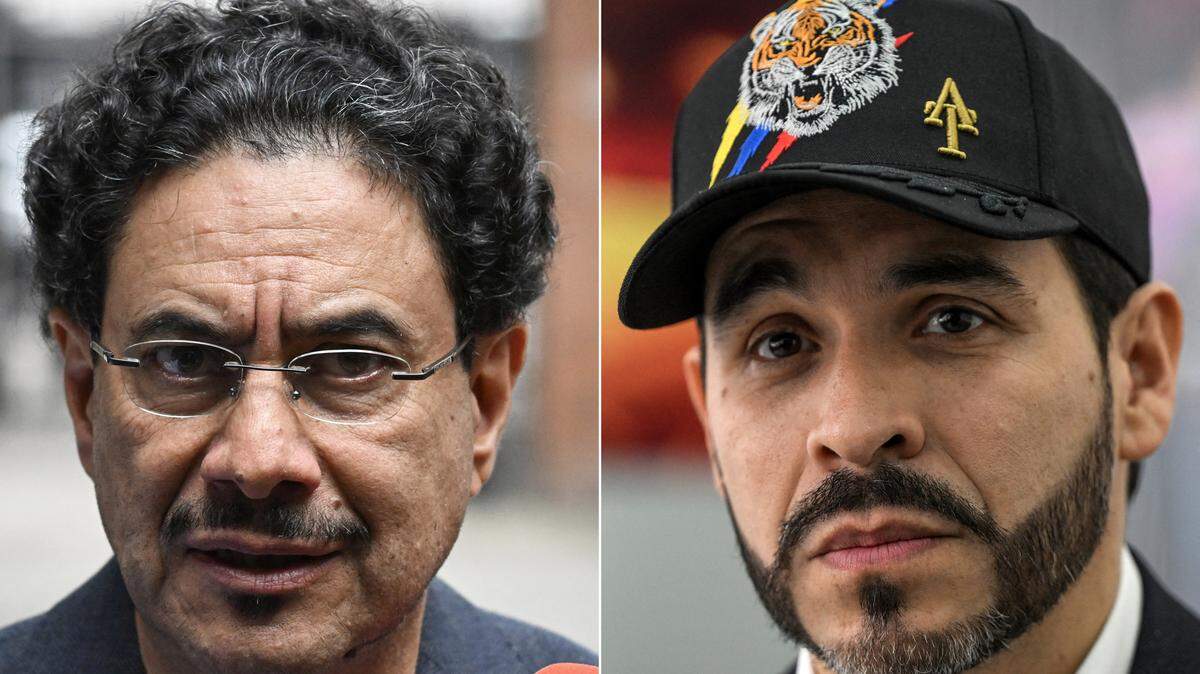
Political fireworks are already flying in Colombia, just hours after the first-round presidential results, which saw far-right, pro-Trump candidate Abelardo de la Espriella emerge with the most votes ahead of rival Ivan Cepeda.
For De la Espriella’s camp, there were celebrations as the result fueled expectations that he can turn his first-round lead into a presidential victory in three weeks’ time.
Meanwhile, leftist senator Iván Cepeda’s team – including his ally, President Gustavo Petro, who is constitutionally barred from seeking a second consecutive term – is already scrambling to expand its base in an effort to overturn De la Espriella’s lead.
The result was close — the criminal defense lawyer who has never held public office got nearly 44 percent of the vote, with Cepeda coming in second with almost 41 percent.
But with no candidate securing more than 50 percent of the vote, the election will head to a run-off on June 21.
Competing visions for Colombia
For political analyst Oscar Chala Padilla, the stakes extend far beyond the outcome of the June 21 runoff.
“This isn’t just about who wins the election, but the model the country wants for the next 10 or even 20 years,” he told the Miami Herald. “There are two competing political models. On one side is progressivism, focused on redistribution and social inequality. On the other is the new right.”
Many voters are increasingly drawn to candidates promising tougher security crackdowns, harsher punishments for criminals, and policies aimed at attracting private investment.
De la Espriella has come to embody that vision, advocating a hardline security agenda that includes plans for tougher sentencing for criminals, building 10 mega-prisons, and measures to attract private investment.
In doing so he has aligned himself with regional allies, such as El Salvador’s Nayib Bukele and Ecuadorian President Daniel Noboa. He has also drawn from a Donald Trump-style political playbook of populist messaging, and found allies in the MAGA movement.
On the other side is Cepeda, who has pledged to continue Petro’s flagship “Total Peace” policy, arguing that violence can only be reduced through negotiations with armed groups alongside efforts to reduce inequality and expand opportunity in poorer regions.
But the success of both sides has come at the expense of the political center, where traditional parties have been left struggling to hold their support base.
“The center hasn’t understood the anti-establishment voter. The center-right hasn’t understood this voter. And neither has the institutional right wing,” said Chala.
Centrist figures such as Sergio Fajardo and Claudia López struggled to gain traction. Traditional right-wing candidate Paloma Valencia also failed to connect; a protégé of former president Álvaro Uribe, she represents Colombia’s most influential conservative political tradition.
“Paloma’s mistake was entering the race with a discourse of closeness to the traditional parties and trying to align herself with the center-right in order to gain ground,” Chala said.
As support drifted toward De la Espriella, Valencia shifted between courting radical right-wing voters and appealing to the center. The strategy failed, leaving her with less than 7 percent of the vote despite polling close to De la Espriella earlier in the campaign.
De la Espriella with the edge
While both Cepeda and De la Espriella benefited from increasingly polarized politics and the weakness of in-between parties, De la Espriella’s advantage was not rooted in policy, but packaging.
He has positioned himself as an anti-establishment outsider, backed by a highly stylized, social media-driven campaign. His team has leaned into viral content, including AI-generated dancing tigers, a campaign theme tune, and an election-day post featuring Kellogg’s Frosted Flakes, reinforcing his “El Tigre” nickname.
“His campaign was heavily digital, making use of new technologies, particularly artificial intelligence and automation tools such as ChatGPT and Claude,” political consultant Ruben Erazo told the Herald.
This modern, data-driven approach, according to some analysts, also propelled him to secure a first-round victory.
“These helped his team analyze data from qualitative and quantitative research and shape a campaign driven by voter insights, rather than relying solely on intuition,” Erazo said.
Cepeda, meanwhile, finished second despite expectations he would win the first round more comfortably.
“We have to be self-critical,” said Raúl Cardona, a Cepeda supporter, questioning why the governing coalition had focused more on expanding its base. “Why, in four years, did the Pacto Histórico and Gustavo Petro fail to win over abstentionists?”
He believes victory is still possible, but acknowledges the short timeline: the campaign has just three weeks to reorganize and mobilize voters.
Towards new strategies
By Monday morning, hours after the vote, Cepeda had already begun repositioning.
“I announce to the public that I challenge candidate Abelardo de la Espriella to a political and electoral debate,” read a post on Cepeda’s X account.
Cepeda had previously avoided being roped into a public debate, much to the annoyance of his rivals.
De la Espriella responded Monday, criticizing Cepeda’s U-turn and Petro’s involvement in his candidacy: “Now you say yes, coward? You hid while your boss ran your campaign, and you failed.”
Now Cepeda faces the challenge of persuading undecided voters and the millions who abstained in the first round to back his candidacy. Traditionally, Colombian presidential run-offs are shaped by alliances and coalition-building.
Álvaro Uribe has already said he will back de la Espriella, as has Paloma Valencia. But political scientist Nicolás Molina Arroyave says conventional alliances may matter less this time.
“If you look at the two candidates, neither fits comfortably within Colombia’s traditional political landscape. One is clearly an outsider, while the other has built his campaign in opposition to the traditional right-wing political establishment,” he said.
Molina argues that public opinion will matter more than party structures, but that the political capital of figures like Valencia, Fajardo and López will not disappear.
Votes for Valencia supporters as well as those of other candidates are now up for grabs — and they’re not necessarily being driven by policy, but polarization and dislike of other candidates.
Molina says moves towards the “El Tigre” bloc will be driven more by anti-Petro sentiment than by genuine support for De la Espriella’s program.
José Toro, a Valencia voter, is an example of this.
“I’d support any candidate in the second round who is not a continuation of this terrible government. I will definitely vote for Abelardo,” he told the Herald.
Others, however, feel completely alienated by the choices on offer.
“I will cast a blank ballot,” said Juan Esteban Rivera, another Valencia voter.
Next Tuesday’s debate will be key for both candidates.
“It’s just between him and me. It’s a duel,” Iván Cepeda said.
But Colombians will be watching closely as the pair try to win over a fragmented electorate in a deeply polarized contest.