Crash off Florida coast shows Bahamas, Miami links to drug trafficking network
The arrest of a previously convicted Bahamian cocaine trafficker rescued from the wreckage of a downed plane off the coast of Florida last week is once more thrusting The Bahamas’ reputation as a major drug transit route into the international spotlight, and renewing scrutiny about the role of the country’s politicians and police officers in moving cocaine shipments to the United States.
The incident, which unfolded on the same day Bahamian voters returned Prime Minister Philip “Brave” Davis and his Progressive Liberal Party to power for a second consecutive term, is also raising questions about whether the arrest of Jonathan Eric Gardiner — a politically connected trafficker found carrying $30,000 in cash — could lead to additional arrests, including that of an unnamed Bahamian politician.
Gardiner, who appeared in court in Orlando on Friday, is accused of a federal cocaine importation conspiracy and was charged in the Southern District of New York with conspiracy to import a controlled substance, according to court records.
His case appears linked to a November 2024 indictment in the same federal court in New York in which more than a dozen people were charged, including two key suspects arrested in Miami. The revelations at the time rattled the Bahamian government, prompted the resignation of the country’s police commissioner even though he was not accused of wrongdoing, and fueled speculation about drug traffickers’ foothold in the government.
Gardiner’s indictment is likely to intensify the scrutiny, coming at a time when the Trump administration has made combatting drug trafficking in the Caribbean a key focus of its foreign policy.
A deposition by Drug Enforcement Administration Special Agent Michael Coleman, filed after Gardiner’s Tuesday crash, reveals that he had been under surveillance as part of a broader investigation into drug-trafficking networks allegedly using Bahamian government connections to move U.S.-bound Colombian cocaine through Florida into the U.S.
Previous U.S. government indictment
In November 2024, federal prosecutors charged 13 individuals in New York federal court, including several high-ranking Royal Bahamas Police Force officers, a Royal Bahamas Defense Force petty officer and a Colombian national, Luis Fernando Orozco-Toro, whom Coleman said admitted to being in contact with Gardiner.
Orozco-Toro, who is awaiting trial in New York, told a DEA confidential source during a secretly recorded meeting on Sept. 3, 2024 that Gardiner was putting up “government buildings,” according to the deposition from Coleman. Orozco-Toro “claimed that Gardiner was reportedly trying to keep his involvement below the radar of law enforcement,” the document added. At the time of the recording, Orozco-Toro and the confidential source were discussing details of large shipment of cocaine from Colombian through The Bahamas.
According to Coleman, in October 2024, a high-ranking Bahamian politician met with individuals inside the Bahamian Parliament building to discuss the U.S.-bound cocaine shipment, which had an estimated street value of $30 million. The politician believed the individuals were representatives of an international drug smuggling cartel. In reality, they were DEA informants posing as drug traffickers as part of the investigation.
The politician wasn’t identified in the 2024 indictment, which also implicated politicians in both major political parties. But his name surfaced again last week when a U.S. Air Force helicopter crew rescued Gardner and 10 other Bahamians after the Panamanian-registered Beechcraft 300 King Air turboprop aircraft they were aboard crashed about 80 miles off Melbourne.
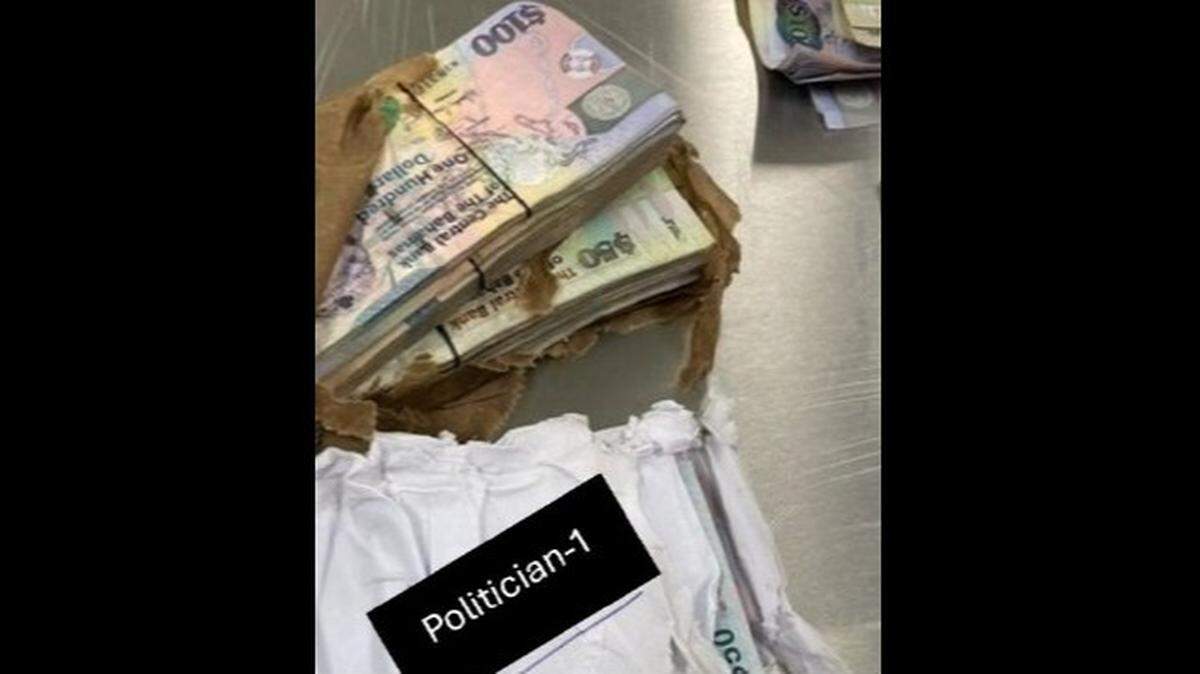
The airplane had reportedly departed from Marsh Harbor, Bahamas, and was headed for Freeport. Gardiner, a previously convicted drug trafficker with government connections who goes by the name “Player,” was carrying a cross-body bag with $30,000 in Bahamian currency — roughly equivalent to the same amount in U.S. dollars — inside a brown paper bag, according to Coleman’s affidavit.
“The bulk cash recovered from Gardiner’s bag is packed in a manner consistent with narcotics proceeds,” Coleman said in the federal complaint filed after Gardiner’s arrest.
Coleman said the money was labeled with the handwritten name of the Bahamian politician linked to discussions inside the Bahamian Parliament building in connection to a planned shipment of between 900 and 1,000 kilograms of cocaine. Federal prosecutors previously claimed in the November 2024 indictment that, in exchange for $2 million in bribes, “a high-ranking Bahamian politician ... would authorize the assistance and involvement” of the Royal Bahamas Police Force to facilitate cocaine shipments through the country.
In the filings, federal prosecutors condemned The Bahamas for allowing its airports and seaports to be used as transshipment points for cocaine smuggling “against the backdrop of rising crime rates.” Coleman’s deposition, meanwhile, sheds new light on the investigation and on how cocaine is moved from The Bahamas into the United States, with South Florida — particularly Miami — serving as a key transit point.
DEA investigating
The DEA has been investigating multiple drug trafficking organizations transporting large quantities of cocaine by air and sea from Colombia, Venezuela, Haiti and the Dominican Republic through The Bahamas and, ultimately, into the United States, since 2022, according to Coleman.
In the Gardiner filings, he notes that The Bahamas has multiple small airstrips throughout the southern portion of the island chain that generally do not require flight plans for arriving or departing aircraft. Increasingly, Coleman said, multiple drug trafficking organizations have relied on these remote airstrips to move drug shipments under the protection of local officials, including high-ranking members of the Royal Bahamas Police Force.
Once the drug loads arrive in The Bahamas, he said, drug trafficking operators work with members of the police force “and other officials to move their illicit shipments up the island chain to the northernmost islands, where the shipments are transported into the United States” by boat.
Bahamian government contracts
Gardiner was convicted in the Southern District of Florida on federal narcotics and money laundering charges in 2006, and sentenced to 18 years in prison. In 2014, he was deported to The Bahamas where, according to the affidavit, he owns a business that, among other things, bid on Bahamian government-issued construction contracts and launder his narcotics trafficking proceeds .
He is also tied to a Georgia-based trafficking ring, which relied on Gardiner to acquire cocaine from The Bahamas, according to DEA wire taps. He allegedly sent nine kilograms of cocaine through Miami in February 2023 to Georgia.
In one recorded conversation cited in the complaint, a co-conspirator described the logistical challenges of moving the cocaine to Miami, including dealing “with air traffic control and the coast guard,” while also discussing the involvement of corrupt government officials.
According to wiretapped conversations, Gardiner had “five private planes and flew from the ‘islands’ to Florida,” even though he was barred from entering the U.S. due to his prior incarceration and deportation.
Last week’s plane crash is not the first time Coleman has been connected to a downed aircraft. Coleman said Gardiner was involved with a drug load in or about 2023 in Rum Cay, Bahamas, during which the plane being used to transport cocaine crashed and the drug pilot died.
Miami Herald reporter David Goodhue contributed to this report.
This story was originally published May 18, 2026 at 4:42 PM.