Sargassum is choking Barbados’ beaches. Here’s how it’s being turned into fuel
Legena Henry was lecturing her renewable energy class at the University of the West Indies, discussing Barbados’ goal of becoming fossil-fuel free by 2030, when a student raised a practical concern.
“When we go 100 percent fossil-fuel free,” the student asked, “what am I going to drive?”
Henry — a graduate of Howard University and the Massachusetts Institute of Technology who had recently arrived at the Cave Hill campus from her native Trinidad — laughed. “Well,” she said, “I’ve seen some fancy electric cars around Barbados. We’ll probably be driving one of those.”
The student pushed back, noting that most people could not afford them.
Henry realized the same was true for her. She began thinking about alternatives. Barbados, once a crown jewel of the British empire built on sugar production, could follow Brazil’s lead and power vehicles with sugar-based fuels, she thought.
That summer, she recruited the student and several classmates to explore the idea as part of a research paper for the Inter-American Development Bank. Within weeks — after collecting liters of wastewater from rum distilleries across the island — they reached a conclusion.
“There isn’t enough sugar in Barbados to drive our cars,” Henry said.
Then another student spoke up.
“Dr. Henry, I see sargassum every day on my way home,” the student said. “Can we see if sargassum would work?”
Henry, a wave-energy expert who closely followed climate-change debates, immediately recoiled at the thought of using the invasive seaweed that had come to choke Barbados’ shorelines.
“Oh, no,” she recalled thinking.
But the student was persistent — and excited. Henry relented.
In 2024, Henry made history when she drove an electric car charged with biogas made from sargassum. Now, she’s hoping to expand that one vehicle into a fleet of taxis using inexpensive natural gas.
“Any gasoline car outfitted to drive on natural gas can also drive on renewable biogas. We want the whole world to know this,” she said. “We are building step by step, taking the scenic route to that reality.”
Choking Barbados’ beaches
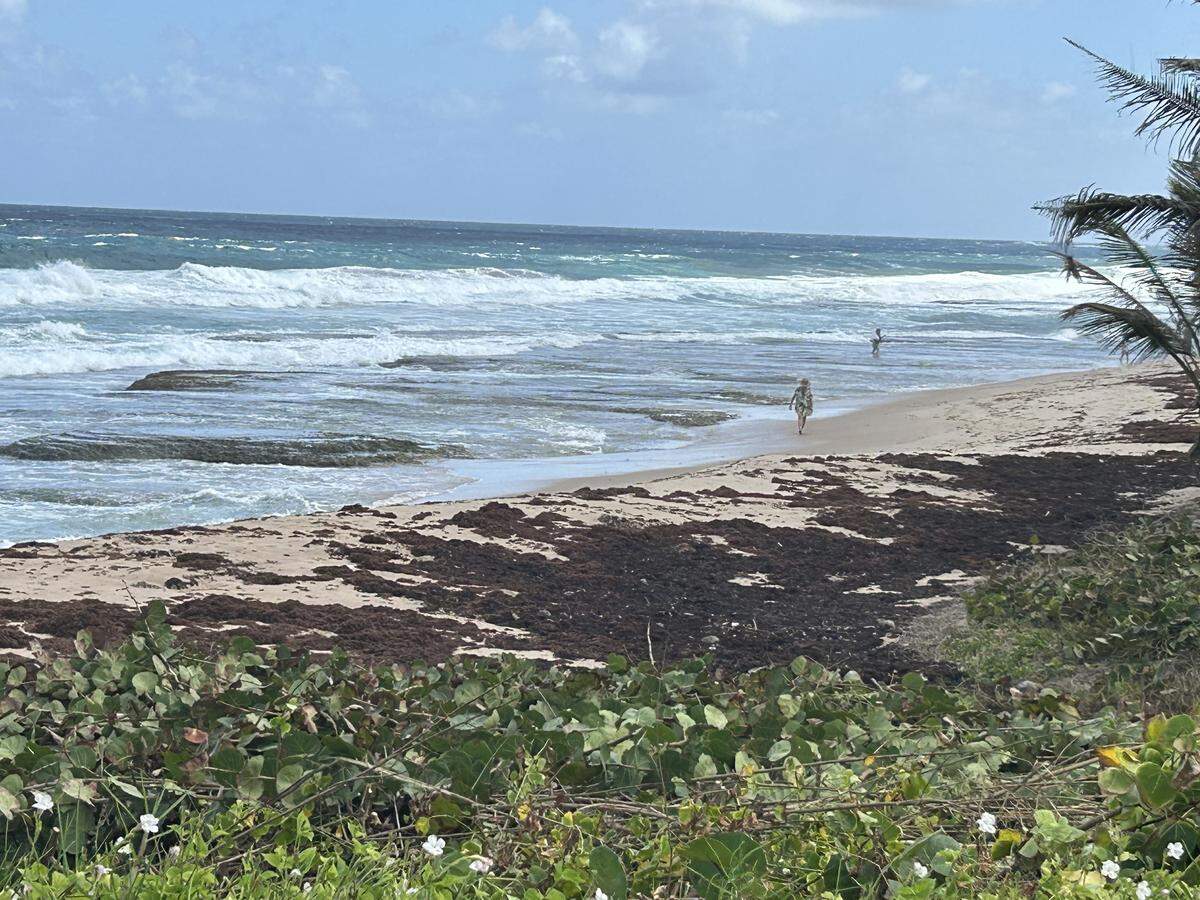
Visit any beach on this easternmost Caribbean island and, alongside white sand and turquoise waves, something far less serene is likely to stand out: decomposing seaweed choking the shoreline.
The floating brown seaweed, known as sargassum, washes ashore, releasing a toxic, rotten-egg stench as it decays in the sun. The problem is so severe here that one luxury resort spends millions of dollars on beach clean up and moving sun-bathing tourists around. Linked to climate change, the unsightly algae is disrupting tourism and straining Barbados’s economy.
“It might be the decision between somebody going to Majorca or Barbados if there’s going to be sargassum,” Henry said.
In Barbados, where Prime Minister Mia Mottley has made climate change a central focus of her government and in 2018 declared sargassum a national emergency, Henry has developed a solution she believes could do more than clear beaches — it could help Barbados’ mission to be fossil-fuel free by 2030.
She is using the seaweed to power vehicles.
“Lots of people have solutions for sargassum. There are agricultural fertilizers. There’s cosmetics and products for your face and your skin. We’re saying, wonderful, and we love that, but energy is actually a solution that meets sargassum at the same scale of its arrival,” she said.
Henry’s biogas is made from a mixture of sargassum, rum distillery wastewater and manure from Blackbelly sheep. While the initial pilot program produced 2,500 liters of fuel, she has scaled up to a five-acre site in St. John, Barbados, where she aims to generate at least one hundred times that amount.
In a country that’s one-seventh the size of Rhode Island, Henry says, residents pay “way too much for gas.”
“We pay four times what Americans pay to drive every kilometer, and our salaries are probably one-fifth the average US salary. So basically, a huge chunk of what you earn is the cost of driving in this country,” said Henry, who has a Ph.D in mechanical engineering and until recently taught renewable energy at UWI.
Her initial goal is modest but meaningful: cutting fuel costs in half for drivers.
The road to getting there, she believes, lies in the waste products that no one cares about — rum wastewater that’s dumped into the ocean daily and sargassum that ends up in landfill after washing ashore.
“Because we’re using waste to produce energy, we think we can design our solution around the ideal price for the consumer in this country. So I’ll start with half,” she said. “We raised equity and are waiting on the bank to approve debt financing for our $1.1 million venture.”
A growing global problem
Changes in ocean conditions are fueling the sargassum crisis. Warmer Atlantic waters allow the seaweed to grow and spread faster, with some nearly 38 million metric tons observed in 2025, according to a report released by the University of South Florida.
The algae’s impact extends even to Florida. Barbados, though, is among the hardest-hit. Yet because of the island’s geographic location, the sargassum that reaches its shore is also “pure,” Henry said, meaning it’s relatively free from the heavy metals that it absorbs elsewhere. “This helps,” she said in respect to her patent-pending formula.
In collaboration with her university’s administration, she has spun out the start-up company Rum and Sargassum, which promotes the economic and environmental benefits of biogas while highlighting the economic toll of rotting sargassum seaweed on the coastlines.
“This country is on a path to being fossil-fuel free by 2030, so we’re in an environment where there’s a welcoming open arms for renewable energy solutions,” she said.
Biogas is typically associated with agriculture and not transportation, a distinction that Henry says makes her unique at conferences, where she’s often “surrounded by dairy farmers.”
“We think of it as pioneering work, but necessary work because of this crisis, ‘seaweed on sand’ in our Caribbean islands,” she said.
Henry has also turned the venture into a teaching tool. Before moving to the St. John location, she operated out of the Alleyne School in St Andrew, Barbados, using her knowledge to show how kitchen waste and cow manure can be transformed into methane, a usable fuel.
An oversized black waste-to-energy system sitting outside a science lab showed students how food scraps can be transformed into fuel and fertilizer.
“It’s designed for individualized biogas production,” she said. “Families can have one of these in their backyard, take their kitchen waste and make energy that they can keep cooking on.”
The system fueled the prototype Henry used in what became known as Test Drive Zero.
“We got Test Drive Zero to work at 2 a.m. before the big event,” she said, explaining how she and a partner used a propane tank to store the biogas and then used it to fuel a generator that charged an electric car.
“We had to be creative. We had to use a refrigerator pump to get the gas to the right pressure to fire up the generator and charge the car,” she said. “It was very much an undertaking, and we were really proud when we finally charged the car.”
This story was originally published January 1, 2026 at 9:25 AM.