Did Brazilians imitate the raid on the U.S. Capitol? There are similarities, analysts say
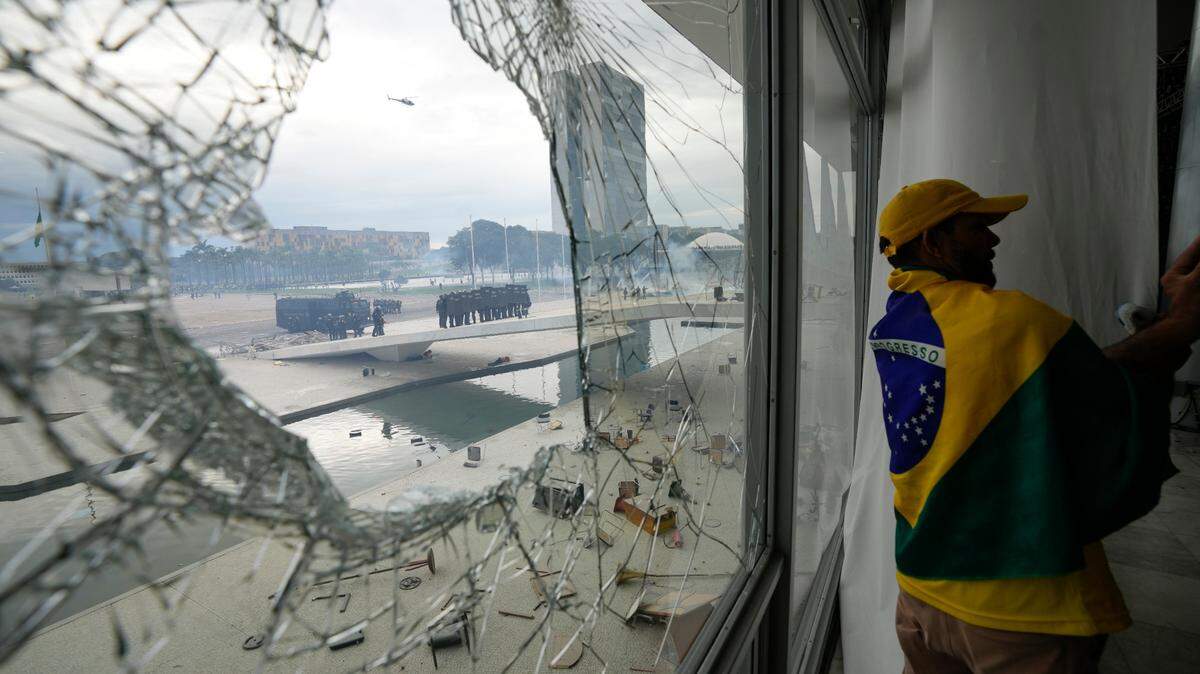
Brazilians were picking up the pieces Monday after the violent attack against government buildings over the weekend, in a coordinated revolt that experts say was clearly inspired by the Jan. 6, 2021, insurrection at the U.S. Capitol.
Asking the military to topple newly inaugurated leftist President Luiz Inácio Lula da Silva, thousands of followers of former President Jair Bolsonaro broke into government buildings, overturning furniture, breaking windows and vandalizing statues and paintings inside the presidential palace and the Congress and Supreme Court buildings.
Around 1,200 followers of the former president were arrested on Monday as they camped outside the army general headquarters in Brasilia. Officials pledged they would bring those responsible to justice, and the world condemned the events as an assault against democracy.
Bolsonaro, who according to Brazilian news reports is currently in Orlando, was quick to distance himself from the events. “Peaceful, law-abiding demonstrations are part of democracy. However, depredation and the storming of public buildings, as occurred today, as well as those practiced by the left in 2013 and 2017, break the rule,” the ex-president wrote Sunday night on Twitter.
Those monitoring Sunday’s violence said there were clear parallels between the events in Brazil and the attack on the U.S. Capitol.
“There’s no coincidence in politics. The acts are clearly inspired by the Capitol invasion,” said Bruna Santos, director of the Woodrow Wilson Center’s Brazil Institute.
Like the followers of outgoing President Donald Trump in early 2021, Bolsonaro’s supporters do not believe that his opponent legitimately won the election and were willing to use violence. “Their intention was to create enough chaos so that the military would intervene,” said Lian Lin, analyst at Economist Intelligence Unit, the policy research firm of the British magazine The Economist.
Besides breaking into the country’s main seats of power, protesters also blocked roads and the entrance to oil installations with the hope of disrupting the economy. The protests seemed to have died down somewhat, but the situation remained tense Monday, Lin said.
Experts said there were notable differences between the attacks in Washington and Brasilia.
“The most important difference is timing. The Capitol invasion had the clear goal of preventing [President-elect Joe] Biden from swearing in, so as to prevent his victory from becoming a fait accompli. In Brazil, all deadlines (announcement of results, swearing-in, inauguration) have been missed,” Santos explained. “The effect is that the possibility of such an action working now is much more remote — as the immediate response from the international community signals. This means that the cost of supporting such an action, for political and institutional actors who have something to lose (parliamentarians, military) is much higher.”
While most observers believe that Brazil’s political institutions will prevail, they warned that the country continues to be highly polarized and will continue to pose challenges for the incoming Lula administration.
On Sunday, Lula decreed a state of intervention in the capital, in what was seen as a show of force to prevent violence spreading to other areas of the country.
Brazilian Justice Minister Flávio Dino told reporters that police have begun tracking those who paid for the buses that transported protesters to the capital. At a news conference late Sunday, Brazil’s minister of institutional relations said the buildings would be inspected for evidence, including fingerprints and video and photos, to hold people to account, and that the rioters apparently intended to spark similar unrest nationwide.
“They will not succeed in destroying Brazilian democracy. We need to say that fully, with all firmness and conviction,” Dino said. “We will not accept the path of criminality to carry out political fights in Brazil. A criminal is treated like a criminal.”
Monday’s arrests came in addition to the 300 people held Sunday after they were caught in the act.
But police were noticeably slow to react, even after the arrival of more than 100 buses, leading observers to ask whether authorities had either simply ignored numerous warnings, underestimated the protesters’ strength, or been somehow complicit.
Prosecutors in the capital said local security forces had at the very least been negligent. A supreme court justice temporarily suspended the regional governor. Another justice blamed authorities for not swiftly cracking down on budding neo-fascism in Brazil.
This story was complemented by wire services.
This story was originally published January 9, 2023 at 2:03 PM.