
Proposed highway in Trinidad spurs hunger strike — again
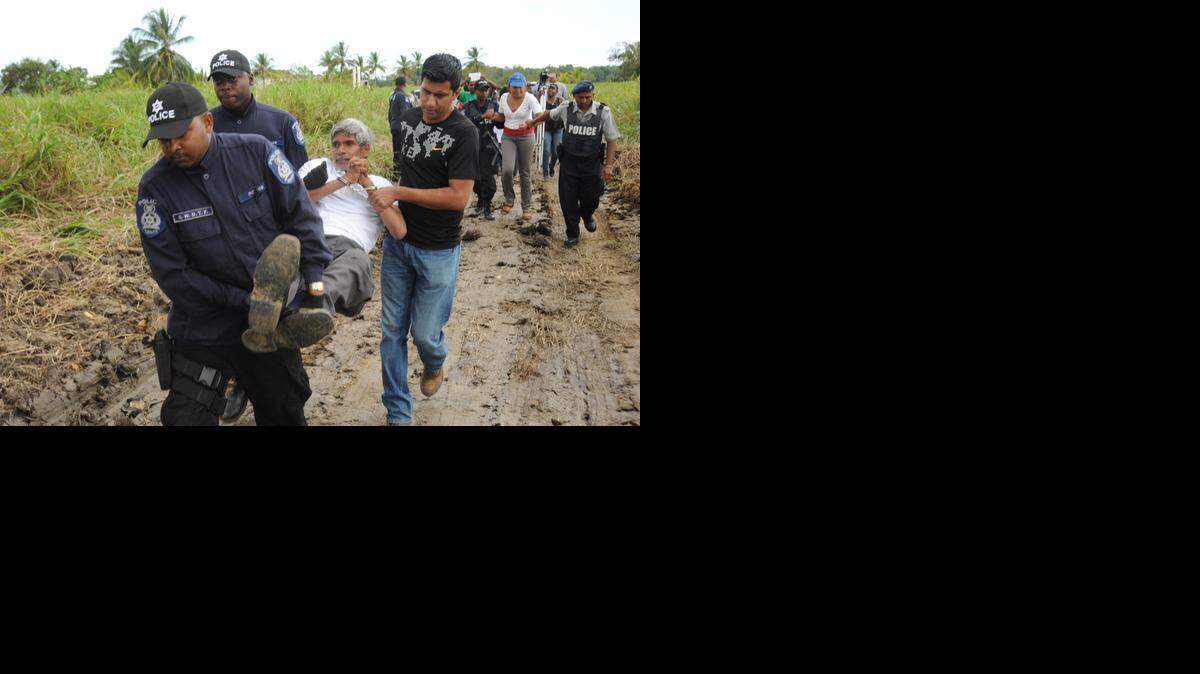
It’s become a daily routine for Wayne Kublalsingh, a rail-thin 55-year-old man with tidy salt-and-pepper hair who arrives each morning to sit outside the prime minister’s office. He holds his palms together in prayer. He speaks in low tones to curious passersby. And he waits — ignoring pangs of hunger, holding out hope that the prime minister will hear his plea.
For the past three weeks, Kublalsingh, an environmental activist and former University of West Indies lecturer, has waged a hunger strike to protest the construction of a highway that he fears will devastate wetlands and fracture tight-knit communities in the southwestern region of the country.
But it’s an uphill battle: For many in this oil-rich twin-island of 1.3 million people, the highway symbolizes Trinidad’s thirst to prove itself as an industrialized economic powerhouse in the Caribbean.
Kublalsingh’s efforts have earned him national notoriety as he is at turns ridiculed and praised in newspapers and on talk radio shows. His demands: He wants the government to halt construction on a nine-mile stretch of highway and consider other options. He wants officials to conduct additional studies on the project proposal, measuring the potential impacts on the environment and local businesses.
Most of all, he wants to meet with Prime Minister Kamla Persad-Bissessar to discuss the concerns held by his group, the Highway Re-Route Movement. So far, she has shown no signs of budging on her plans to press on with construction that she insists is necessary to bring relief to communities plagued with traffic. At a recent gala in South Florida, Persad-Bissessar — on her way home from addressing the United Nations in New York — extolled the highway and other infrastructure improvements pushed under her four-year-old tenure.
“You would not believe the infrastructure work that has been done to our Trinidad and Tobago,” Persad-Bissessar told the crowd as she listed the various highways that have been completed. “We know we have some challenges in respect to the highway but thus far, the high court and the court of appeal of Trinidad and Tobago has said we can build our highway. We don’t have to stop the highway so we continue to build.”
The highway, estimated to cost $1.2 billion, would be the largest and most expensive infrastructural endeavor executed in Trinidad.
From the start, it’s been a controversial idea. Trinidad’s economic prosperity in recent years has brought on collateral woes — stifling congestion and hours-long commutes for residents who travel into city centers for work and school each day.
Some say that investing in sweeping, big-budget highways will fix the problem. But it’s a fraught issue for a country aiming to strike a balance between economic development and protecting natural resources.
“If we keep going this way, the whole of Trinidad and Tobago is going to be asphalt,” said Suresh Chaitoo, 54, whose family owns land in Mon Desir, one of the communities along the planned highway route.
Members of the Highway Re-Route Movement maintain that they have no problems with the primary segment of the project, which would connect the major cities of Point Fortin and San Fernando. Their concerns lie with the costliest portion of the construction, a proposed four-lane freeway that would connect the new San Fernando roadway with an existing highway that leads to the nation’s capital. Protesters argue that the connection between the two highways could be made by widening and improving existing local roads — an option that they say would prevent the need for residents to be relocated, and which would save taxpayers millions of dollars.
“While highways are important, they are not correct for every community,” Kublalsingh said. “What people want is connectivity, not highways.”
This is Kublalsingh’s second hunger strike; the first one, staged in 2012, lasted 21 days, until outside organizations agreed to conduct an independent review of the highway proposal. That review raised serious concerns about the project, saying that the design lacked community involvement, that many potential ramifications remained unknown, and that the planned stretch between Debe and Mon Desir may prove to be wider and costlier than necessary.
But government agencies overseeing the project say the highway will be a boon for Trinidadians, estimating that 93 percent of the labor and materials for construction will be sourced from local communities.
Last week, an appeals court judge denied a request for an injunction to halt the construction.
In a letter penned at the outset of the hunger strike, Persad-Bissessar urged Kublalsingh to back down from his hard-line stance, maintaining that the construction of the highway was necessary to relieve residents in the southwestern part of the country who “endure the daily stress and inconvenience of the frustrating traffic and the consequential adverse impact on their quality of life.”
“We cannot, and will not, be held to ransom by your decision to bring harm to yourself,” wrote Persad-Bissessar, the country’s first female prime minister.
Oxford-educated, with a measured and erudite manner of speech, Kublalsingh doesn’t quite fit the image of radical environmental protester. He frequently arrives at the protest site in a pressed cotton button-down and dark trousers, shaded by a standing umbrella and flanked by a gaggle of family and supporters. Some of his backers are notable figures in Trinidad, such as legendary Carnival mas-man Peter Minshall.
As the hunger strike has worn on, Kublalsingh’s voice has grown more frail and the bones of his face more pronounced, but he continues to talk with visitors. Politicians, union officials, journalists,????? environmental leaders and curious civilians sit beside him each day to hold his hand, press damp towels to his forehead, or read from the Bible.
Others try to convince him to end the strike and save his own life.
“We are very, very moved,” said Nico van Oudenhoven, a tourist from Canada who visited Kublalsingh after reading about the hunger strike in the newspaper. “But you will die, man — you’re too good for this.”
“You shouldn’t do this,” added his wife, Roana. “It’s not worth it.”
Kublalsingh remained stoic.
“We can’t let it go,” Kublalsingh responded, “because we’ll have to fight this again tomorrow.”
The hunger strike has also sparked derision. In the newspapers, people lambaste Kublalsingh’s efforts and question whether he’s staying true to his fast; he goes home in the afternoon and has plenty opportunity to eat or drink in private, they say.
Drivers passing the protest site sometimes slow to hurl admonishments out the window.
“All yuh go from there with that s---!” shouted one detractor.
“We want the highway!” yelled another.
One Mon Desir resident, Mohan Baney, said he is holding out hope that Kublalsingh’s efforts will help prevent homes like his, which will be destroyed under eminent domain if the highway continues as planned. The land has been in his family for generations, and he wants to pass it along to his grandchildren, he said, adding that the compensation offered by the government was insultingly low.
“Sixty-five years in this place — what am I doing going to build a new house now?” Baney said. “It is not just about a highway — it’s Trinidad Dr. Kublalsingh is trying to protect. I am here with this man, and I will stay with him.”
Miami Herald Caribbean Correspondent Jacqueline Charles contributed to this report from Miami.
Miami Herald Caribbean Correspondent Jacqueline Charles contributed to this report from Miami.
Highway controversy
February 2010: After years of planning, Trinidad government decides to move ahead with a $1 billion extension of the Sir Solomon Hochoy Highway. It is anticipated to be the most ambitious infrastructural project in the country’s history.
January 2011: Highway contract is awarded to a Brazilian construction company.
September 2011: Construction on the highway extension begins.
Nov. 15, 2012: Activist Wayne Kublalsingh begins a hunger strike to protest the highway. It lasts for 21 days, until an independent committee agrees to conduct a review of the proposed project.
March 3, 2013: The review committee’s report raises concerns about potential social, environmental and economic impacts of the project.
Sept. 17, 2014: As construction continues, Kublalsingh begins his second hunger strike, refusing to drink water or eat food until he gets a meeting with Prime Minister Kamla Persad-Bissessar, or until construction is halted.
This story was originally published October 10, 2014 at 9:20 PM with the headline "Proposed highway in Trinidad spurs hunger strike — again."