
In 2000 most Puerto Ricans identified as white. In 2020, few did. Why that number dropped
For Raquel Ortiz Roldán, a Puerto Rican woman who lives in the coastal town of Arecibo, the 2020 Census was a way to affirm her multiracial identity as a member of a large, extended mixed family. New write-in boxes under each of her selected races allowed her to describe herself better.
Ortiz Roldán marked herself as “White,” “Black or African American,” and “Some Other Race.” In the write-in boxes she identified as “afrodescendiente” — Afro-descendant — and “Taíno,” indigenous people from the island.
“When you don’t have any other options, it’s like, ‘Look, there is orange juice and grape juice. You have to choose between those two.’ But if they tell you there is orange juice, grape juice and soursop juice, then people can choose soursop too,” said Ortiz Roldán, 47.
Ortiz Roldán is among a growing number of Puerto Ricans who did not identify solely under the “White” category in the 2020 Census — breaking long-standing trends in Census racial data on the island. In the 2000 Census, the number of people identifying as “White” only in Puerto Rico was 80.5 percent. On a Caribbean island rich in Black heritage — and a history of colonization, migration and slavery — those numbers did not reflect the on-the-ground reality, said experts and researchers.
Then, the results of the last Census in 2020 in Puerto Rico stunned island residents, scholars and activists. The number of island residents identifying only as “White” saw a dramatic decrease between 2010 and 2020, to 17 percent. About half of the population identified as “Two or More Races,” while a quarter identified as “Some Other Race.”

Experts, scholars and activists say that modifications to the Census questionnaire’s design, historical events that rocked Puerto Rico, and local efforts to educate people about race and racism resulted in the significant demographic changes in the 2020 Census, which signal changes in local perceptions of identity.
“Puerto Rico, following the census, is not a white country. We who do anti-racist work know that and so do many other people,” said Bárbara Abadía-Rexach, professor of Afro-Latinidades at San Francisco State University. “But it was not what the censuses were reflecting.”
Spotty record for Census in Puerto Rico
The U.S. Census Bureau conducts a population count every decade, capturing information on race, sex, age and other data that decide public policy and billions in federal funding. While the Census has some insight into how the island understands its own racial identity, scholars say that federal racial data collection practices do not correspond with how Puerto Ricans understand race.
“The U.S. Census uses categories that are interpreted as ... mutually exclusive. In Latin America and the Caribbean, racial categories have always been seen as a continuum. ... It is understood that there are all kinds of mixture,” said Palmira Ríos, a researcher at the Public Administration Graduate School at the University of Puerto Rico.
For decades, the island’s territorial government promoted a narrative of la mezcla de las tres razas, or “the mix of the three races” — that Puerto Ricans hailed from a harmonious combination of Spanish, indigenous Taíno and African heritage, said Isar Godreau, a professor and researcher at the University of Puerto Rico in Cayey.
“In the Hispanic Caribbean, the idea of mixture does not contradict the notion of whiteness,” the professor said, “You can understand that you are white and also understand that you are mixed.”
But that ideal the government promoted also erased the idea of racism and distanced itself from Blackness, she added. That local understanding of race, filtered through Census categories, could explain why Puerto Ricans mostly marked themselves as “White” in 2000 and 2010.
“I’m not telling you that it was an easy selection,” she said. “But when people see the options that exist and they say well, I’m not Black, I’m not Indigenous, I’m not Asian ... well then I’m white. And since there is a [local] discourse that allows that, we saw the results.”
Puerto Rico lost nearly 12% of its population in the last 10 years, according to the U.S. Census Bureau. But migration doesn’t account for the change in population demographics on the island, said demographer Raúl Figueroa.
“Those who emigrate are not very different from those who stay,” said Figueroa. “That factor should not affect so much, especially considering the magnitude of the change that occurred.”
Figueroa said that changes in the design of the questions — like adding in write-in sections and example groups under racial categories — contributed to changes seen in the most recent Census in both Puerto Rico and the mainland U.S. Along with other scholars interviewed, Figueroa said he believes that the 2020 Census results are more representative than the 2000 and 2010 counts of the island’s racial composition.
“I think now the numbers ... are looking more like what they really are,” he told the Miami Herald.
Multiple crises
An investigation using pre-Hurricane Maria data from Godreau, along with Center for Puerto Rican Studies Director Yarimar Bonilla, could also shed light on the recent Census results.
A 2016 survey conducted by Bonilla originally explored Puerto Rican perceptions of the economic crisis, which developed as a landmark U.S. Supreme Court decision cast doubt on the island about Puerto Rico’s autonomy as a territory; a debt-ridden economy that spurred an exodus; and the federal imposition of a Fiscal Oversight and Management Board to oversee the island’s finances.
These were “different instances in which it was specified that Puerto Rico was a colony,” said Godreau.
In the demographic component of the study, Bonilla and Godreau decided to team up and include an open-ended question asking participants to describe their racial identity. They wrote a paper on their findings, published in June.
They found that only about 20% of all participants identified as white. And those who did also gave qualifiers, describing themselves as “white Latina” or “Puerto Rican white.” Most also opted to use federal government terms such as “Latino” or “Hispanic,” while only 10% used Puerto Rican terms for mixed racial identification, like “café con leche,” “coffee with milk,” or “trigueño” — brown-skinned.
Godreau and Bonilla concluded that the political, economic and social turmoil on the island had affected the identity of Puerto Ricans, who were now placing themselves in a larger mainland U.S. racial context instead of an isolated one exclusive to the island. Sixty-eight percent of all interviewed agreed that Puerto Rico is a colony.
“The Commonwealth no longer has resources, because it has been bankrupt for a while, it does not have the resources to reproduce its racial myths,” she said. “The myth that we can call ourselves white ... without being challenged by our colonial reality.”
Then, President Donald Trump, whose campaign used anti-Hispanic rhetoric, came into power in January 2017. Hurricane Maria hit in September of that year, killing thousands and destroying critical infrastructure. Federal hurricane relief was slower than in states like Florida and Texas. During a presidential visit to Puerto Rico after the storm, Trump tossed paper towels into a crowd, angering many Puerto Ricans. A series of devastating earthquakes and the coronavirus pandemic followed. The events likely exacerbated tendencies she and Bonilla had seen, Godreau said, particularly the decrease in people only identifying as white. But they did not expect it would be so steep.
In all, people identifying as multiracial in Puerto Rico’s population increased by 1,238%, while people identifying as “Some Other Race” alone or in combination increased by 629% since 2010 — phenomenons that tracked trends in the mainland U.S.

Pushing Census education
As the flurry of disasters struck Puerto Rico, local groups continued building on decades’ long work against racism. Among those was Colectivo Ilé, a Black women-led group that focuses on eradicating racism and celebrating Blackness.
In collaboration with a coalition of 45 other organizations, the organization launched a Census education campaign to reduce the number of people who identified as only white and to encourage Black Puerto Ricans to claim their heritage and write themselves in as Afro-descendant.
They flooded the internet, television and radio with their campaign, and created an educational tool kit and hashtags like #PuertoRicoisAfro.
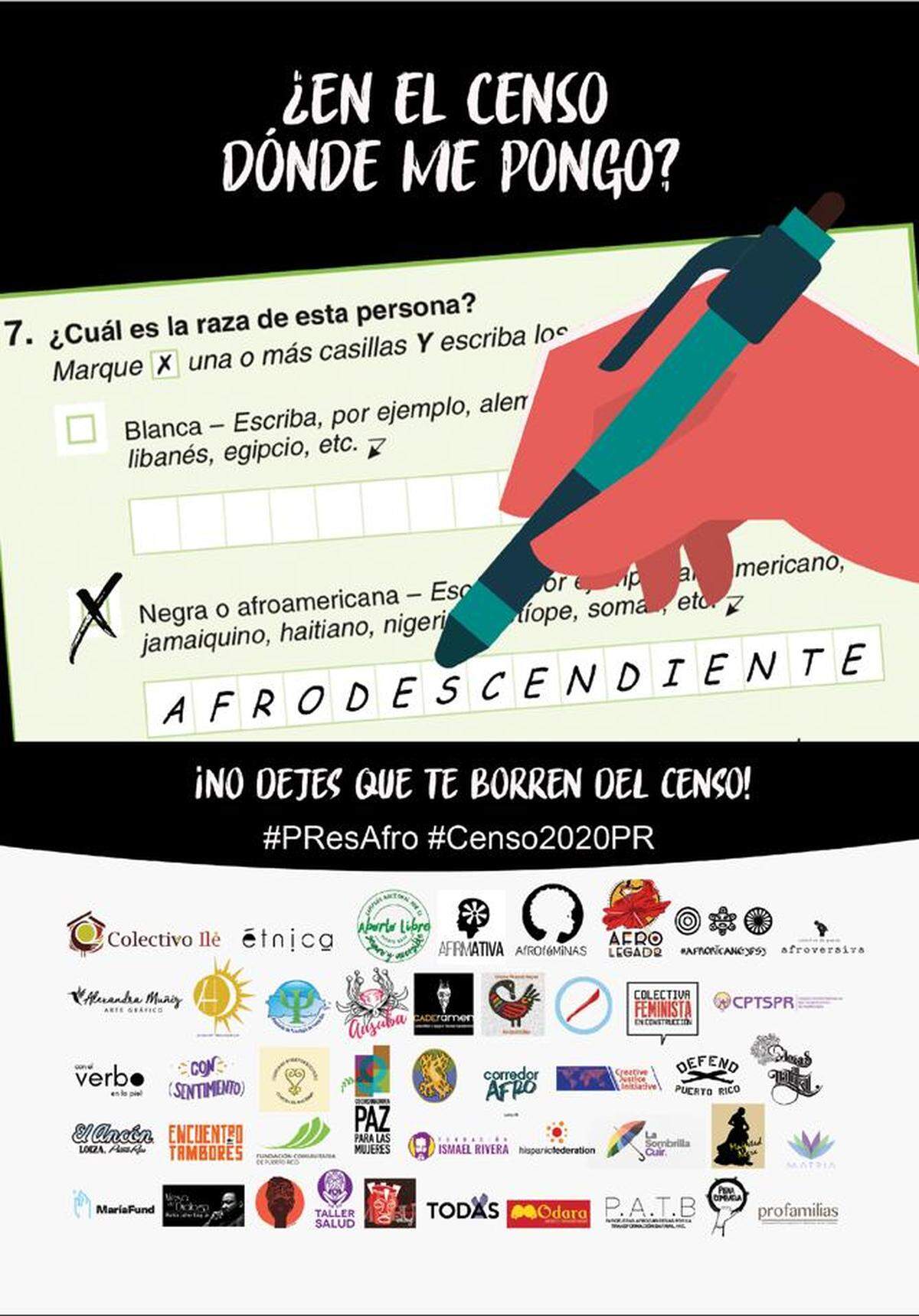
For Irán Rodríguez, a 26-year-old social work graduate, identifying as “Black” and writing in “Afro-Boricua” — Boricua is a traditional way Puerto Ricans use to refer to themselves — was a way to celebrate who he was and a “step of affirmation.” He told the Miami Herald that campaigns like Colectivo Ilé’s made him feel supported in his choice.
“You say to yourself, what I always suspected is valid. I am a Black person, a person who is Afro-descendant,” he said.
‘I am not leaving my blackness behind’
The number of Puerto Ricans who identified as “Black or African American” alone was half in the 2020 Census of what it had been in 2010. However, the percentage of people identifying as “Black or African American” in combination increased by nearly 300 percent. Abadía-Rexach, the San Francisco State University professor, said that decline in Puerto Ricans who solely identified as Black revealed the nuances of racial categorizations.
“Of course we are mixed people. But a person who is visibly black, should [they] mark Black with something else? This is a very subjective, very individual matter, but it is a question that I would ask,” she said, “I come from a mixed family, but people see me as black. I look at myself in the mirror every day, as a Black person. I’m not going to mark more than Black.”
The increase of Puerto Ricans identifying as “Black or African American” alone or in combination— about 17.5% of the population — was welcome news for Colectivo Ilé and other local organizations.

“What people are doing is saying, ‘Yes, I am black and I am something else, but I am not leaving my blackness behind,‘‘ said María Reinat Pumarejo, Colectivo Ilé’s director, “I am not leaving behind my relationship with my Black ancestors, which is vital that it be understood.’”
Race-informed public policy
Academics say that the island’s government has not methodically collected data on race to inform public policy, despite darker-skinned and Black Puerto Ricans denouncing racism and racial discrimination.
“Puerto Rican officials have always said that racism does not exist, racism is not a problem and they simply remove it from consideration in what is public policy. And the easiest and most effective way to do it is to get all statistics out of it,” said Ríos, the public administration professor.
No racial Census data exists for Puerto Rico between 1960 and 1990 because the local government decided to not collect it under a joint agreement with the Census Bureau. Ríos noted that the Department of Corrections and Rehabilitation doesn’t track race in its population. While academics have worked to quantify race and racism in Puerto Rico, they say the lack of official data has made it difficult.
Conversations surrounding demographic and Census data in Puerto Rico and Latin America highlight “the need to see valid and reliable data in order to formulate public policies, to dismantle and effectively combat racial discrimination,” said Ríos. She added that local officials must get more involved in U.S. Census Bureau operations so that federal population counts also include Puerto Rican views on race and identity.
Puerto Rican Sen. Ana Irma Rivera Lassén is a prominent lawyer and member of Movimiento Victoria Ciudadana, a recently formed, left-leaning political party. She aims to implement government policies that celebrate Afro-Puerto Ricans and combat racism. She sponsored a bill to designate March 21 as the “National Day for the Eradication of Racism and the Affirmation of Afrodescendance,” close to the March 22 anniversary of Puerto Rico’s abolition of slavery.
Schools and official institutions will hold educational and cultural events that week. Government agencies, including the departments of Family, Justice, and Labor, will have to organize initiatives that recognize the contributions of Afro-Puerto Ricans as well as execute policies that educate about racism within each agency. The law also orders the Puerto Rico Statistics Institute to collect demographic data that would document and monitor issues of race and racism, and to work with public agencies to do so.
Rivera Lassén’s bill became law in early August. The March 21 holiday will be celebrated in 2022. While better data collection practices are created, the senator said the 2020 Census results can be used to develop race-informed public policy.
“I believe that this will help us to set our sights precisely on recognizing the groups, communities and people who suffer discrimination based on race,” she said.
The population count results made Reinat Pumarejo and other scholars and activists hopeful about the future of anti-racism work in Puerto Rico. But she emphasized there is much work left to be done. Colectivo Ilé has continued with its regular programming, and has since organized forums about the Census results.
“We know that this celebration has to be anchored in continuous anti-racism work. We know that this is a step,” she said. ”We know that this admission gives us fertile ground for work.”
You can explore Puerto Rico’s Census results below:

This story was originally published October 15, 2021 at 7:00 AM.