
Claver-Carone: Argentina wants to ‘obstruct’ elections for president of regional bank
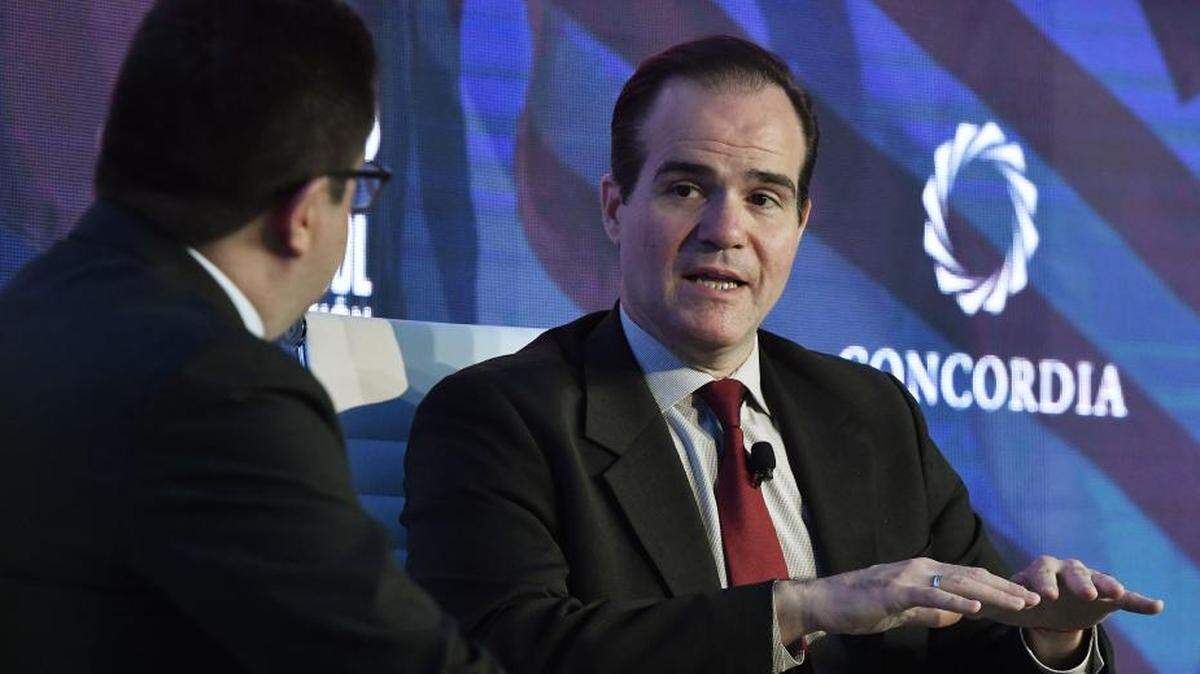
Mauricio Claver-Carone, an adviser to President Donald Trump who is running to be the head of the Inter-American Development Bank, accused a “minority” of Latin American countries led by Argentina of trying to “obstruct” and “subvert” the election for the position.
In a call with journalists Tuesday in which he defended his candidacy, Claver-Carone said Argentina, Chile, Mexico and Costa Rica were using “obstruction” tactics. Argentina and Costa Rica have put forward their own candidates for the bank’s presidency.
“Our candidacy has won the majority support of the region,” said Claver-Carone. “We are seeing a minority effort, led by Argentina, to hinder the election because they have not been able to present a competitive vision.”
Claver-Carone is the current director for Latin America in Trump’s National Security Council and has been central in the administration’s policies toward Cuba and Venezuela, as well as in negotiations on migration issues and private investment in the region. Previously, he served as the U.S. representative to the International Monetary Fund and as an adviser to the Treasury Department.
The Inter-American Development Bank, one of the primary sources of financing for the countries in the region, comprises 48 Latin American, Caribbean, and European nations plus the United States, Canada, Israel, Japan, Korea and China.
Claver-Carone said he had the votes necessary to get the job because he had the “public” support of 17 Latin American and Caribbean countries, including Brazil and Colombia. “It only takes 15 to win,” he added. The United States controls 30 percent of the votes, which are distributed by each country’s contributions.
The presidential adviser said he was committed to creating a more efficient, equitable and transparent team for the bank, which has had only four presidents in 61 years. He also said that he would work on the region’s recovery from the coronavirus pandemic and to attract more private investment, especially from U.S. companies interested in relocating their operations from Asia to Latin America.
But his nomination, which breaks with the tradition of selecting a Latin American to lead the bank, has generated strong opposition.
The European Union, Mexico, Argentina, Chile and Costa Rica support postponing the election proposed for Sept. 12 and 13 of this year. Instead, they recommend holding elections in March 2021, when there would be no uncertainty around who occupies the White House.
“Since its founding in 1959, the IDB has been led by a Latin American president and a vice president nominated by the United States. This was the vision of Presidents Eisenhower and Kennedy, who agreed on the need to strengthen the Bank’s Latin American identity,” said Joseph Borrell, the E.U. high representative for foreign affairs in a letter sent to several Latin American governments. “We believe that changing this model is a far-reaching policy that can only be the result of calm reflection.”
Elections require the presence of at least three-quarters of the 48 member countries.
Claver-Carone said that all member countries approved a resolution agreeing to hold the elections in September. Borrell’s letter, he added, was sent in a personal capacity and did not represent the views of the European nations that are members of the bank.
“Any attempt to hijack an election by a minority of countries despite very clear rules of procedure would be undemocratic and an effort that the United States would challenge,” he said.
Claver-Carone, of Cuban origin, also recalled that the United States is the second-largest Spanish-speaking country after Mexico. “What makes me less Hispanic than other people in the region?” he asked.
Several former U.S. diplomats and analysts have also pointed out that if Joe Biden is elected president, the funds the region needs to recover from the COVID-19 pandemic could be caught up in a political conflict between a Democratic administration and a former Trump administration official.
The Biden campaign told the Miami Herald that Claver-Carone was “too ideological.”
But Claver-Carone said that if elected, he would not get involved in U.S. partisan politics, a promise he made to Democratic Sen. Bob Menendez, with whom he built a close relationship as a former lobbyist on Cuban issues in Congress.
Follow Nora Gámez Torres on Twitter: @ngameztorres
This story was originally published August 11, 2020 at 3:52 PM.