Despite early gains, Puerto Rico stumbles in data darkness amid lack of coronavirus tests
Puerto Rico won early praise for taking bold and decisive actions to shut down the spread of the coronavirus — closing non-essential businesses, issuing stay-at-home orders and imposing a curfew.
As most of the mainland eventually followed suit, Gov. Wanda Vázquez said the U.S. territory of 3.2 million could be an example of how to fight the “invisible enemy” of COVID-19.
But in the month since Puerto Rico began battling the virus, it has fallen behind in almost every other aspect. Despite multiple attempts to ramp up testing and a contact-tracing program, the island is now a regional laggard.
And that has some fearing that the coronavirus will join the long list of maladies — hurricanes, earthquakes, political instability, a decade-long recession — that have battered the island.
Melissa Marzán-Rodríguez, an epidemiologist and assistant professor in the Public Health Program at Ponce Health Sciences University in southern Puerto Rico, said the lack of robust testing means researchers are stumbling around blind, in data darkness.
“It’s like we’re sailing without a map, and that’s complicating everything,” she said. “It’s as if you were preparing for a tropical storm but then you’re hit with a category three hurricane.... We just don’t know.”
As of Tuesday, Puerto Rico had run 8,151 tests for the novel coronavirus — the equivalent of one test for every 392 people. That’s the lowest per-capita testing rate of any U.S. state. Florida, by comparison, has run more than 200,000 tests, or one for every 107 residents. The national average for states is one test for every 115 people, according to data pulled from the COVID-19 Tracking Project and the U.S. Census.
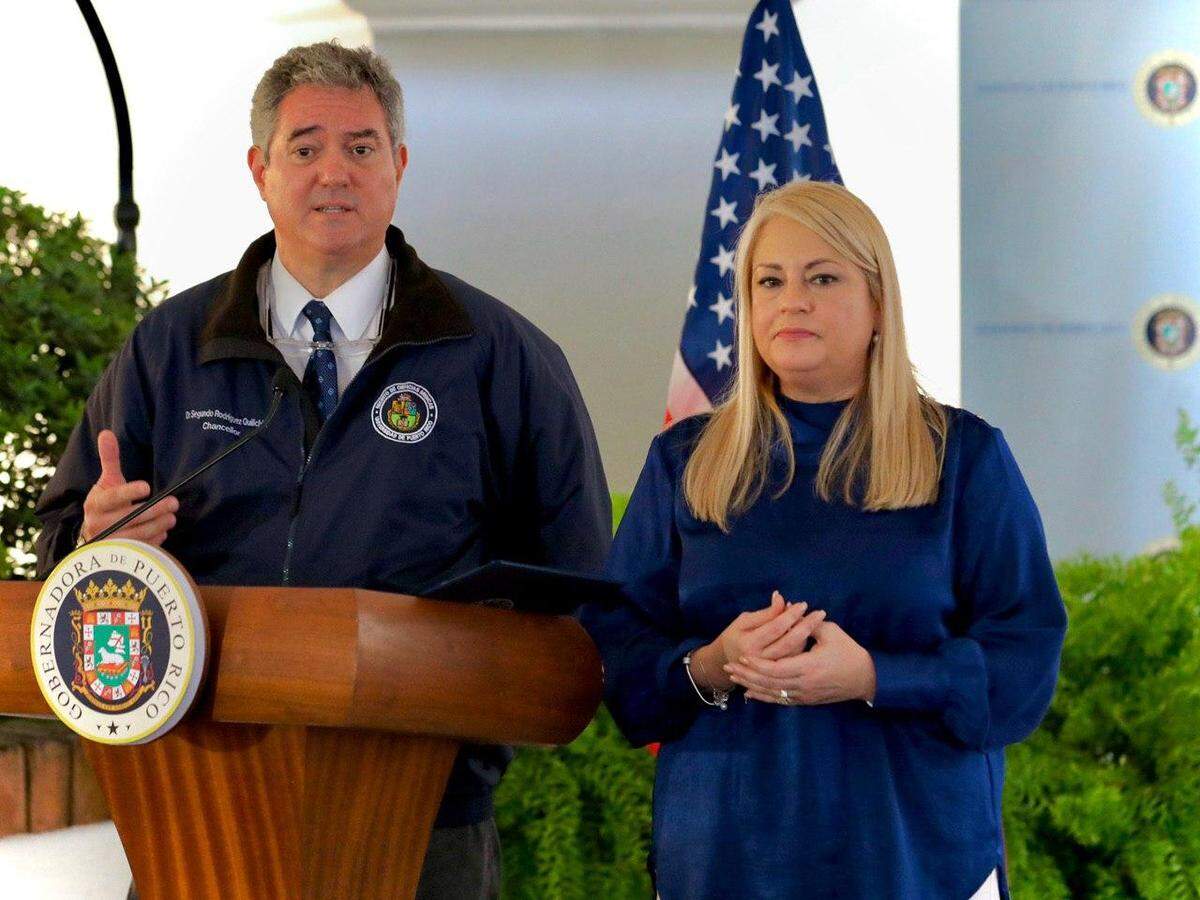
Based on those limited results, Gov. Vázquez and her Coronavirus Task Force on Saturday reassured the public that the social distancing measures the island has endured since March 16 are working — that the pace of new infections is starting to slow.
Health officials also boasted that Puerto Rico has fewer coronavirus cases than any U.S. state of a similar size. And that’s true. While Puerto Rico has 932 coronavirus cases, Connecticut and Nevada, which have about the same population, have reported 13,380 cases and 2,971 cases each. However, Connecticut has run more than 45,000 tests and Nevada has performed 25,000 tests.
To complicate matters, the data that does exist in Puerto Rico is often muddled, researchers say.
On Sunday, for example, the Health Department reported its largest one-day jump in new coronavirus cases, saying 109 people had been added to the list of the sick. But those tests had been performed between March 24 to April 2.
The Health Department has not responded to multiple information requests from the Miami Herald, including questions about the day-to-day breakdown of new cases. But public health experts say they’re facing the same hurdles.
Mirna Arroyo, an epidemiologist and lawyer, said the government has been notorious for not providing clean, usable data. While health officials, for example, say the apex of death and illness could hit anytime between now and May 8, Arroyo said the information isn’t available in a way that other researchers can double-check those assumptions or run alternate models.
“We can’t say anything about it one way or another,” Arroyo said, when asked about the prospect of reopening the economy. “The reality is we haven’t run enough tests, our data is not robust, and the models have a large margin of error.”
Hopeful Signs
Despite the lack of data, there are reasons to believe the outbreak is under control on the island. One month into the pandemic, hospitals have not been overwhelmed. Of the island’s 631 ICU beds, only 309 are occupied. And only 373 of the island’s 1,145 ventilators are currently in use.
The government also acknowledges its blind spot. Health Secretary Lorenzo González has said that at least 20,000 tests need to be performed to paint a clearer picture of what’s happening. And while he says 200,000 tests are now available on the island, it’s unclear how quickly the testing gap can be closed.
Another weakness in the island’s response has been contact tracing. Despite plans to let universities or municipalities take the lead on that effort, nothing has truly happened yet, experts said.
Arroyo said it should have been a priority when cases were in the dozens and is even more so now.
“Yes, we’re late to the game,” she said. “But better late than never.”
Echoes of Maria
The data deficit is being exacerbated by lingering distrust of the government.
Since the coronavirus first made an appearance on the island in early March, the administration has churned through three health secretaries. The second one, Concepción Quiñones de Longo, resigned after less than two weeks on the job, claiming she was pressured to sign off on $40 million worth of deals to acquire 1 million rapid test kits. Those contracts have been canceled and the Health Department is under federal investigation.
Adding to the sense of institutional chaos, on Tuesday the Health Department’s chief press liaison, Eric Perlloni, resigned after audio leaked of him complaining about local reporters.
Fernando Rivera, the director of the University of Central Florida’s Puerto Rico Research Hub and a professor of sociology, said Puerto Rico’s COVID-19 response “was very strong off the bat,” as it took social distancing seriously.
But the parade of health chiefs, the questionable contracts and the meager and conflicting public information is taking a toll.
“All that good will that they began with is eroding,” he said. “The lack of transparency and the lack of accountability is problematic.”
Rivera and others see similarities to the aftermath of Hurricane Maria in 2017, when the death toll was, initially, grossly underestimated.
“During Maria you would have people saying, ‘My parents died during the crisis but they’re not showing up in the numbers,’” Rivera said. “I think, sadly, we have the same situation again. And there are two possibilities: Either the information is there and it’s not being shared, or there’s not the capacity to [gather the information] and share it in a way that researchers and public health officials can do their work.”
Local doctors have been trying to fill the gaps. On March 17 — days after the first case was confirmed on the island — a group of public health experts from the Ponce Health Sciences University launched a website to track COVID-19-like symptoms. Since then, more than 40,388 people have uploaded information into the platform, and the initiative now has the backing of Harvard University’s public health program and other institutions.
The Health Department launched its own COVID-19 dashboard last week.
Luisa Morales, a Ponce university epidemiologist who worked on the private initiative with Marzán and others, said the public sector needs all the tools and data it can get to guide its policy decisions. And that’s particularly true as the conversation has turned to reopening the economy.
“My worry is that people will drop their guard,” she said. “Already, when you go to supermarkets, you’re seeing more cars and people on the street…. I’m worried that people might have a false sense of security.”
Only time will tell if Puerto Rico’s data gaps will truly undermine its ability to fight the disease.
Marzán said the island has had a long-running problem with collecting and disseminating information.
“For the last 15 years it has been the norm not to have any data, and you just adjusted to that fact,” she said. “But obviously, in critical moments like this, it takes on added importance. Now it’s a matter of life or death.”
This story was originally published April 15, 2020 at 6:00 AM.