Boricua-wood? Developer with Miami ties pushes $70 million movie studio in Puerto Rico
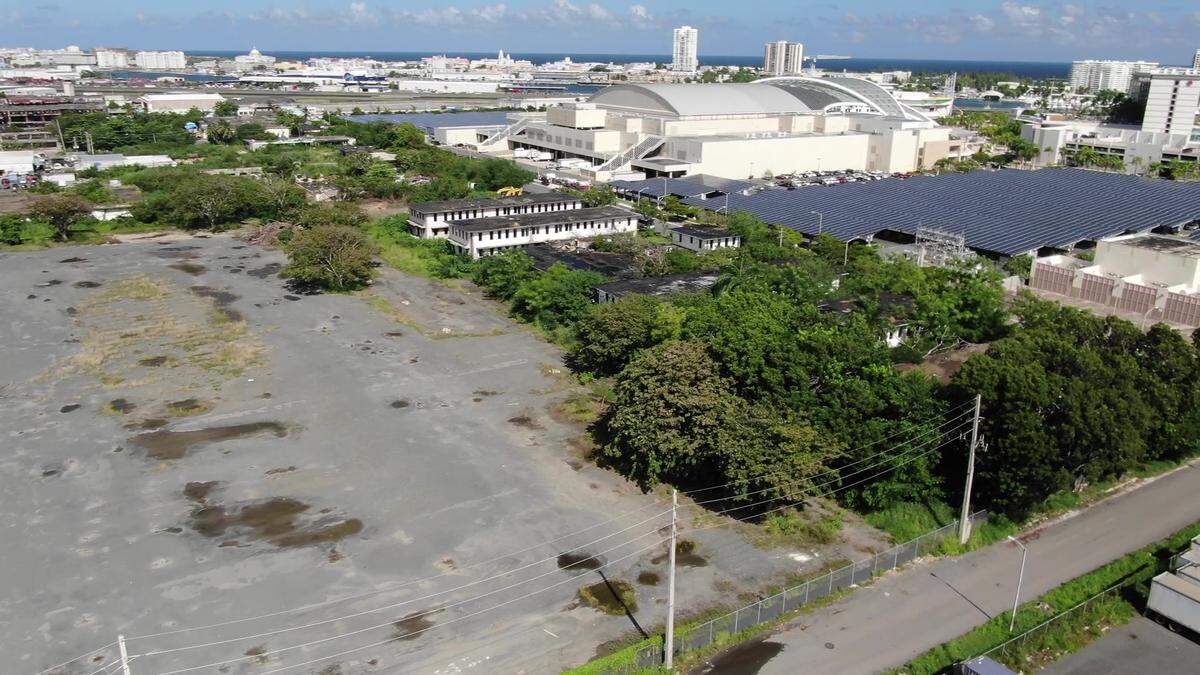
With its crumbling buildings, thick vegetation and scurrying lizards, the blighted lot near Old San Juan would make a great set for a horror film. Instead, developers are hoping it will tell another kind of story: one about how a struggling island became a moviemaking powerhouse.
If all goes well, by 2022 this forlorn 14-acre lot will be home to a buzzing movie production facility with three or four sound stages, a backlot with facades of Miami and New York, and warehouses full of gaffers, electricians and set designers.
Puerto Rico is already attracting big budget productions like Johnny Depp’s “The Rum Diary,” “Bad Boys II” and “Fast Five” — part of the “Fast and the Furious” franchise — but it doesn’t have the sound stages and post-production facilities to make the island a one-stop shop.
“It really is an amazing island, it has everything a film company could want,” said Keith St. Clair, the man behind the $70 million Puerto Rico Film District project. “You have beaches, you have rainforests, you have cities, you have culture, you have Old [San Juan], you have great food — everything on this island is perfect for the creation of movies, and the studio will be icing on that cake.”
The initiative comes as Puerto Rico is hoping to star in its own rags-to-riches story. The island is staggering under more than $72 billion in debt and billions more in unfunded pension obligations, unemployment is twice the national average and more than 133,000 people left last year in the wake of a devastating 2017 hurricane season.
Once the Film District is up and running, it could potentially create about 1,300 jobs and pave the way for more, St. Clair said.
“We’d like to build a stunt school — start educating people so they can come back here and stay here,” he said. “If we can create this, we can create jobs, create educational opportunities; there would be myriad things we could do.”
A wiry 72-year-old from Wales, St. Clair looks the part of jet-setting entrepreneur. He’s got electric guitars hanging on the walls of his office and a gold medallion around his neck. When he’s not working on business deals he’s often making music with his rock band, which recently returned from a tour of China. “I’ve discovered that I’m a pretty good front man,” he said.
St. Clair cut his teeth in European real estate before moving to Miami in the 1990s, where he combined more than 20 travel and tourism companies under the brand Travel Leaders — Florida’s largest independent travel distribution company at the time — with its headquarters in Coral Gables.
Over the next two decades he was a fixture of the South Florida business set. He was on the board of the Florida International University Foundation, a member of the World City CEO Roundtable and on the travel advisory board for Continental Airlines. While he was president of Assist Card in 2009, the company became one of the sponsors of the Miami Heat.
.JPG "DSC_0142 (2).JPG")
But in 2015 he moved to Puerto Rico, which offers hefty tax incentives to tourism developers and allows many well-positioned newcomers to avoid federal income tax and local tax on their dividends and passive income.
St. Clair went all in, buying the iconic ESJ Towers Resort on Isla Verde beach, and relaunching it as Azul under his St. Clair Collection brand. He’s also working on other hotel projects on Isla Verde, the mountains of Cayey and the island of Vieques.
“I came to Puerto Rico for the tax credits and fell in love with the island and married a Puerto Rican,” he said. “I see nothing but upside.”
And the Film District is central to that vision — a project that would not only create jobs, but promote the island on the silver screen and drive tourism to fill his hotels.
In many ways the initiative is a no-brainer, as voracious streaming services are hungry for content and production space.
Just a few years ago “there was no Netflix, no Amazon Prime, no Hulu, no Apple getting into content production,” St. Clair said. “Netflix has 800 programs somewhere in the world being filmed right now and they’re geared up for the next 10 years, so there’s huge demand.”
But there’s also huge competition for that business.
Colombian President Iván Duque has made promoting the “orange economy” — creative industries writ large — part of his national policy. And nearby Dominican Republic is home to the thriving Pinewood Studios. In addition, states across the mainland are trying to outdo each other with juicy perks and tax incentives.
Florida’s major film incentives expired in 2016, although individual counties still offer perks. And recent efforts to revive broad incentives have faced pushback from conservative lobbying groups like Americans for Prosperity that argue that taxes should be used to “properly fund essential services and, despite the tales Hollywood’s best writers can script, that does not include funding red carpet affairs.”
And yet tax incentives are vital to the moviemaking business.
Through 2017, Puerto Rico was one of the queens of film perks. Projects that met certain requirements could apply for tax credits covering up to 90 percent of their costs. Crucially, those tax credits could then be sold on the secondary market — making projects virtually risk-free for investors.
Not surprisingly, some questioned why the bankrupt island could also afford to be a tax haven.
Manuel Laboy, Puerto Rico’s Secretary of Economic Development and Trade, said the administration is sensitive to those concerns, and recently overhauled its tax code to adjust to the new reality. Now it offers film productions transferable tax credits worth 40 percent to 55 percent of production costs — still one of the most generous programs around. (Georgia, by comparison, offers producers a 20 to 30 percent tax break.)
But the government says the credits pay for themselves. From fiscal year 2016 through 2019 there were 99 films shot on the island that pumped $424 million into the economy. In exchange, Puerto Rico offered about $200 million in tax incentives, according to the island’s Film Development Program.
In the last fiscal year, there have been 3,000 days of film production that created 8,000 jobs and 11,500 nights’ worth of hotel stays, the government said.
“This is a strategic economic sector for us,” Laboy said. Ultimately, the island wants to be in the same category as Georgia, Louisiana, New York or Canada.
“We’re not there yet,” he said. “They’ve been at it for a long time and have built their brands, but we’re on the right path and we hope to be competing in the big leagues against that club.”

And the Film District is key to getting there.
“When we’ve talked to production crews, they tell us that Puerto Rico has tremendous talent and good incentives but the one area that needs improvement is our filmmaking infrastructure,” he said. “That’s why we think that the Film District is important.”
The local government is leasing the land to the Film District and providing tax breaks, but it doesn’t have a financial stake in the operation, Laboy said. “All of the financing is coming from the private sector.”
Antonio Sifre, a corporate and entertainment lawyer who helps production companies navigate the island’s tax code, said the previous incentives were more generous but had an annual cap. Now, there is no limit to how many films can apply for the tax benefit.
“It’s important not to create artificial barriers like that,” he said. “Now, if three series and 10 movies come to Puerto Rico, the question is ‘Do we have the crews? Do we have the hotel and apartments and the equipment?’ Those are natural limits that we will break through as the industry grows.”
St. Clair acknowledges that his business prospects — particularly the hotel enterprises that are helping bankroll the Film District — are tied to the island’s tax laws.
.JPG "DSC_0168 (2).JPG")
“I see no logic to anybody damaging the tax credits in the sector that I’m in,” he said. “Tourism is one of the few sectors I’m told that is likely to be protected.”
As an example, he said one of his recent $31 million hotel projects received $9 million in tax credits but will produce revenue for the island indefinitely.
“For the next 50 years the government will receive room tax, for the next 50 years there will be people employed there, for the next 50 years they’ll receive property tax,” he said. “Tourism is an investment in a perpetual river of money for the government.”
Some in the local film community are dubious that the ambitious Film District project will ever be completed. In the past others have tried and failed to start studios — most notably music superstars Jennifer Lopez and Marc Anthony.
And St. Clair has faced headwinds. When he broke ground on the project 16 months ago he was hoping to have it finished by the end of 2019. Instead he’s faced permitting and remediation hurdles; he’s also fighting insurance companies to get reimbursed for damage caused by Hurricane Maria; and then there was the political upheaval over the summer that saw the island churn through three governors in a matter of weeks.
Even so, demolition at the Film District site, long delayed, began this month.
“When I started this a year and a half ago I thought it was a good idea and it still is,” St. Clair said. “I’m 100 percent committed.”
This story was originally published November 15, 2019 at 5:00 AM.