
Puerto Rico’s leadership crisis heads to island’s Supreme Court
The next battle in the heated war over Puerto Rico’s leadership will be waged in the U.S. territory’s Supreme Court.
The island’s high court announced that it will begin holding hearings Tuesday on whether Pedro Pierluisi is Puerto Rico’s legitimate governor. But even if the court rules in Pierluisi’s favor, a combative Senate could make his life complicated.
In a fiery speech Monday, Thomas Rivera Schatz, the president of the Puerto Rican Senate, reiterated his view that Pierluisi is an illegitimate leader because he was never confirmed as the island’s secretary of state — and therefore never should have been in the line of succession when Gov. Ricardo Roselló stepped down last week.
“The Senate never gave its consent to Pierluisi, his swearing in was invalid, and he’s acting illegally as the governor,” Rivera Schatz said. “It’s my duty to take him to court, and it’s my duty to protect the Senate, the constitution and the people of Puerto Rico.”
The rebuke was even more scathing because Rivera Schatz and Pierluisi are members of the same ruling New Progressive Party, or PNP.
Eduardo Bahtia, the head of the opposition Popular Democratic Party, said the entire country was being held hostage by the power struggle taking place inside the PNP.
“This is the biggest political crisis in the history of Puerto Rico,” he said. “And it’s a manufactured crisis.”
Pierluisi came to power on Friday after former Gov. Rosselló resigned amid corruption scandals and the outrage that erupted after it was revealed that he used misogynistic and homophobic language in a private chat group with 11 of his advisors and confidants.
But Pierluisi’s political ascent has been troubled from the start. He was named secretary of state on Wednesday, and while Puerto Rico’s House narrowly ratified him in that role on Friday, the Senate delayed its vote.
Even so, Rosselló relied on an obscure 1952 law, which was amended in 2005, to argue that Pierluisi didn’t need approval from both chambers. The Senate is now challenging the constitutionality of that law in court.
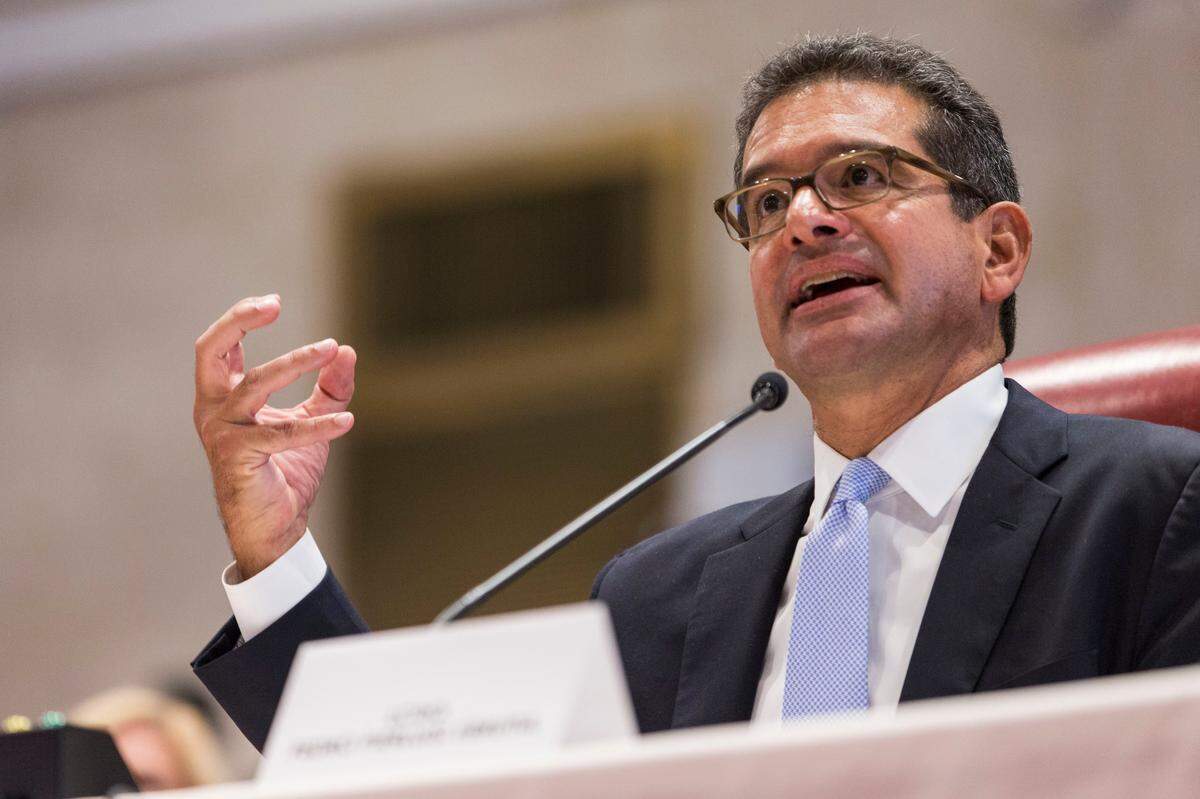
Pierluisi, 60, had hoped to avoid a prolonged legal battle by offering to step down if the Senate voted against him. And there were expectations that the chamber might do so on Monday.
Instead, Rivera Schatz ended the meeting Monday without a vote and claimed that Pierluisi only had five solid supporters — not the 15 he needs to be ratified.
After the legislative session, Pierluisi said that most of the senators “did not have the opportunity to express themselves in regard to the office that I hold.”
And he said he would “await, with the utmost deference, for the decision of the Supreme Court, confident that it will be the best for Puerto Rico.”
The political infighting has led many to believe that Rivera Schatz wants the governorship for himself. On Monday, the senator pushed back against critics, saying he wanted to win the office “through votes” and not political maneuvering. The next elections are November 2020.
The political crisis comes as the U.S. territory of 3.2 million people is trapped in a deep financial and debt crisis and struggling to recover after the devastating 2017 hurricane season.
On Thursday, The Washington Post reported that the Trump administration, citing corruption allegations, will place new restrictions on about $8.3 billion dollars in federal aid to the island that are part of a Housing and Urban Development disaster mitigation program.
Jenniffer González, the island’s non-voting member of the U.S. House of Representatives, or resident commissioner, was in San Juan to attend a caucus of the PNP party. Asked if the island’s turmoil was hurting her efforts in Washington, she said, “of course it is.”
And she suggested that some of the damage is self-inflicted.
“The sad thing is that after the political crisis, we have this legal crisis,” she said.
Pierluisi has said he won’t make any important decisions until his leadership has been confirmed, but he’s also asking authorities to move quickly.
“We don’t have time to lose,” he said Sunday. “The hard work of rebuilding our island after the onslaught of Hurricane Maria, improving the fiscal situation of our government, making our economy continue to grow, and restoring the credibility of Puerto Rico cannot stop.”
This story was originally published August 5, 2019 at 6:50 PM.