
Insulza on Venezuela: ‘Everybody should be able to run’ for office
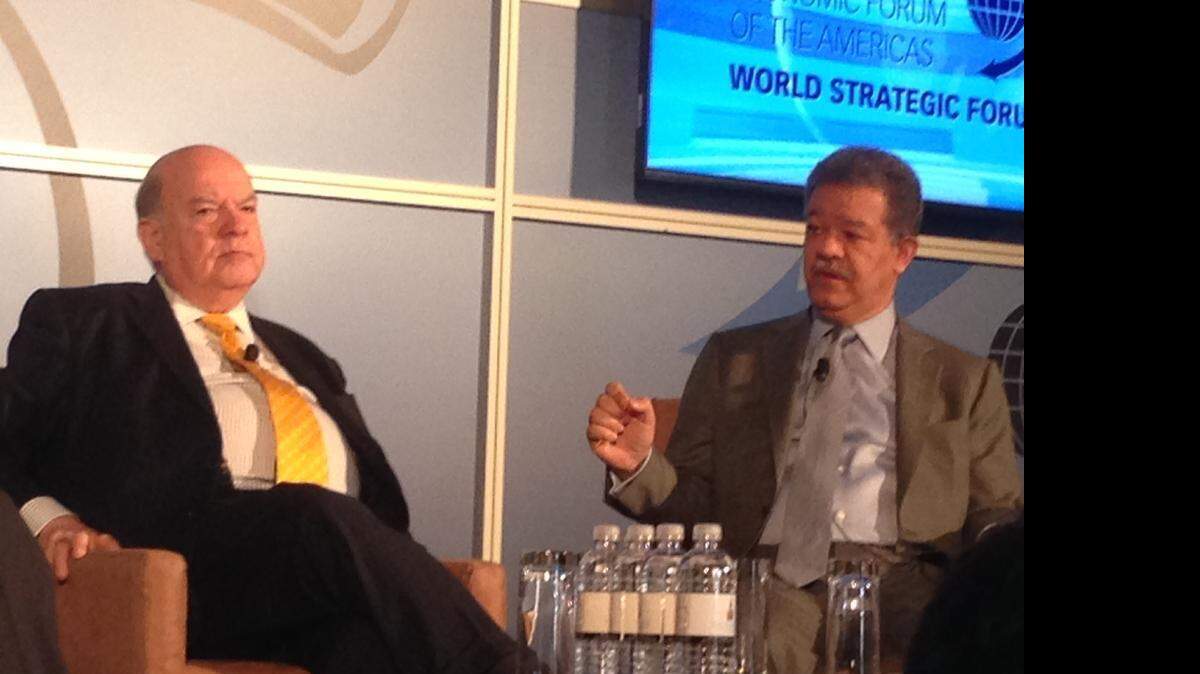
José Miguel Insulza was elected 10 years ago as Secretary General of the Organization of American States. His second term ends May 26, when he will be succeeded by former Uruguayan Foreign Minister Luis Almagro. He spoke to the Miami Herald about the Summit of the Americas, Cuba, President Barack Obama, Venezuela, his next move and other issues after appearing at the Miami World Strategic Forum. Below are excerpts:
What were your impressions of the summit?
We all knew that Cuba was going to be the main issue and everybody was ready for that. The most important meeting held at the summit was the bilateral between President Obama and President Raúl Castro. From that point of view, it was successful. We expected them to be in the same room at the plenary but we did not expect a long meeting as the one they had. It was important.
During the plenary, there were some strong words against the United States from Raúl Castro and others. How significant were those exchanges?
I certainly didn’t like that. I understand that Raúl Castro had to make some strong statements. I think the advice of President Obama not to delve too much into history was unfortunately not followed by some other presidents and that was not the best way to deal with the occasion.
We’ve seen several summits where the atmosphere was very tense. In Panama, Obama was cracking jokes. What’s your take on the mood of the summit?
With very few exceptions, the mood was light and was good. Everybody was happy to be there. Everybody understood we were in a very historic moment. They felt good and positive about it. I spoke to several presidents when they were leaving and they were in a very good mood. Almost everybody was there; only the president of Chile, who had a weather problem in her country and three of the prime ministers from the Caribbean did not come. It was a record participation.
How would you assess President Obama’s performance in Panama?
I think it was very good. Frankly, I liked his speech very much. He started not disregarding or any kind of rejection of the historic events that other presidents had made but rather calling to focus on the future. Then he concentrated on the way he wanted to do things. He left the door open for a better understanding. But he was very clear in saying that good understanding does not mean that countries should avoid giving their opinions about what’s going on in other countries. It doesn’t mean intervention; it’s freedom of speech. He was very careful in what he said. He was very much with the leaders. Contrary to what he had said, he had a lot of bilaterals. Then he address the business community and a very large and vocal civil society meeting. He was very successful in both.
What happens next with the Cuba-OAS relationship. Will Cuba be joining the OAS?
The decision in 2009 was that the sanctions will be lifted and the return of Cuba to the organization was to take place with a dialogue with the Permanent Council, which has never been set. Actually, in the climate of the region, I don’t think that is a problem. My feeling, however, is that Cuba will not return yet to the OAS. It’s going to wait for some time. I think the issue of the U.S. continues to be very relevant for them. They want to have normal relations with the U.S. first. Second, it’s been so many years that probably they would prefer to go to other institutions of the inter-American system that are part of the OAS. After telling your people for 54 years that the OAS is the worst thing in the world, you just don’t come and sit down without explaining.
On Venezuela, what’s your sense of what will happen with the U.S.-Venezuela relationship?
I think that there’s a willingness for an opening. After all, the U.S. continues to be the largest customer of Venezuela. Nobody has even spoken about the possibility of changing that. What we need is a meaningful dialogue in Venezuela. For a real dialogue, what you need is stability of the government and the release of the people who have been put in prison for the last few years. If the dialogue leads to solving the problem of Venezuela, that would be very welcome.
Should the sanctions the U.S. imposed on several Venezuelan officials be lifted?
I think the problems with the sanctions was not the sanctions themselves. Everybody recognizes that it’s a country’s right not to give visas to some citizens. The real big problem was in how it was announced that Venezuela was a threat to the United States. I understand the explanation but it’s really hard to understand for several people of good will in the region. As a result, the government closed ranks.
Venezuela has elections coming in a few months. Will OAS monitors will be allowed?
The only [public] organizations that everyone really trusts as observers are the OAS and the European Union. We observed elections in Venezuela until 2006 or 2007. There was never any problems with that and we’re very much willing to do it. Unfortunately, our Democratic Charter says the electoral system of the country has to request the observers. I think Venezuela has a fairly good electoral system. But the election has to be called at a proper time, not abruptly and then everybody should be able to run. There is some tendency to accept only candidates that are acceptable and that definitely is not a good idea.
If the OAS is not allowed to monitor, will the results be called into question?
I think for the government, they should do it precisely for that. The government of Venezuela has nothing to win from not accepting our observer mission. If they win, we’re going to recognize that they won. And if they lose, they’re going to lose anyway. For the stability of Venezuela and for this election to be a path to a better understanding, it would be a good think to have an observer mission.
What do you see as your biggest accomplishment over the past decade?
We’ve helped the dialogue in Colombia, we’ve attempted to solve the problem between Belize and Guatelama, we got involved in matters between Colombia and Ecuador in 2007. The biggest issue has been to promote dialogue and inclusion over suspension, exclusion and confrontation. After looking at the summit, I can say that was a big success. It was a rocky decade, and we sailed through it ok.
You have received some criticism on Venezuela. How about things you wish you had done better?
I wish we had moved faster to lift the suspension of Honduras. It wasn’t my doing; I was very much in favor of that. The suspension was too prolong for that country and that’s something I wish we had done. We have increased enormously the activities of the Commission on Human Rights but we don’t have the resources to deal with that enough. My main concern with the commission is that we don’t have enough money to deal with al the cases so people go to the commission and wait four or five years for their case to be admitted. That’s something that has concerned me. I also wish we had continued the discussion on the inter-American Democratic Charter. Democracy is not only broken by coup d’états. There are other matters that should be considered. We have elected democracies and more governable countries but some countries still tend to see accountability as a barrier to enforcing the policy that they really want to enforce: freedom of the press, independent judiciaries. Good functioning institutions are seen more as obstacles than as part of the democratic system as it should be considered. The whole issue is not how to stabilize democratic elections but also the rule of law and other matters in the region.
What’s next for you?
I’m very much interested in going back to my country and continuing my work in Chilean politics. I left Chilean politics in a quite abrupt manner. I resigned my post as Minister of the Interior one day and was sworn in at the OAS less than 48 hours later. I’m very much eager to go back to my country. I have a lot to do there.
Would that include a presidential run?
I’m going back to Chile and will be as much active in politics as I can. Time will see.
This story was originally published April 17, 2015 at 8:00 AM with the headline "Insulza on Venezuela: ‘Everybody should be able to run’ for office."