
Gunman at gala scorned Trump, authorities say
WASHINGTON -- The gunman who tried to storm a gala featuring President Donald Trump had written angrily about the administration, authorities said Sunday as they examined his communications and cross-country movements in the days leading up to the attack.
The episode Saturday night, at the White House Correspondents’ Association dinner at the Washington Hilton, raised new fears about a scourge of political violence afflicting the United States, and about the safety of one of the most targeted presidents in history.
Shortly before the attack, the suspect, identified by law enforcement officials as Cole Tomas Allen, 31, of Torrance, California, sent messages to his relatives denouncing Trump administration policies and suggesting he intended to take violent action, according to a person familiar with the investigation. Other written material found in his hotel room contained similar statements, the person said.
Just past 8:30 p.m. Eastern on Saturday, the suspect, armed with knives, a shotgun and a handgun, barreled through security at a full sprint, heading toward the ballroom at the hotel. Many of the United States’ top government officials and prominent journalists were crammed into the ballroom in tuxedos and gowns for the annual correspondents’ dinner. Seated at the head table on a raised platform were Trump and the first lady, Melania Trump.
Gunshots rang out, audible inside the ballroom, but the armed man never made it inside: He was tackled before he could descend the staircase leading to the event.
A Secret Service officer was shot while trying to stop the attack, but was protected by a bulletproof vest. Investigators were still running ballistics tests, but Todd Blanche, the acting attorney general, suggested that authorities had reason to believe the bullet that hit the officer came from the suspect, not another officer. There were no other reported injuries, according to Markwayne Mullin, the homeland security secretary.
Allen faces federal firearm and assault charges, with more charges possible, said Jeanine Pirro, the U.S. attorney for the District of Columbia.
A graduate of the prestigious California Institute of Technology, or Caltech, Allen has worked as a mechanical engineer, a self-employed video game developer and a tutor.
People who knew him described his demeanor as mild-mannered. But a note that authorities said was written by him expressed rage at the Trump administration.
The writing was shared with The New York Times by two law enforcement officials who asked not to be named because they had not been authorized to disclose the information. In it, the writer alludes to allegations of sexual misconduct, saying that he is “no longer willing” to allow a “traitor to coat my hands with his crimes,” an apparent reference to Trump, though the president is not mentioned by name.
The writing suggested that administration officials were his targets, and that Secret Service agents were “targets only if necessary.” Hotel security, the Capitol Police and the National Guard were “not targets if at all possible.” And hotel employees and guests were “not targets at all.”
Anticipating criticism that the attack would not be in line with Christian teachings, the writing appears to refer to reports of abuse in immigrant detention camps, the recent lethal attacks on boats in the Caribbean Sea and eastern Pacific Ocean, and the bombing of an elementary school in Iran.
“Turning the other cheek when *someone else* is oppressed is not Christian behavior,” the writing reads.
Trump appeared to refer to the writing in an interview with Fox News on Sunday morning when he noted that the suspect had “a manifesto” and that he “hates Christians.”
“He was a very troubled guy,” Trump said.
Allen had taken a train from Los Angeles to Chicago, and then from Chicago to Washington, where he checked into the Washington Hilton a day or two before the dinner.
The hotel is the same one outside which President Ronald Reagan survived an assassination attempt in 1981. The correspondents’ dinner has been held there for more than 50 years, with presidents usually attending.
There were no metal detectors set up at the hotel’s entrances, and a secure perimeter was only established closer to the ballroom. Blanche defended the security setup, noting that the suspect did not make it to the ballroom.
“The system worked,” said Blanche, who had also been inside. “We were safe. President Trump was safe.”
Even so, Trump used the episode to try to justify his $400 million ballroom at the White House on the site of the demolished East Wing. “This event would never have happened with the Militarily Top Secret Ballroom currently under construction at the White House,” Trump wrote in a post on social media Sunday morning. “It cannot be built fast enough!”
But even without the ballroom, he attends events outside the White House, including rallies and UFC fights.
Fear and pandemonium
The gala Saturday was expected to be an intense spectacle, even before the chaos broke out.
It was Trump’s first time attending the black-tie dinner as president, and most of his Cabinet and top aides were in attendance. He would be showing up to make remarks after a year spent sparring with reporters who cover him, suing their employers for billions of dollars and insulting them, often in viciously personal terms.
In the past, he has skipped the event and mocked the performances, which are often filled with satirical jokes at the expense of whichever president is in office.
This year, the main entertainer was not a comedian, but mentalist Oz Pearlman. As the armed attacker was running past security a floor above, Pearlman was on the dais, leaning over Trump and the first lady, smiling and holding a card, apparently demonstrating one of his tricks.
Inside the room, it was difficult to tell what exactly was happening when the loud bangs first rang out, but panic quickly rolled like a wave right up to the dais. The look on Pearlman’s face changed to one of alarm. The first lady ducked under the table. The president stayed seated as Secret Service agents, dressed in tuxedos, surrounded him and began drawing their weapons.
Guests dove to the floor. Secret Service agents climbed over tables to protect some of the country’s most high-ranking officials, smashing the plates of spring peas and burrata that were served only minutes before.
As agents hustled the president and his wife off the dais, Trump appeared to trip or get pushed down. The agents pulled Vice President JD Vance from his seat by his shoulders. When agents grabbed Tulsi Gabbard, the director of national intelligence, they briefly got stuck between two tight tables and had to redirect toward a different exit.
Outside the ballroom, gun-toting agents ran through the cavernous hallways, pointing their firearms at panicked party guests and screaming at reporters to get low. Caterers in white jackets cried out in terror as they bolted for cover in a stairwell.
“Shots fired! Shots fired!” agents said as they pinioned the small group of reporters and photographers traveling with the president into a corner against a wall.
CNN journalist Wolf Blitzer was outside the ballroom and just steps away from the attacker when he rushed past security.
“I just saw a big gun,” Blitzer said. “And I heard a loud -- loud bangs that were going off. It was extremely frightening.”
Shortly after Trump was whisked offstage, he told aides he wanted the dinner to resume and proceed as scheduled. He was “determined” to deliver his speech, one senior administration official said.
As Trump pushed officials to restart the dinner, hotel staff members moved to prepare the head table. But security officials ultimately decided Trump had to leave. He announced on Truth Social that the dinner would be postponed.
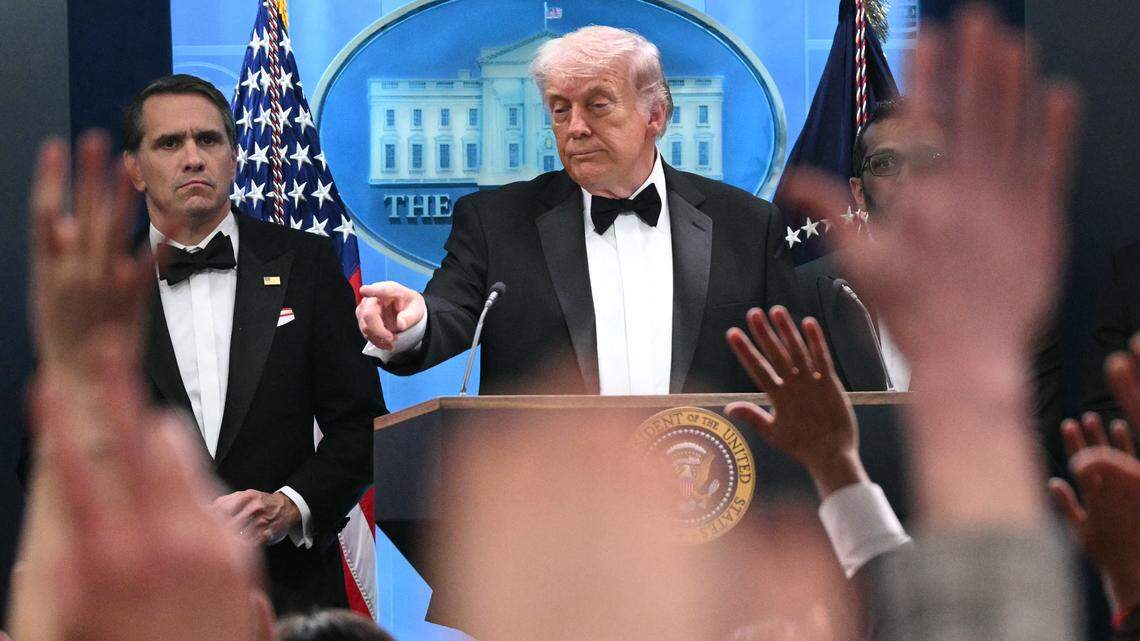
He was reflective at a news conference late Saturday back at the White House, sounding more subdued than usual. “It’s always shocking when something like this happens,” he said.
A frequent target
There is a long history of presidents making a point of being visible after a threatening situation. In Trump’s case, being a survivor of multiple attempts on his life has become intertwined with his political persona, especially during his comeback in 2024.
On July 13 of that year, Trump became the first U.S. president to face an assassination attempt since the shooting of Reagan in 1981, when a bullet nicked his ear while he was giving a speech in Butler, Pennsylvania. Surrounded by Secret Service agents, he raised his fist in the air and shouted “Fight! Fight! Fight!,” an indelible image that became a familiar visual of his successful reelection campaign.
The 20-year-old gunman in Butler was able to fire several shots, killing a spectator, before the Secret Service returned fire and killed him. But the fact that he came so close to killing Trump prompted immediate demands for changes at the Secret Service. The agency’s competence was called into question and its director resigned.
Then, on Sept. 15, 2024, a man armed with a rifle hid in the shrubbery at the Trump International Golf Club in West Palm Beach, Florida, plotting to shoot Trump. The gunman, Ryan Routh, was convicted of attempted assassination and sentenced to life in prison.
Asked on Saturday why he believed he was so often the target of violence, Trump said it was because of the consequential nature of his presidency.
“The people that do the most, the people that make the biggest impact -- they’re the ones that they go after,” Trump said.
Other public officials have been targets, too. A mass shooting in 2017 of Republicans at a congressional baseball practice nearly killed Rep. Steve Scalise of Louisiana. Last year, conservative activist Charlie Kirk was assassinated at a college speaking event in Utah.
The violence has not been confined to one party. A Democratic state lawmaker in Minnesota, Melissa Hortman, and her husband were shot to death last year. Gov. Josh Shapiro of Pennsylvania survived an arson attack at his home, and the husband of former House Speaker Nancy Pelosi was severely injured by a hammer attack at his home in San Francisco in 2022.
Trump on Saturday seemed eager in the moment to reduce the charged atmosphere.
“In light of this evening’s events,” he said, “I ask that all Americans recommit with their hearts to resolving our differences peacefully.”
This article originally appeared in The New York Times.
Copyright 2026 The New York Times Company