
East Coast residents may face more-destructive hurricanes, study finds. What to know
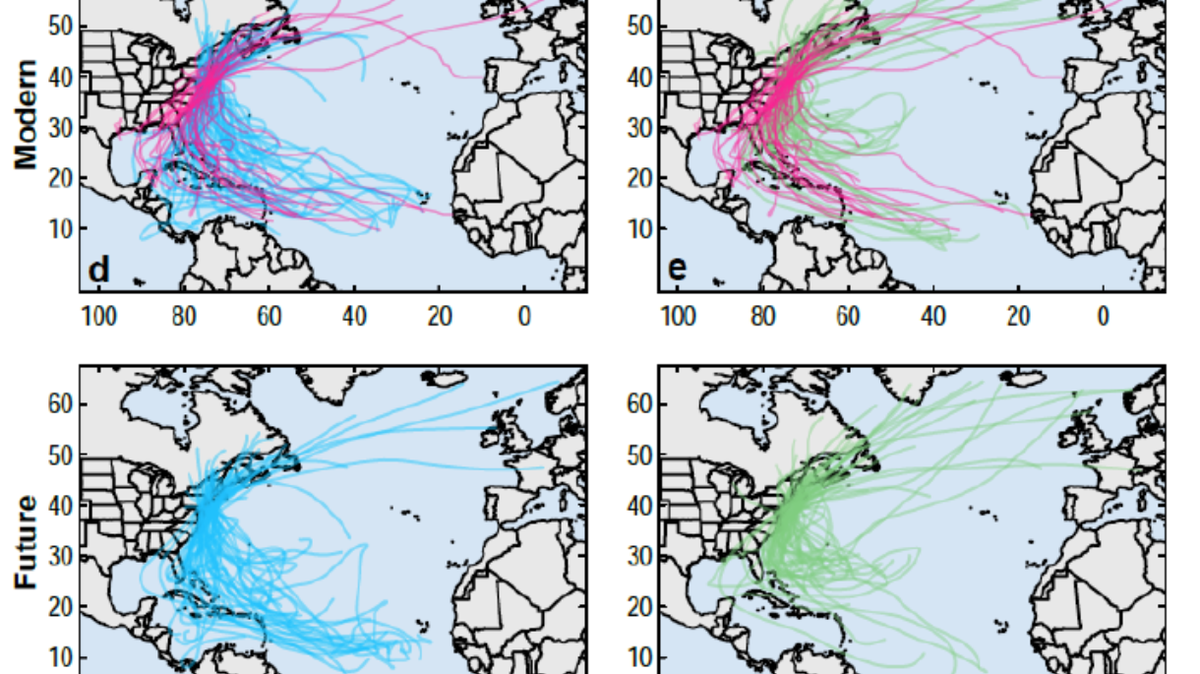
Residents along the East Coast may face more destructive hurricanes that could linger over coastal cities longer, a new study has found.
This comes after 19 hurricanes have hit U.S. coastlines between 2010 and 2020, qualifying as “billion-dollar disasters,” climate scientist Andra Garner at Rowan University in New Jersey, pointed out in her study published on Nov. 22 in Earth’s Future.
These hurricanes resulted in over 3,500 lives and roughly $480 billion in economic losses.
But by the late 21st century, hurricanes will likely worsen in the East Coast by arriving quicker, leading to less warning time, and slowing down while over land, causing them to stay longer, according to the study believed to be the first of its kind by Garner, who analyzed over 35,000 computer simulated storms.
Garner said the work “suggests the need for adaptation measures to protect our coastlines, given that our research indicates that we’re already seeing storms forming closer to the U.S., and moving more slowly along the East coast than in the past,” in an emailed statement to McClatchy News.
The longer a hurricane lasts makes the potential for damages higher, according to a news release for the study.
“Think of Hurricane Harvey in 2017 sitting over Texas, and Hurricane Dorian in 2019 over the Bahamas,” Garner said in a statement. “That prolonged exposure can worsen the impacts.”
Typically, when a hurricane moves along the East Coast, “there are larger scale wind patterns that generally help push them back out to sea,” she explained. “We see those winds slowing down over time,” meaning they can last longer.
“The longest-lived tropical storms are predicted to be twice as long as storms today,” the release noted.
When it comes to understanding the potential, future dangers Atlantic coastal communities are up against with hurricanes, over 35,000 computer simulated tropical storms were created under three differing climate scenarios in the study.
The scenarios studied included the pre-industrial era of 850 to 1800, when the climate wasn’t influenced by environmental pollutants from humans; the modern era of 1970 to 2005 with recent climate conditions; and the future era of 2080 to 2100 with a climate “under additional warming due to anthropogenic greenhouse gas emissions.”
“Future economic and human costs of tropical cyclones (TCs; i.e., hurricanes) will depend upon changing storm tracks,” the study notes.
Under a very-high emissions climate scenario, from the preindustrial to the late 21st century, it was found that hurricanes are 15% more likely to begin forming closer to the southeast coast and 6% more likely to terminate in the northeastern Atlantic, based on the simulated storms.
Additionally, hurricanes are 15% more likely to move the slowest along the U.S. Atlantic coast, leading to worse impacts.
The coastal cities of Boston, Massachusetts, Norfolk, Virginia and New York City were analyzed, which showed that over time, hurricanes will tend to travel closer to Boston and Norfolk than NYC.
In the future, hurricanes are more likely to travel within around 62 miles of Boston and Norfolk than within 62 miles of NYC.
Because of this, there is an increase in danger posed by hurricanes, particularly for Norfolk since the U.S. Navy base, Naval Station Norfolk, is there and the threat “could translate to national security risks for the U.S.”
Based on the study’s storm models, it was found that Boston, Norfolk and NYC experienced a shorter time between when hurricanes form and when they approach the cities, leading to less preparedness for the storms.
“These results emphasize the necessity and urgency of adaptation and mitigation measures to help protect coastal communities both now and in the future,” the study emphasized.
Garner said the study raised the concern that more damaging storms like Hurricane Sandy, which wreaked havoc in 2012 in the Mid-Atlantic region, are likely to occur.
“The work produced yet more evidence of a dire need to cut emissions of greenhouse gases now to stop the climate warming,” she also said.
However, Garner and her colleagues acknowledged that more research is needed to entirely understand how a warming climate relates to changing storm tracks.
The study’s co-author Benjamin Horton, who leads the Earth Observatory of Singapore, said the work “suggests that climate change will play a long-term role in increasing the strength of storms along the east coast of the United States and elsewhere.”
Garner told McClatchy News that “since we know that we as humans are the cause of the warming we’re seeing, we know we can also be the solution, which should give us a lot of hope moving forward.”
This story was originally published November 23, 2021 at 1:36 PM.
.jpg)