Carbon dioxide ‘cold traps’ confirmed on moon — and they may affect lunar exploration
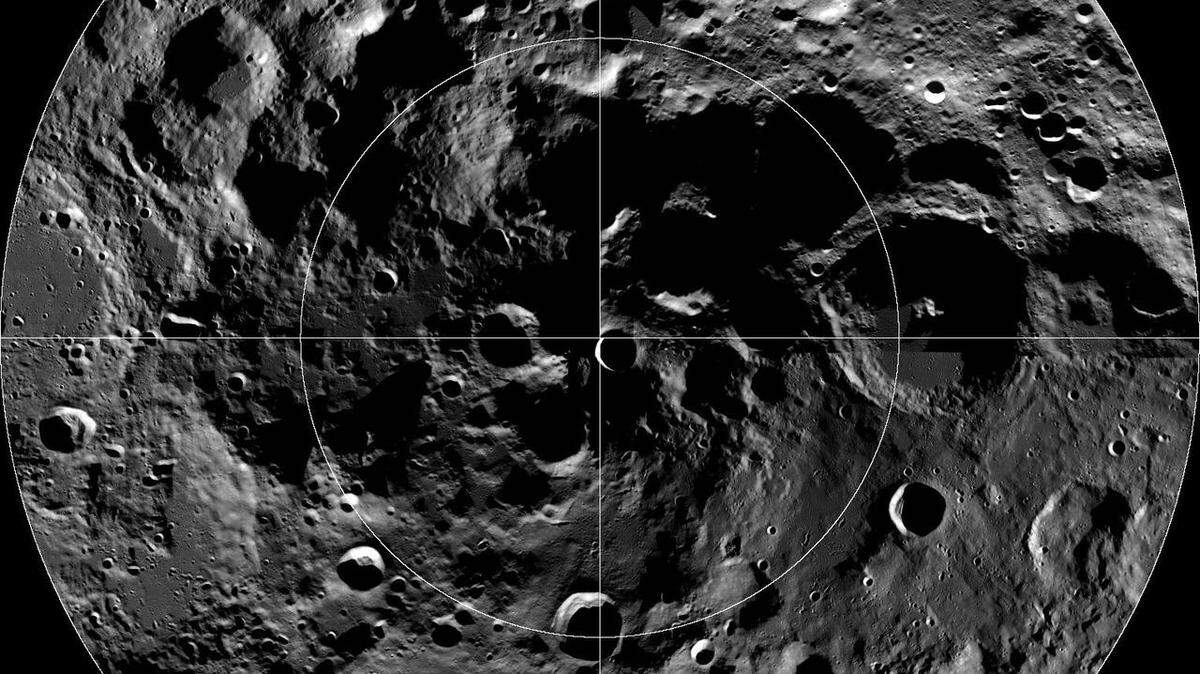
Is the moon harboring material that could make sustained lunar exploration a more realistic prospect than ever before?
That’s a question posed by researchers after an analysis of 11 years of data revealed certain regions of the moon’s south pole are cold enough to have ice slathered in carbon dioxide (CO2) in what scientists call “cold traps.”
Cold traps are areas on the lunar poles blanketed in a shadow of permanent darkness thanks to the moon’s tilt.
Experts have known cold traps are ideal environments for ice, but until now, researchers couldn’t reliably measure the extreme temperatures there — often dipping below those on frigid Pluto — that could sustain the presence of CO2.
Although the findings put a decades-old mystery to rest, the discovery does not confirm CO2, in solid form, actually exists on the moon.
Because comets that contain a variety of materials, including CO2, occasionally crash into the moon, scientists know the gas is present — but how much and in what form remains unclear, study lead author Norbert Schörghofer, a planetary scientist at the Planetary Science Institute in Arizona, told McClatchy News.
If upcoming missions to the moon prove CO2 cold traps in fact house the gas in solid, icy form, future lunar exploration is in for a major upgrade.
Researchers say solid CO2 in cold traps could aid the development of rocket fuel, steel or other materials that have the potential to prolong trips to the moon and impact the likelihood of a sustained robot or human presence there.
“The next step should definitely be to send a mission to one of these areas to measure the concentration of CO2. This is technologically challenging, because temperatures are continually at [minus 350-400 degrees Fahrenheit], on top of the permanent darkness,” Schörghofer told McClatchy News.
“Such a visit could be the start of the lunar carbon industry,” he added. “Searching for concentrated carbon on the Moon is the closest equivalent to prospecting for oil on Earth, without the negative environmental impact.”
Beyond the potential for CO2 ice as a resource, researchers also want to better understand these cold traps to learn more about the origins of water and other compounds in the solar system.
“I like to refer to the cold traps of the moon’s poles as the garbage collectors of the solar system, where they’re picking up anything that happens to flow by in space,” Paul Hayne, a planetary scientist at the University of Colorado, Boulder who was not involved in the study, told McClatchy News. “These are really pristine locations where we could find evidence for the types and amounts of comets that are hitting both Earth and the moon over this last billion years of history.”
“There’s nothing like that on Earth that would record that kind of delivery because all of those molecules would be consumed by the Earth’s atmosphere and vaporized,” added Hayne, whose own study published in 2020 found that tiny cold traps no bigger than a penny are much more common than previously thought, spanning an area of about 15,000 square miles.
The new research, published Oct. 7 in the journal Geophysical Research Letters, found the CO2 cold traps spread over about 79 square miles where temperatures remain below minus 352 degrees Fahrenheit.
The team discovered these extremely cold lunar regions after analyzing 11 years of temperature data from the Diviner Lunar Radiometer Experiment, an instrument that measures surface temperatures on the moon while flying aboard NASA’s Lunar Reconnaissance Orbiter.
Hayne said he agrees the new study’s evidence shows CO2 cold traps exist on the moon, but he wonders what else the frigid lunar temperatures could sustain.
“If CO2 is stable. What else is stable there?” Hayne said. “There might be carbon-containing compounds or methane ices and other very interesting volatile materials that are delivered by comets or even volcanoes on the moon in its ancient history that would be both useful from a scientific standpoint and for exploration.
“This is just the tip of the iceberg,” he added.
This story was originally published November 17, 2021 at 11:04 AM.