
This small plane is first in the world to fly with no moving parts, study says. How?
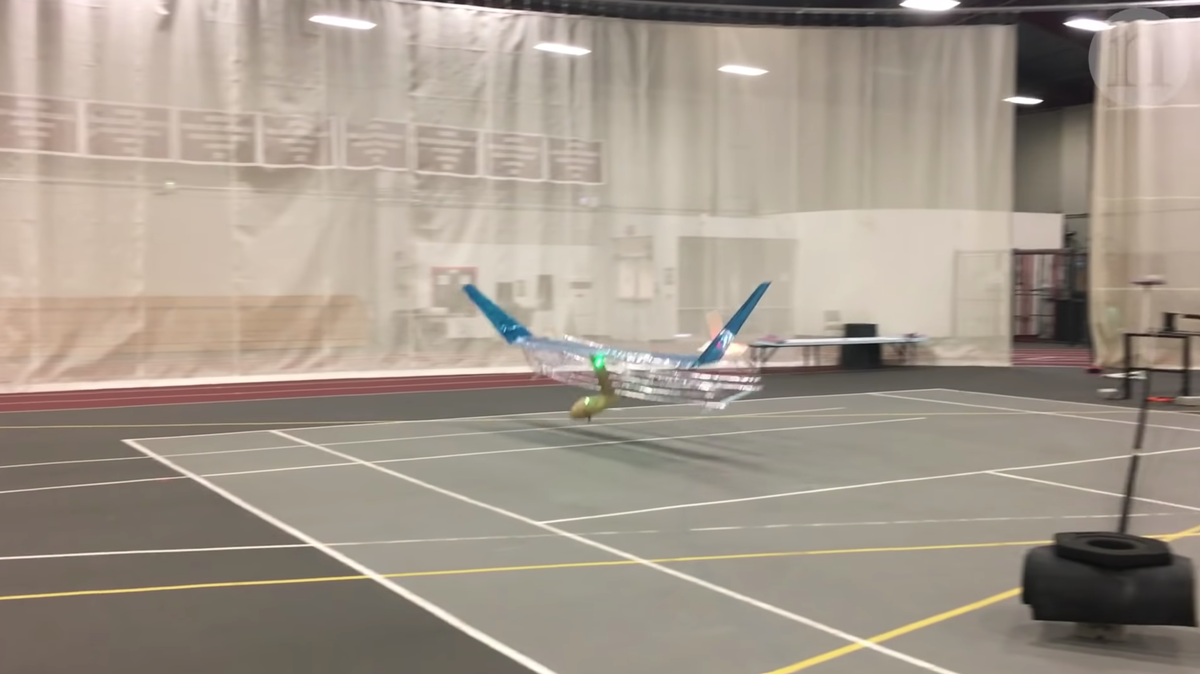
Steven Barrett, an aerospace engineer at the Massachusetts Institute of Technology, says he got the idea for his latest research study in part from a popular TV show.
“In Star Trek you have shuttlecraft gliding silently past,” he said, according to Scientific American. “I thought, ‘We should have aircraft like that.’”
Now, Barrett is one of the authors of a new study published in the journal Nature, which details the first-ever flight of a small aircraft without the use of moving parts.
Instead, the aircraft flies silently — and without using fossil fuels — by using “ionic wind,” the study says.
Barrett said in a press release from MIT that he first started thinking about how to fly a small aircraft without moving parts nine years ago.
“It was a sleepless night in a hotel when I was jet-lagged, and I was thinking about this and started searching for ways it could be done,” he recalled in the press release. “I did some back-of-the-envelope calculations and found that, yes, it might become a viable propulsion system.
“And it turned out it needed many years of work to get from that to a first test flight.”
So how did the aircraft — with a wingspan of 16 feet — fly and make history?
Wires around the wing of the aircraft are charged with lithium-polymer batteries, the study says. Wires near the front of the wing are positively charged, while others in the back are negatively charged, and ions are sent barreling back to those negatively-charged wires in a sort of magnetic pull.
Barrett described it as “millions of collisions between (nitrogen atom) ions and neutral air molecules,” according to the Scientific American, which likened the process as “creating a wind that pushes the plane forward fast and hard enough to fly.”
While testing the aircraft, Barrett says there “were some pretty epic crashes,” according to Science Magazine. But after hundreds of test runs — and the use of a “slingshotlike apparatus” to get it off the ground — the small aircraft managed to travel nearly 200 feet.
It flew with the use of “ionic wind” for 10 test flights, the study notes.
But don’t expect this method to be used in larger planes anytime in the immediate future, Barrett cautions.
This story was originally published November 21, 2018 at 3:55 PM.