
What is the ‘secret sisters’ Facebook scam, and how can you spot it?
The holidays are rolling around again, and that means scammers are back in force trying to take advantage of people looking for gifts.
But there’s one scam officials say has come back year after year, and they’re warning people not to fall for it. It’s called “Secret Sisters.”
The scam usually takes the form of a letter on social media, which users are told to copy and paste to their own statuses or send to others. The text varies somewhat depending on the post, but there is a general format that looks similar to this one, which popped up in 2017.
“The Secret Sister Gift Exchange is back! I am looking for 6 (or more!!!) ladies who would be interested in a holiday gift exchange. Doesn’t matter where you live, you are welcome to join. You only have to buy 1 gift at $10 or more and send to your secret sister. (Hello, Amazon!)You will then receive anywhere from 6 to 36 gifts in return ... Let me know if you are interested and I will send you info on your sister.”
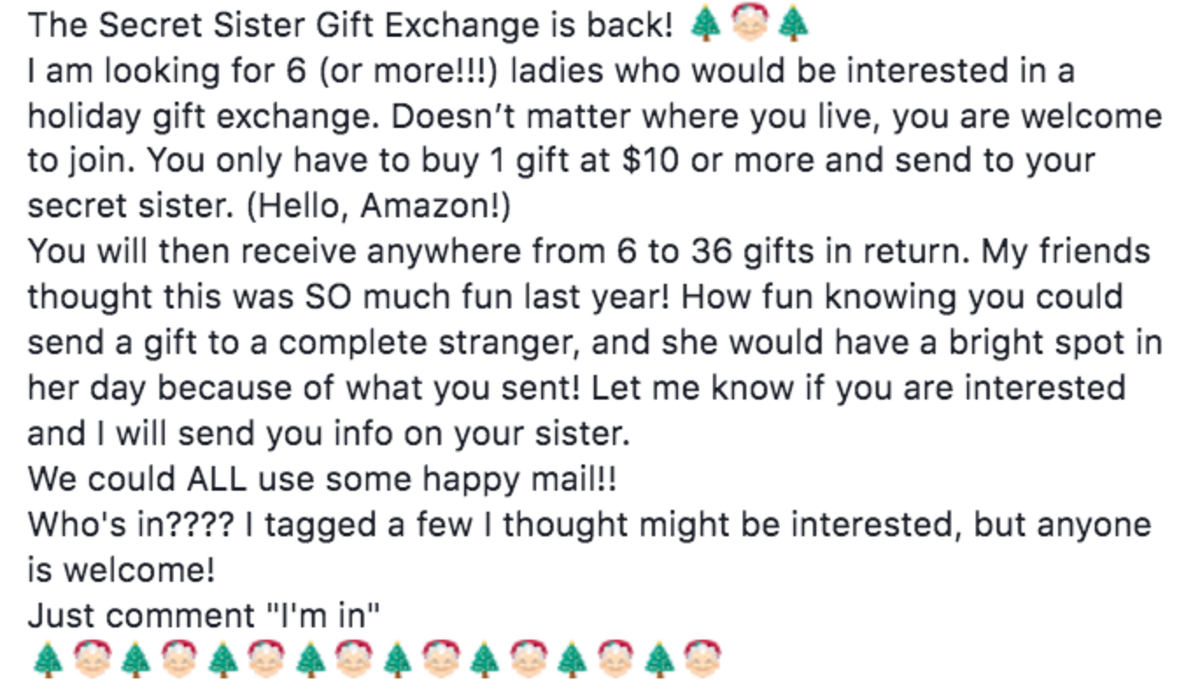
Officials, including the Wauwatosa Police Department in Wisconsin, have posted warnings about the scam, which the Better Business Bureau says is a crooked scheme.
“This is a typical pyramid scheme. This is on Facebook instead of the old way of using letters because social media allows it to spread a lot faster,” the Better Business Bureau said, according to KCRA. “Pyramid schemes are illegal either by mail or on social media if money or other items of value are requested with assurance of a sizable return for those who participate.”
The online version of the scheme dates back to at least late 2015, according to Snopes, and it almost always describes sending one gift to someone and then receiving up to 36 in return, according to the site.
The problem is, it only works if every single person contacted follows through on the post exactly, and so does everyone else after that, and after that, and so on.
It’s also illegal, according to the Postal Inspection Service.
“Chain letters don’t work because the promise that all participants in a chain letter will be winners is mathematically impossible. Also, many people participate, but do not send money to the person at the top of the list,” the service wrote.
It said such schemes were illegal regardless of whether they were done using pen and paper or over the internet.
This story was originally published November 13, 2018 at 3:20 PM.