He dedicated his life ‘to a hobby that got out of control.’ And the pelicans thrived
After his youngest son moved out, Harry Kelton and his wife, Darlene, bought a houseboat in Biscayne Bay at Pelican Harbor Marina.
It didn’t remain an empty nest for long.
One day in 1980, the couple saw an injured pelican near their floating home. They took the bird in, removed a fish hook from its mouth and nursed it back to health.
They then rescued another pelican. And another. And another — until they founded Pelican Harbor Seabird Station and treated injured birds daily.
The couple’s nonprofit initially focused on brown pelicans, but now it assists all types of native wildlife, including songbirds and tortoises. The station, 1279 79th Street Causeway in Miami, has cared for more than 39,000 patients since it opened in 1980.
Kelton, who dedicated his life to his “hobby that got out of control,” caring for South Florida’s pelicans, died on Aug. 23 at 96. His life will be celebrated by the Seabird Station he founded later this year.
Navy man and engineer
The bird aficionado was born May 3, 1926, in Raleigh, North Carolina. He served in the Navy from 1943 to 1947 and graduated from Purdue University in 1948. In 1970, he moved to North Bay Village, the island town between Miami and Miami Beach. He worked as a mechanical engineer for various companies until retiring in 1996.
Alongside Darlene, his wife of 48 years, Kelton helped revolutionize the rehabilitation of brown pelicans. They released more than 7,000 pelicans, which helped bolster the population while on the endangered species list.
The couple also developed “the cotton fish,” a medical procedure where they would stuff a fish with cotton balls and feed it to a pelican with a hook in its stomach. When the pelican ate the fish, the cotton would cover the hook and the pelican would eject it.
Kelton, a respected wildlife advocate, served on the board of the International Wildlife Rehabilitation Council for about a decade.
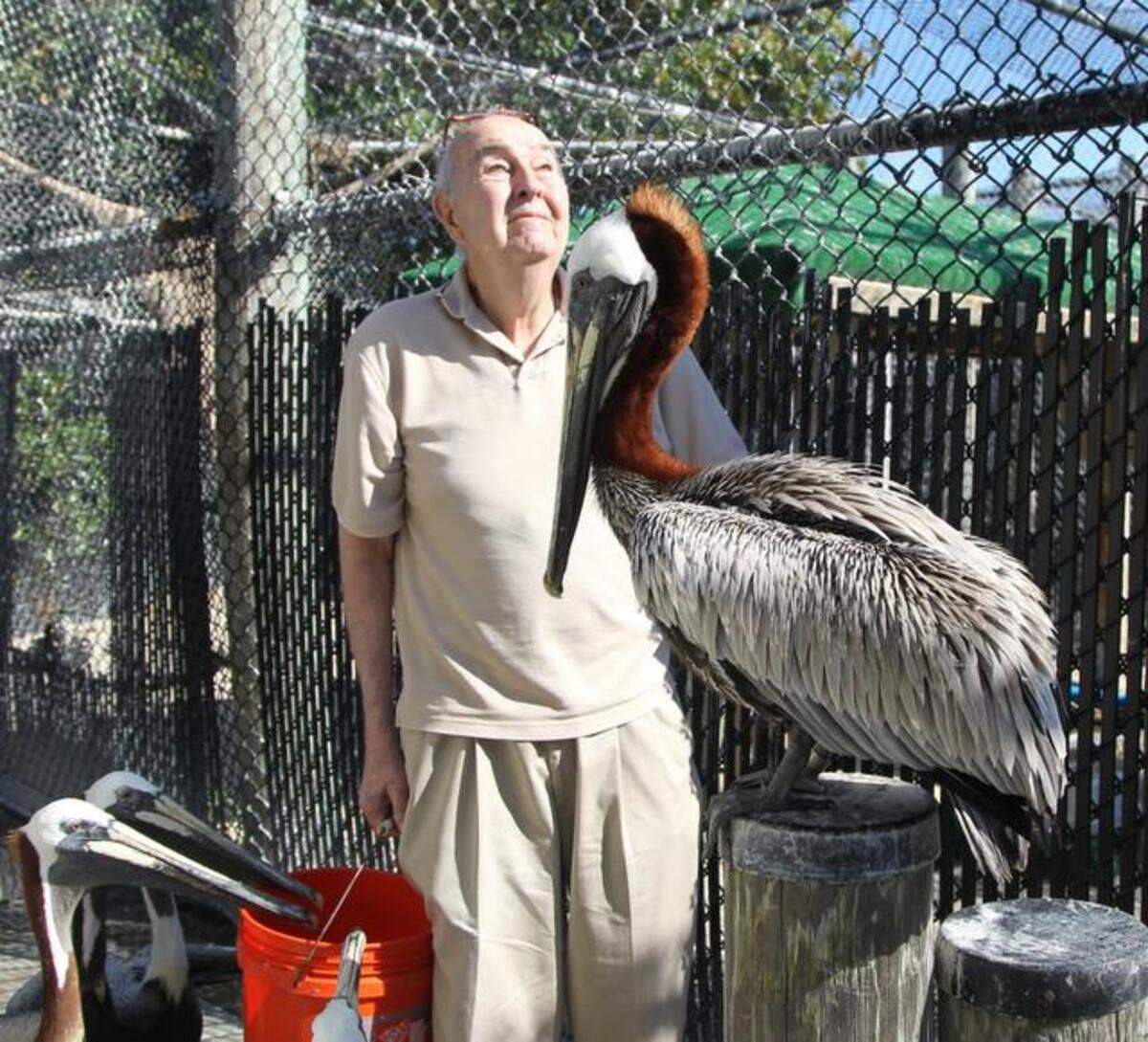
In the Seabird Station’s main office hangs a photo of the Keltons. It reminds everyone at the nonprofit — whether or not they met them — about their legacy and impact, Director of Communications Hannah McDougall said.
“We really just started as a tiny seed that Harry and Darlene planted,” McDougall said. “And so I don’t think a day goes by that their impact and their memory is lost on anyone.”
The Keltons are the reason the Seabird Station is considered a renowned expert in rehabilitating brown pelicans nationwide, Executive Director Christopher Boykin said.
“He changed Miami forever just by treating the first pelican,” he said. “And then continuing to care for pelicans.”
An influence at pelican station
Even into his 90s, Kelton remained dedicated to the Seabird Station, Boykin said. He served as secretary in 2017 and on the board of directors, while based in North Carolina, until 2019. Kelton was also supportive when the nonprofit voted to expand its mission to treating all native wildlife.
One day at Pelican Harbor, Kelton asked Boykin to tag along on a boat ride. He climbed down the boat ladder, insisted on driving and did so expertly, leaving Boykin in awe of his seamanship and navigation skills.
“Here he is in his late 80s, 90s still leading the charge, still serving in a leadership role on the board of directors, very, very active in Pelican Harbor, climbing ladders, doing manual labor,” he said. “I was just really impressed with how physical he was and how sharp he was.”
And while friendly and warm, Kelton was also an opinionated man, Boykin said.
He met weekly with some Seabird Station staff at the Miami Shores Burger King. Kelton would take the time to enjoy his favorite cheeseburger and outline his concerns — the station’s future and his legacy.
And when he was ready to step down, Kelton had a special request for Boykin: “Take care of the pelicans.”
Every Saturday morning, Kelton and Darlene would make coffee and bring boxes of doughnuts from Dunkin’, said Jude Mishcon, a long-term volunteer at the station. The crew would chat and shoot the breeze before a day of work.
Mishcon volunteered at the nonprofit in 1997 and stayed for close to a decade. She returned to volunteering about four years ago.
“Once I was there, that was it,” she said. “I was part of the family.”
On boating trips around Pelican Island, Kelton taught Mishcon how to reel in a sick pelican for treatment.
“He was fierce about being an advocate and protector for the birds,” she said.
Kelton loved pelicans, but he also loved all types of wildlife and the outdoors, son Bob Kelton said.
He remembers hearing his father’s stories about his days hunting and fishing — and even occasionally skinny dipping — in the then-clear Miami River. He even sold hunted snakes to Native Americans, who would skin them, make wallets and sell them to tourists.
Outdoor connection
Harry Kelton, whose family moved to South Florida in the middle of the Great Depression, told his son that he kept a pet black racer, a large non-venomous snake. A mischievous child, he would pull it out of the culvert where it lived and flaunt it while chasing girls down the street.
His connection with the outdoors carried over into adulthood. Before heading to his job as a mechanical engineer, he would stop by a freshwater lock in Little River. He would sometimes encounter manatees — and reel in fish — in his early-morning pastime.
In fact, most of the memories Bob cherishes are of his father outdoors. The pair were once on a 13-foot boat when Kelton saw a pelican perched on a tree. He jumped into the water to try to get the pelican down, and minutes later, Bob spotted some sharks.
When son told dad, he didn’t flinch. He instructed Bob to hit them with a paddle if they got too close.
Another time, Bob and his daughter, then 3, were at the Seabird Station when a pelican swooped in and grabbed her by the foot. It gobbled down one of her shoes.
But grandpa was there to save the day. He grabbed the pelican, pried open its mouth and shoved his arm down, almost to his shoulder.
“Here comes my wife screaming ‘Why is my daughter being attacked?’ because she’s crying, and he washed the shoe and just calmly put it back on,” Bob said.
When Bob asked his father why he dedicated his life to the pelicans, he replied that he wanted to leave the world a better place. And when it came time to retire, he didn’t hesitate.
“He wanted to step away from it ... because he told me, if you run it up until the day you die, then it dies with you,” Bob said.
The Seabird Station didn’t end with Kelton. Instead, it’s moving to a new location and expanding to serve more patients.
Survivors and celebration
Kelton is survived by two sons, Robert “Bob” Kelton of Hollywood, Florida, and John Kelton of Zebulon, North Carolina. He was preceded in death by his wife, Darlene, his stepson David Buckwalter and his stepdaughter Kaye Taylor. He is survived by seven grandchildren and four great-grandchildren.
The Seabird Station will host a celebration of life for its founder on Nov. 3 from 4:30 p.m. to 7 p.m.
This story was originally published September 15, 2022 at 11:29 AM.