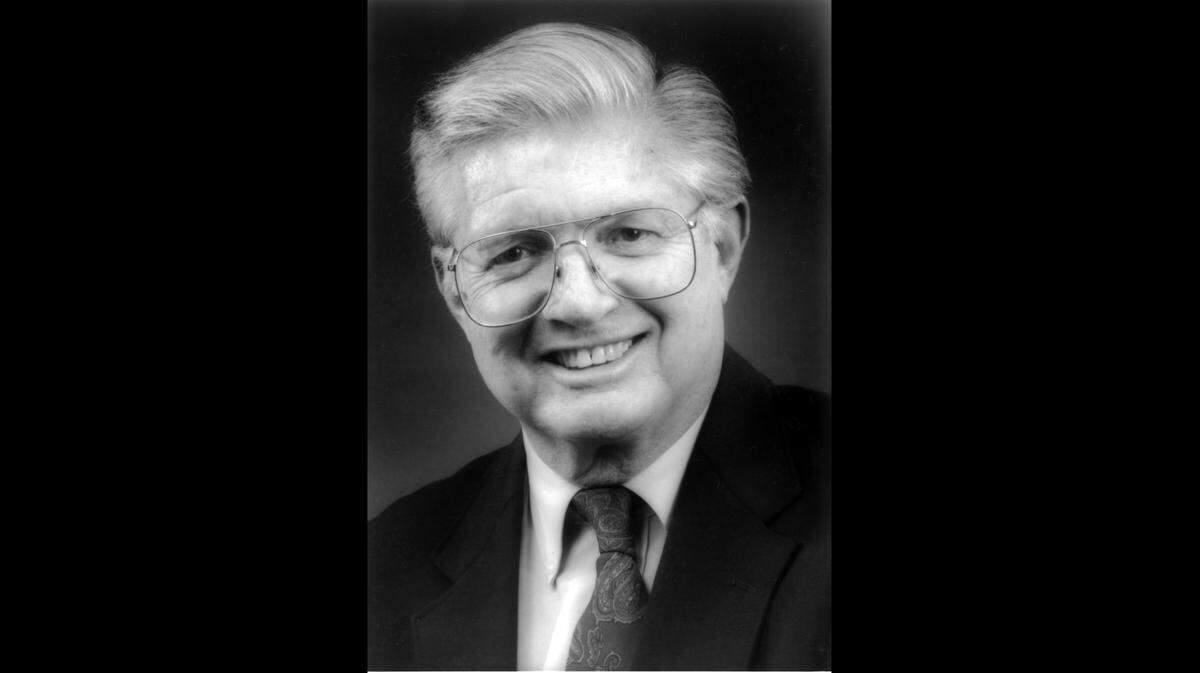
Sen. Dick Renick, brother of pioneering TV anchor, dies at 91. Helped preserve old Capitol
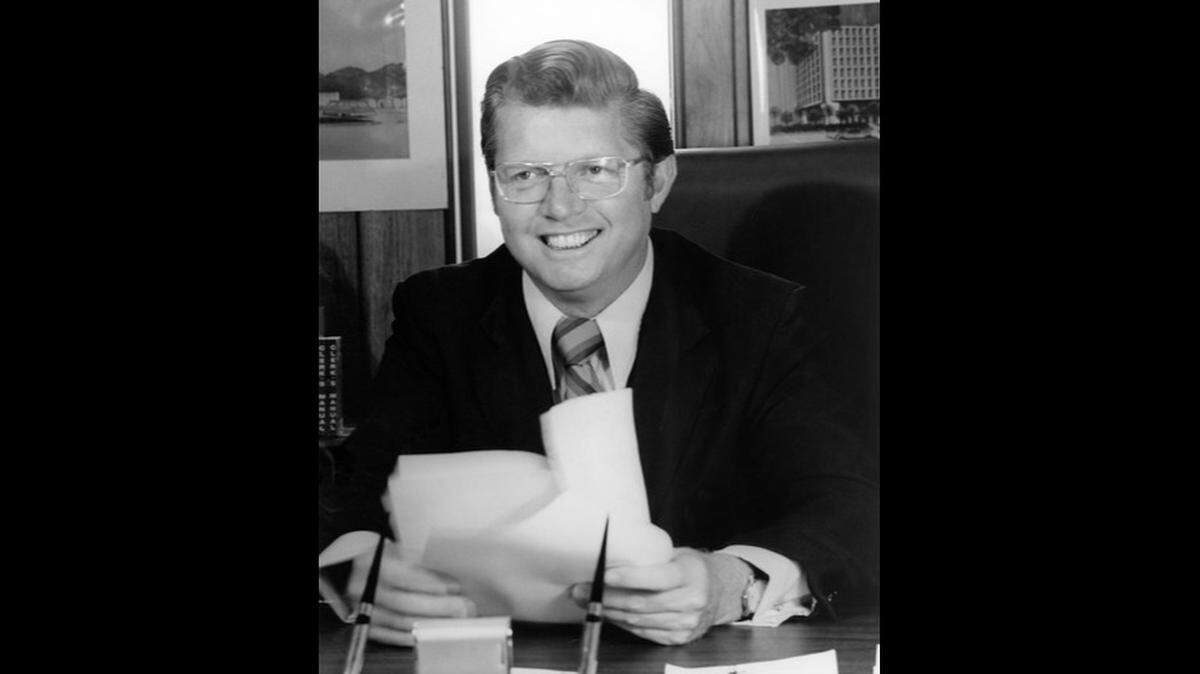
An early morning call from Tallahassee to London by a determined Florida senator from a prominent South Florida family may well have helped save the state’s old Capitol building from demolition.
Sen. Richard “Dick” Renick, who died on Jan. 31 at 91, faced a challenge in Florida’s Senate in 1977. He had to convince fellow senators and the governor to save the deteriorating building that had had been around since 1845.
Renick was from a pioneering Miami family that included older brother Ralph Renick, South Florida’s first news anchor for its first television station — WTVJ, the CBS affiliate at the time. The journalist, famed for signing off every broadcast with “May the good new be yours,” was WTVJ’s anchor from 1950 to 1985. He died in 1991 at 62. Youngest brother was educator Robert Renick, a Miami-Dade School Board member, who died in 2003 at 69.
Saving the Capitol building
Dick Renick’s wife, Valerie Renick, remembers her husband’s eureka moment and the events that led up to the state Capitol building’s saving and restoration amid plans for a new high-rise complex. Today the stately old building is the Florida Historic Capitol Museum.
Florida’s governor at the time was Reubin Askew, who favored demolition, and members of the Cabinet, like House Speaker Donald Tucker, also tilted toward demolition.
“Why don’t we just build a new one? That would be easier and we can get the money funded and we can get it together,” Renick heard on the floor.
“What are you going to do with the old one?” Renick asked.
When he was told during session it was to be demolished and a new building would go up on Apalachee Parkway Renick, his wife said, reportedly responded, “No! You are not!”
“At about 5 o’clock in the morning he said, ‘Lloyd’s of London! That’s the answer! And he called at 5 a.m. It was 10 a.m. in England. They were having a board meeting and the fellow that answered the phone spoke with Richard and Richard told them exactly what was being voted on the next day for governor’s approval. And they said, ‘They can’t do that. They just cannot do that. That’s a historical site. We’re going to insure that Capitol.’”
The next day Renick waved both arms at the president of the Senate. He told fellow senators and Gov. Askew of his 5 a.m. call and of Lloyd’s of London’s proposal.
“Well, it was like people’s balloons kept starting to pop. They wanted to be on the winning side,” Valerie Renick recalled. The votes shifted in favor of Renick’s opinion.
In 2016, when a resolution was cast by then-Miami-Dade Commissioner Xavier Suarez to rename a Coral Gables dog park after Renick, his 1977 action on the Senate floor was lauded.
Years later, after Renick’s Feb. 7 funeral, former Coral Gables Mayor Dorothy Thomson applauded Renick, too.
“Dick was proudest of his achievement in saving the old Capitol building in Tallahassee, he would say,” Thomson told the Miami Herald. “No insurers would cover it. Dick would proudly tell anyone that it was he who went to the ends of the earth to find an insurer, which he successfully did by contacting and ‘selling’ Lloyd’s of London on the significance of the structure, which thereafter was able to be saved, and subsequently, renovated. Senator Renick was most proud of this achievement. Too often, great accomplishments are forgotten and lost in history.”
Politics
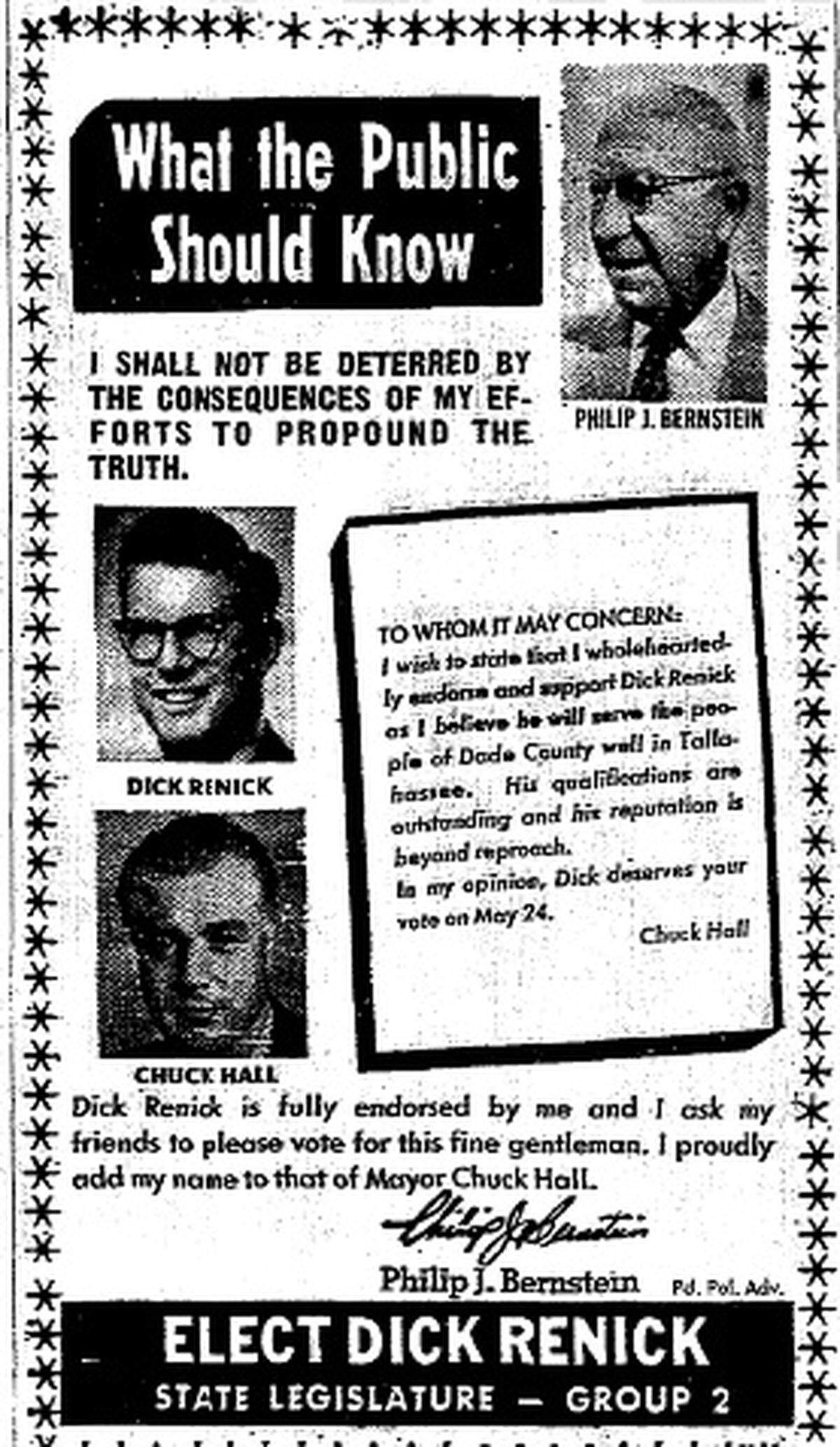
On Feb. 28, Florida Gov. Ron DeSantis directed that the flags of the United States and the State of Florida be flown at half-staff at the Miami-Dade County Courthouse, Miami City Hall and at the State Capitol in Tallahassee in honor of Renick.
In his order, DeSantis wrote: “During his time in the Florida House, he served on several committees and was appointed Vice Chairman of the Natural Resources and Conservation Committee. He also represented District 40 in the Florida Senate from 1974 until 1978 and District 39 from 1980 until 1982. Former Senator Renick will be remembered for his dedication to serving our state and country.”
Among the key legislation sponsored by Renick and signed into law during his Senate tenure: a tenant-landlord security deposit statute that protected the security deposit and provided interest on security deposits to tenants. Changing hit-and-run driving offenses from misdemeanor to felony charges. Renick also launched a successful campaign in Miami-Dade to provide for bullet-proof vests for the Florida Highway Patrol and won legislative approval for funding.
During Renick’s time in the Florida House, he served on several committees and was appointed vice chairman of the Natural Resources and Conservation Committee.
Renick had also served in the Florida House of Representatives from 1966 to 1972 as a Democrat, later switching parties to Republican when he ran unsuccessfully for Florida’s Secretary of State seat against Jim Smith in 1986.
“For years, I’ve philosophically been a Republican,” Renick told the Miami Herald in 1986 about his party switch. “I’m just much happier.”
Over the ensuing years Renick, who lived with his wife in Pinecrest, ran for several community seats, including Miami-Dade School Board in 2004 and the Miami-Dade Commission District 8 seat serving South Miami-Dade.
Renick didn’t win with those attempts.
Miami-Dade film coordinator
He also was Miami-Dade’s film and TV coordinator from 1987, at the height of “Miami Vice” and its neon glow on filming in South Florida that began with the crime drama’s bow on NBC on Friday nights in September 1984. He was unceremoniously asked to resign in 1991. A year earlier, he had unsuccessfully run for a higher-paying county clerk position.
The move to replace Renick in the film office was seen by some as political after he’d sought the county clerk position, which would have doubled his salary.
“When the county denied him a leave, Renick, discovering that others had been given such leaves in the past, sued and won. When he lost the election, the county had to reinstate him in his old job,” the Herald reported in 1991.
Family history
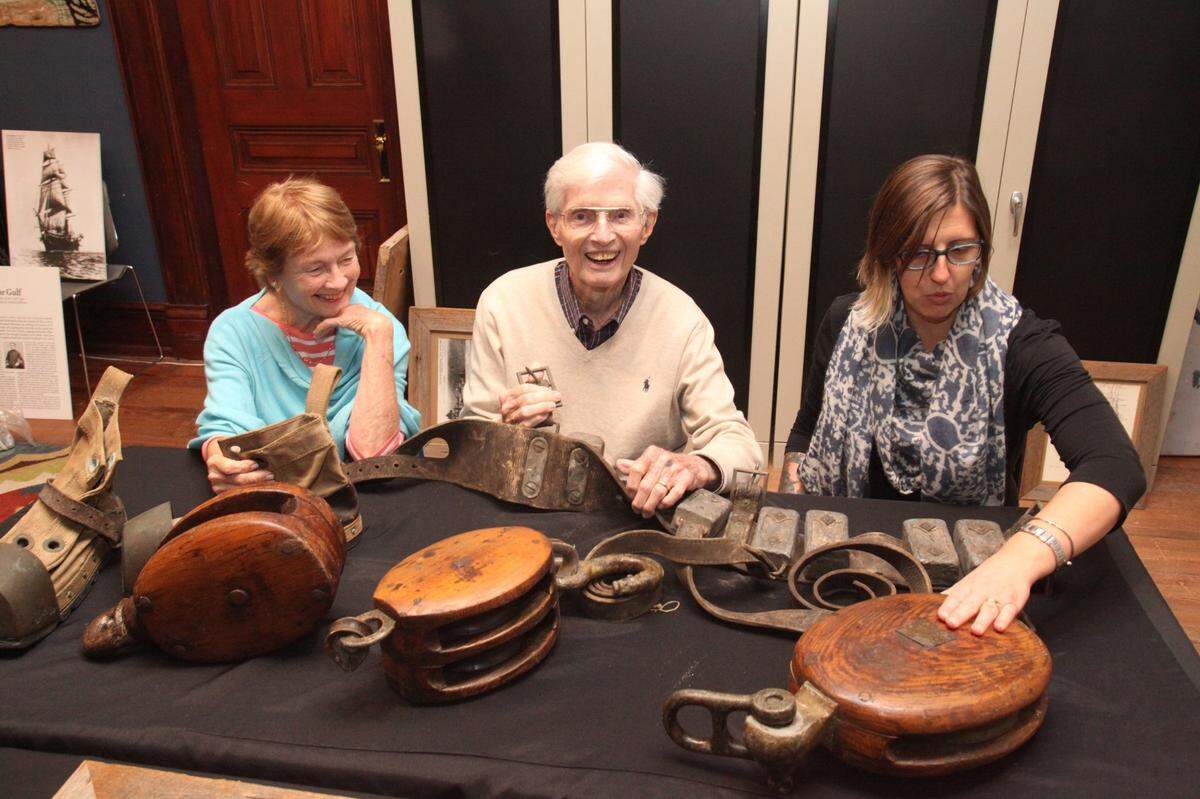
Renick was born in the Bronx on Oct. 14, 1930. When his parents divorced in 1940, his mother Rosalie gathered her three sons into a 1936 Cadillac convertible and drove from New York to Miami to her parents’ house in Hialeah, Renick recalled in an oral history video he presented for Pinecrest Pioneers in 2017.
“Mother lived to over 99. I miss her. She had a wonderful life,” Renick said in the video. Rosalie also made sure her boys did their chores. “I used to think that my name was Richard Garbage,” Renick told the Miami Herald in 2007 for his mother’s obituary. She was constantly reminding him: “Richard! Garbage!”
The Renicks attended Hialeah Elementary and St. Mary’s Catholic Middle and High School.
Renick joined the Navy in October 1947, serving until Nov. 1950 as a radio operator and signalman with two years’ sea duty aboard the USS Conserver ARS 39.
After his honorable discharge from the Navy, Renick’s brother Ralph invited him to WTVJ’s studio in Miami.
“I had never seen a television studio or a television camera in my life,” Dick Renick said in his oral history video. “When I went out to the Pacific to be on a ship out of Pearl Harbor right after the war they didn’t have television so I was spellbound.”
Renick completed his internship as a cameraman at WTVJ in 1951, studied camera work at the University of Miami, and started his own production company and worked as a producer and cinematographer.
He met Valerie, the woman who would become his wife in 1954, when she was working at WTVJ.
About 18 or 19 at the time, and fresh out of Edison High School where she attended after moving from New Jersey, she was a bit taken aback when Renick, about 23, asked her out on a double date to go fishing in Key Largo.
“I said, you’d better speak to my dad because I don’t even know where the Keys are. He was such a gentleman. My dad liked him immediately,” Valerie Renick said.
On the drive back, Renick accidentally dropped the fishing pole he had borrowed from Valerie’s father and it was lost on the road. Renick was upfront with her father — a former chief petty officer with the Navy — about losing his fishing pole.
“I was a nervous wreck,” Valerie remembered. But Renick owned up to his mistake and made good on a new fishing pole for her father. “My mother was impressed immediately.”
The couple lived in Pinecrest and raised two daughters.
“We have so many wonderful memories that we will cherish forever. His love of family, friends and country was an inspiration to everyone that knew him,” his daughter Deborah Renick Sims said in an email to the Herald.
Survivors, donations
In addition to his wife, Valerie and daughter Deborah, Renick’s survivors include his daughter Karen Renick; grandchildren Jennifer Murdock, Bethany Scott, Daniel Richard Renick Whittelsey, Julia Whittelsey and Riley Hicks; and great-grandchildren Souther, Sawyer and Sable Scott.
Services were held. Donations in Renick’s honor can be made to the Environmental Learning Center in Vero Beach.