
Marvin Sackner, a physician, inventor and renowned collector of word art, has died
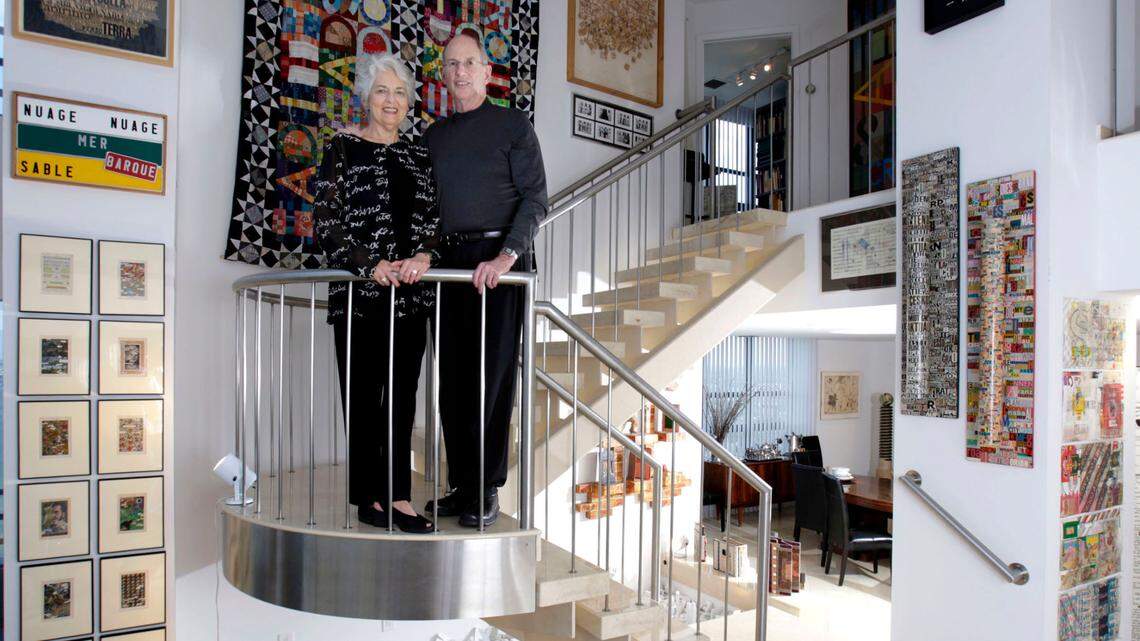
Marvin Sackner, a Miami Beach physician and inventor who with his wife, Ruth, assembled one of the world’s foremost collections of word-oriented art, has died.
Sackner, 88, died Tuesday after a brief illness at the hospital where he once served as director of medical services, Mount Sinai Medical Center in Miami Beach. Ruth Sackner, his wife of 59 years, died in 2015.
Well known in Miami’s cultural world and abroad, the Sackners lived surrounded by the art they collected, which they described as “visual poetry.” They amassed some 75,000 pieces, making their collection the largest of its kind in the world. The pieces range from the early Modern era to the hard-to-define concrete poetry movement of the 1960s as well as contemporary work.
“He was truly a remarkable mind, one who was unique in the depth of his intellect, and the collection reflects that,” said Franklin Sirmans, director of the Pérez Art Museum Miami. Sackner donated some 300 works to the museum in 2016. “In terms of depth and focus, it’s nothing short of miraculous. The fact that this collection came together here in Miami is amazing.”

In a brief statement, the couple’s three children —Jonathan Sackner-Bernstein, Deborah Goldring, and Sara Sackner — said: “Growing up in our parents’ ‘home-museum’ seemed normal. Doesn’t everyone have art ... .everywhere? Ruth and Marvin were archival collectors who ... loved living with art as much as they loved living artists. They were always on a quest to meet the artists they collected, many of whom became lifelong friends. Their love of visual art extended to music, literature, and for our dad, the art of science. The world is gray without them.”
Sackner’s death came as an exhibition of highlights from the couple’s collection is on display at the University of Iowa’s main library, the permanent home of the Sackner Archive of Concrete and Visual Poetry since 2019. The exhibit, the library says on its website, demonstrates “the remarkable artistry and diversity of some of the most significant poet-artists of the past hundred years.”
According to the university, the Sackner family donated the collection to Iowa for several reasons: its renowned Iowa Writers’ Workshop; its library system’s reputation as a center for the study of the Dadaist art movement, which used texts and wordplay; and the university’s specialized Center for the Book, which teaches “book arts practice and technique with research into the history and culture of books.”
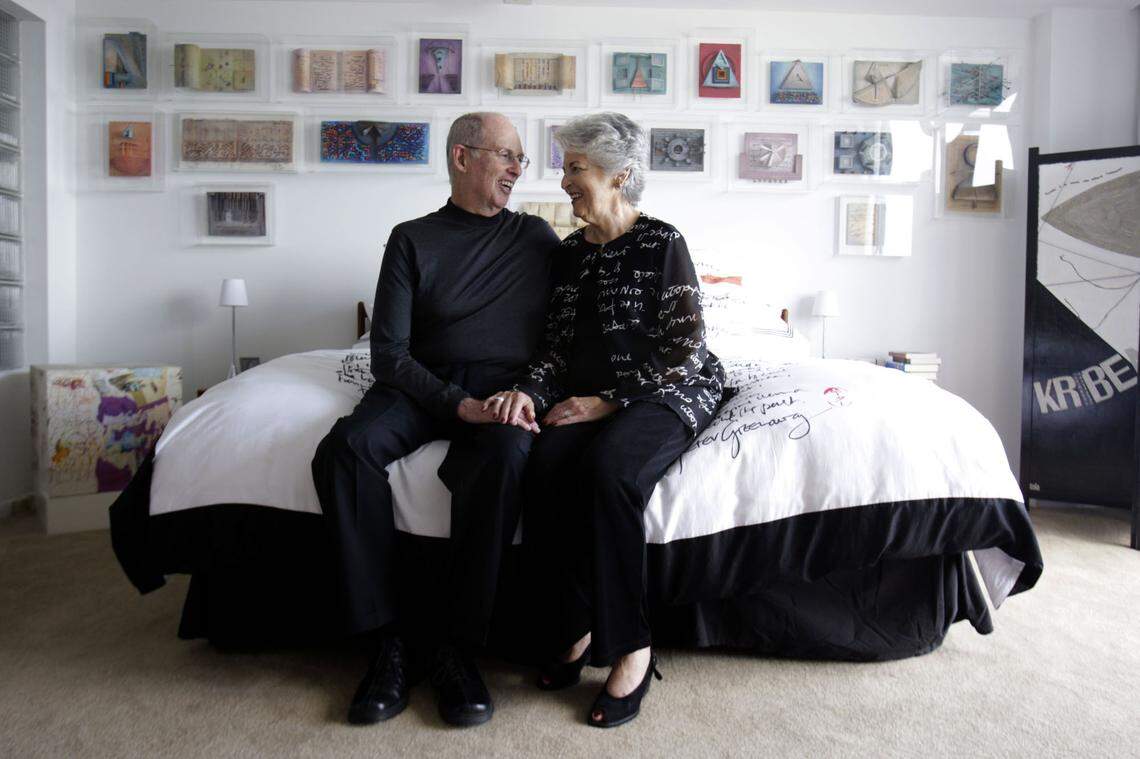
“My beloved wife, Ruth, and I had a dream that one day our efforts to build our collection into one that would reside in a world-class educational institution like the University of Iowa would come true,” the university quoted Marvin Sackner as saying in 2019. “Our dream has finally become a reality. I am just sorry that Ruth is no longer with us to witness this monumental moment.”
The Sackners met as university students in Philadelphia, where they were both born. Marvin Sackner studied pharmacy at Temple University and medicine and what is today Sidney Kimmel Medical College at Thomas Jefferson University. They married in 1956 and moved to Miami Beach in 1964 when Marvin Sackner joined Mount Sinai as chief of pulmonary medicine.

Although interested in art, they did not start the collection that would establish their reputation until 1974. A retrospective that year in Basel, Switzerland, of the work of Tom Phillips, a multidisciplinary British artist, piqued their interest in drawings, paintings, prints and sculptures that use words and texts as the basis for art.
They bought Phillips’ work, which became the foundation of their collection, The Sackner Archive of Concrete and Visual Poetry, which they formally launched in 1979. A description provided by the family says the collection includes “annotated books, periodicals, typewritings, drawings, letters, print portfolios, ephemera, and rare and artist’s books and manuscripts.”
In 2013, hundreds of pieces from the archive were exhibited at the just-opened PAMM. Three years later, Sackner made a permanent gift to the museum of 300 pieces ranging from late 19th Century to contemporary works, Sirman said. That means PAMM can draw on the Sackner pieces for exhibitions to illustrate artistic periods its collection has few other examples of.
“There is a depth to this collection that is unmatched for us in the scope of our collection,” Sirmans said. “What they did is really important for people to consider. This is somebody who doesn’t want to collect what everyone else was collecting. They had a singular and shared desire to explore the world of modern and contemporary art through a very particular lens — around the word, around texts. It’s completely unique.”
Sackner also donated works to the University of Miami’s library system.
In 2014, Sackner was named a Chevalier De L’Ordre Des Arts Et Des Lettres by France’s ministry of culture for his contribution to the arts.
Marvin Sackner once explained that he and Ruth had “play money” to collect art thanks to his other sideline as an inventor and entrepreneur in the field of medical devices and technology.
The holder of more than three dozen scientific patents, according to his family, Sackner served as chief executive officer and chief innovation officer of Non-Invasive Monitoring Systems, Acceleration Therapeutics, and most recently, Sackner Wellness. He published hundreds of academic articles and was at work on new research just before he died. Sackner also taught at the University of Miami’s medical school.
When the Sackners moved from the Venetian Islands to a bayfront Miami apartment, the Miami Herald’s obituary of Ruth Sackner noted, it took four months because they had to figure out where to place the art in their new home. In the end, they were able to fit more than 600 pieces.
Marvin Sackner was also a lover of music, especially baroque opera. He would often travel to attend concerts abroad.
In addition to his three children, Marvin Sackner is survived by his brother Stanley and eight grandchildren. Burial will be at Lakeside Memorial Park. The family said that donations in his memory can be made through the Sackner Memorial Fund at Seraphic Fire by calling 305-285-9060 or by mail to the choral group at 2153 Coral Way, Suite 401, Miami, Florida, 33145.
This story was originally published September 30, 2020 at 7:39 PM.