Jerry Herman, Broadway’s ‘greatest melody writer,’ developed his musical gifts in Miami
Can you imagine a world in which “Hello, Dolly!” didn’t exist?
Unimaginable. Chances are that Jerry Herman composition is in your head now as an earworm just from the title’s mention.
Tony Award-winning composer Herman is responsible for that musical that has charmed audiences since it opened on Broadway in 1964 with Carol Channing as matchmaker Dolly Levi.
Herman, who also wrote the exuberant, feel-good music found in shows like “Mame,” “La Cage aux Folles” and “I Feel Wonderful,” an Off-Broadway production featuring music he wrote while studying at the University of Miami, died Thursday.
Herman, a 2010 Kennedy Center Honors recipient, was 88.
Herman’s goddaughter Jane Dorian confirmed his death to The Associated Press early Friday. He died of pulmonary complications in Miami, where he had been living with his partner, real estate broker Terry Marler.
Herman’s UM legacy
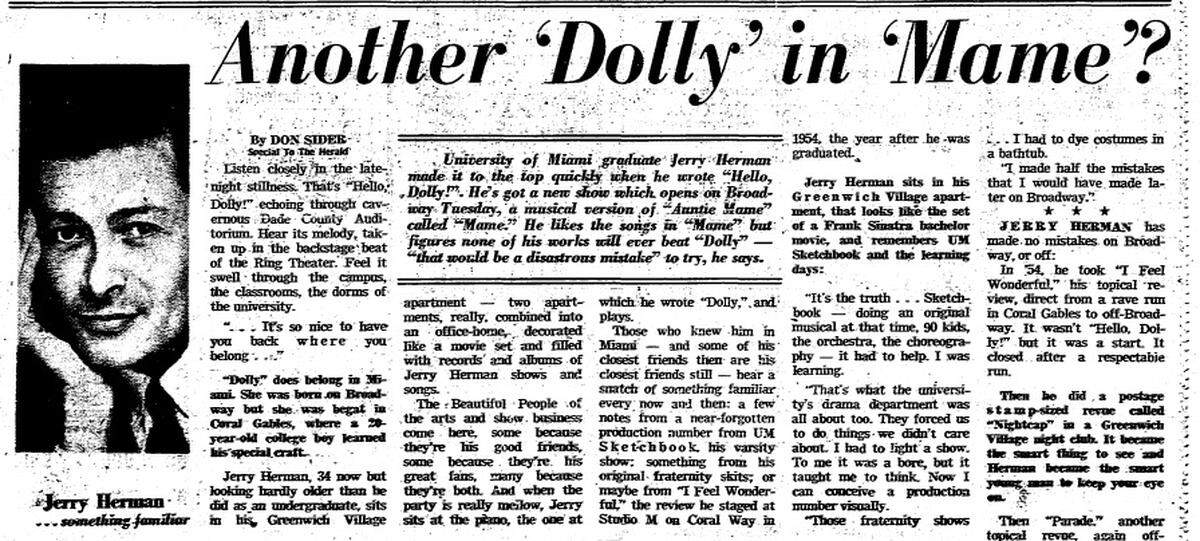
One of the monuments to Herman’s talents is the Jerry Herman Ring Theatre on the University of Miami campus, renovated and dedicated in 1966 to Herman two years after “Hello, Dolly!”
The theater was officially renamed for him in January 1993, a month after Herman gave the university a $300,000 gift to support the venue.
The Jerry Herman Ring Theatre in Coral Gables, home to UM’s drama department since 1951, has helped give rise to the acting careers of subsequent alum like Sylvester Stallone, Steven Bauer, Ray Liotta, Gilligan’s Island’s actress Tina Louise and “Miami Vice” co-star Saundra Santiago.
“Jerry Herman’s talent and creativity left an indelible legacy at the University of Miami, where we will always treasure his many memorable compositions,” said University of Miami President Julio Frenk. “Our hearts go out to his loved ones during this difficult time.”
Shelton Berg, dean of UM’s Frost School of Music, singles Herman out as one of the all-time greats.
“Jerry Herman was perhaps the greatest melody writer of American musical theater,” Berg said. “His beloved and upbeat songs have lifted the spirits of generations, and will continue to do so in the decades to come.”
Arguably one of the most joy-filled compositions in theater and pop music, “Hello, Dolly!” was so popular at one point in 1964 its original Broadway cast recording was replaced at No. 1 by jazz great Louis Armstrong’s rendition from his “Hello, Dolly!” album.
Armstrong would reprise Herman’s greatest hit in the 1969 film version of “Hello, Dolly!” alongside the film’s lead star, Barbra Streisand.
Celebs pay tribute
On Friday, Streisand said of Herman on Twitter, “his tuneful optimism brought joy to the world.”
If one is ever down, a few bars of Armstrong’s singing on “Hello, Dolly!” could be considered a risk-free anti-depressant — unless it leads you toward other Herman compositions and that’s not so much a risk as a treat.
Try, for instance, “I Am What I Am,” sung in “La Cage” by George Hearn. “We Need a Little Christmas” from “Mame,” that co-starred Angela Lansbury and Bea Arthur. Then there is “Before the Parade Passes By,” yet another from “Hello, Dolly!”
“I first met Jerry, with Charlie Cinnamon at the Coconut Grove Playhouse. He did a show with Lee Roy Reams and Florence Lacey. One of those moments you never forget ... and remember. ‘It Only Takes a Moment,’” said director/producer Richard Jay-Alexander as he references yet another one of Herman’s gems from the “Hello, Dolly!” songbook.
Reams became the first male actor to play the title Dolly character in a sanctioned U.S. production at the Wick Theatre and Costume Museum in Boca Raton in 2015.
When Reams visited Herman at his Miami Beach home to seek approval to play the part, “there was no reaction at all. It was just yes,” Reams told the Miami Herald in 2015.
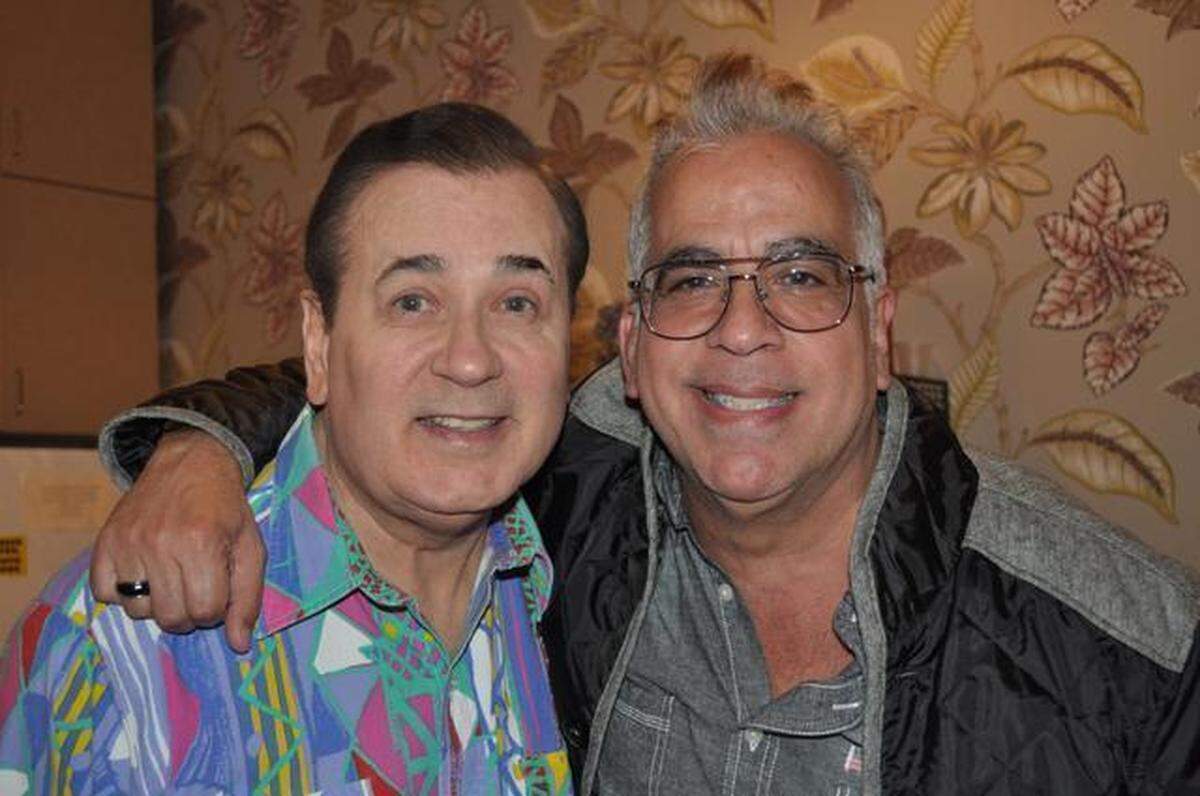
Jay-Alexander, who lives in Miami Beach, has written and directed concerts for Streisand, who, famously, won the film role over Broadway originator Carol Channing.
Most recently, Bette Midler won the best musical actress 2017 Tony for playing the Levi role in a hit “Hello, Dolly!” revival on Broadway.
“Every night was a thrill, full of joy, both onstage and in the house. His music was completely American, and we were lucky to have him,” Midler said in a tweet.
As the news of Herman’s death started to filter through the artistic community he so dominated for so many years, more tributes began flowing in Friday.
Harvey Fierstein, who wrote the book of “La Cage aux Folles” alongside Herman’s songs, said on Twitter, “We lost one of the greats. A collaborator and friend for almost 40 years. I cannot thank him enough for his love, trust, encouragement, support and laughter.”
“Jerry gave us such joy through his music,” Dorian, his goddaughter, said in a statement to CNN. “He was the poet laureate of our time and gave so many extraordinary songs. He touched our hearts and souls with his music and we will miss him deeply.”
Writer and Sirius XM host Seth Rudetsky honored Herman for writing “quintessential Broadway songs. Beautiful melodies and fantastic lyrics.”
Herman’s awards and accolades
The creator of 10 Broadway shows and contributor to several more, Herman won two Tony Awards for best musical: “Hello, Dolly!” in 1964 and “La Cage aux Folles” in 1983. He also won two Grammys — for the “Mame” cast album and “Hello, Dolly!” as song of the year — and was a Kennedy Center honoree. He had three original Broadway productions playing at the same time from February 1969 to May 1969.
In 1967, singer Eydie Gorme recorded Herman’s “If He Walked Into My Life” from “Mame.” The rendition became a signature hit for her, winning the best female vocal performance Grammy for 1967, and provided Herman with one of his fondest memories.
“She won the Grammy and came to me. I was in the hospital with hepatitis, and she came with the Grammy and, oh boy, what a celebration and what a nice relationship we always had because of it,” Herman told the Herald when Gorme died in 2013. “I’ll never forget the first time I heard it. I couldn’t speak. I said, ‘My God, this is going to be a classic record,’ and it sure was.”
Another time, novelist and playwright Paul Rudnick visited Herman at his New York townhouse where he was greeted by a uniform butler and Herman — standing beside a full-length portrait of Angela Lansbury.
The man had flair.
“He provided such joy,” Rudnick said on Twitter.
Herman’s writing style
Herman wrote in the Rodgers and Hammerstein tradition, an optimistic composer at a time when others in his profession were exploring darker feelings and material, according to the Associated Press. Just a few of his song titles revealed his depth of hope: “I’ll Be Here Tomorrow,” “The Best of Times,” “Tap Your Troubles Away,” “It’s Today,” “We Need a Little Christmas” and “Before the Parade Passes By.” Even the title song to “Hello, Dolly!” is an advertisement to enjoy life.
Herman also had a direct, simple sense of melody and his lyrics had a natural, unforced quality. Over the years, he told the AP in 1995, “critics have sort of tossed me off as the popular and not the cerebral writer, and that was fine with me. That was exactly what I aimed at.”
.JPG "ObitJerryHerman (1).JPG")
Herman’s background
Herman was born in New York in 1931 and raised in Jersey City. His parents ran a children’s summer camp in the Catskills and he taught himself the piano. He noted that when he was born, his mother had a view of Broadway’s Winter Garden Theatre marquee from her hospital bed.
Herman dated his intention to write musicals to the time his parents took him to “Annie Get Your Gun” and he went home and played five of Irving Berlin’s songs on the piano, according to the AP.
“I thought what a gift this man has given a stranger. I wanted to give that gift to other people. That was my great inspiration, that night,” he told the AP in 1996.
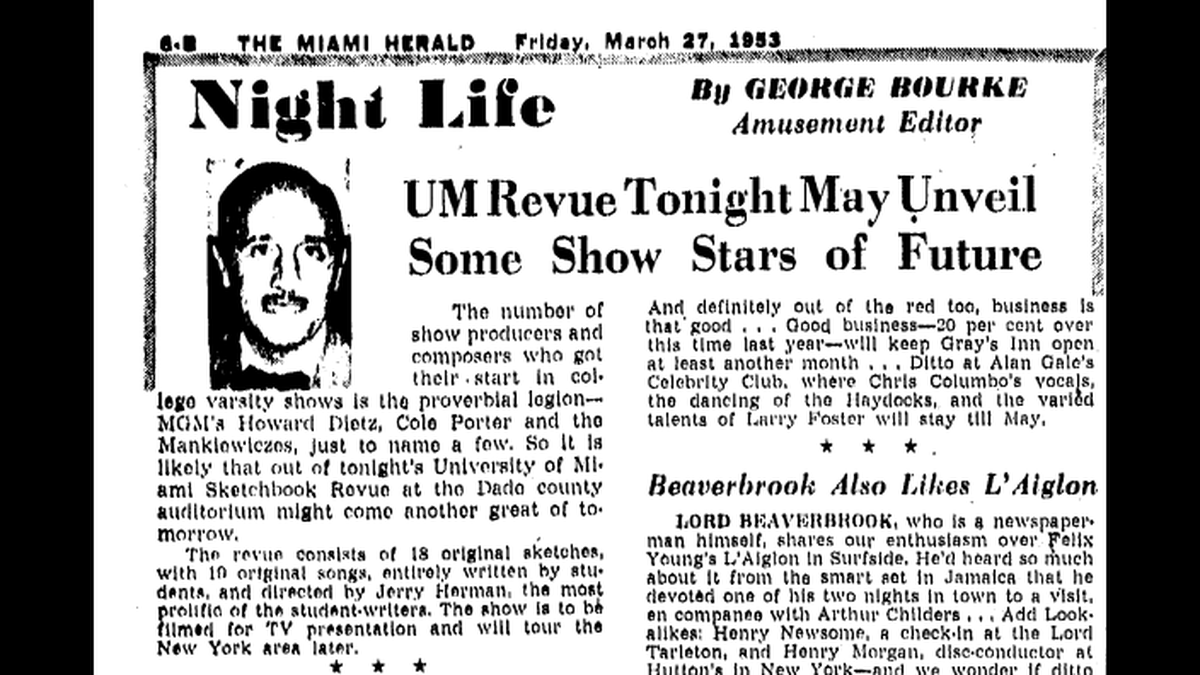
After graduating from the University of Miami’s drama department in 1953, Herman headed back to New York, writing and playing piano in a jazz club. He made his Broadway debut in 1960 contributing songs to the review “From A to Z” — alongside material by Fred Ebb and Woody Allen — and the next year tackled the entire score to a musical about the founding of the state of Israel, “Milk and Honey.” It earned him his first Tony nomination.
Channing and her defining role
“Hello, Dolly!” starring Carol Channing opened in 1964 and ran for 2,844 performances, becoming Broadway’s longest-running musical at the time.
When Channing reprised the Dolly Levi role in a touring version that played the Broward Center for the Performing Arts in Fort Lauderdale in 1994, she realized how the character provided a life-long lesson for the actress.
“None of us knows while we’re learning. When I think I’m learning, I’m not learning anything,” Channing told the Miami Herald at the time. “But when I pick up that ‘Hello, Dolly!’ script after 12 years and look it over, I realize: My God! That’s why she says that line. That’s why he says that to her. ... I realize I must have grown and didn’t know it. Or she marinated. ... I guess in my subconscious I was always thinking about her.”
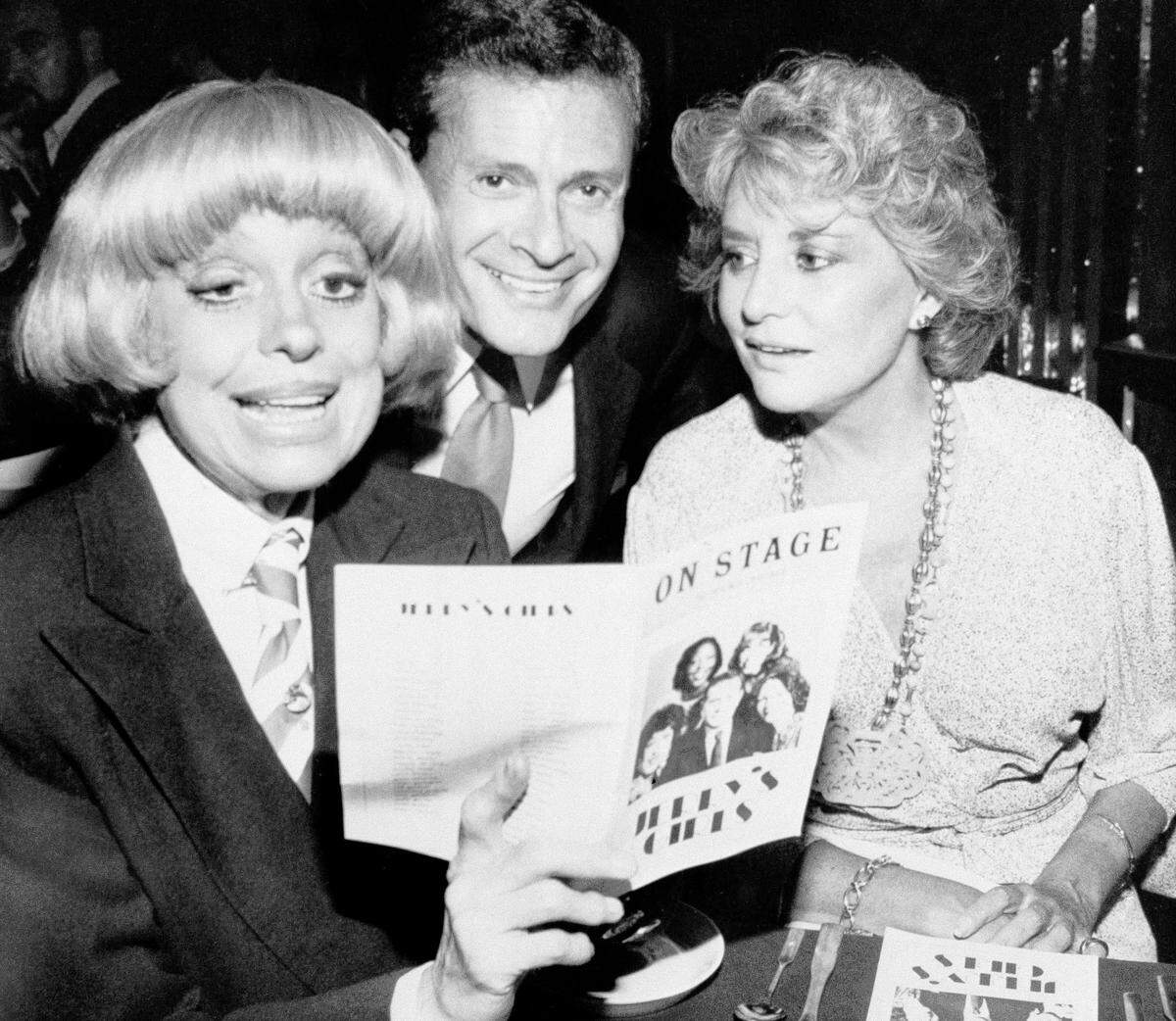
Channing, who died at 97 in January, once said of Herman: “When they passed out talent, Jerry stood in line twice,” CNN reported.
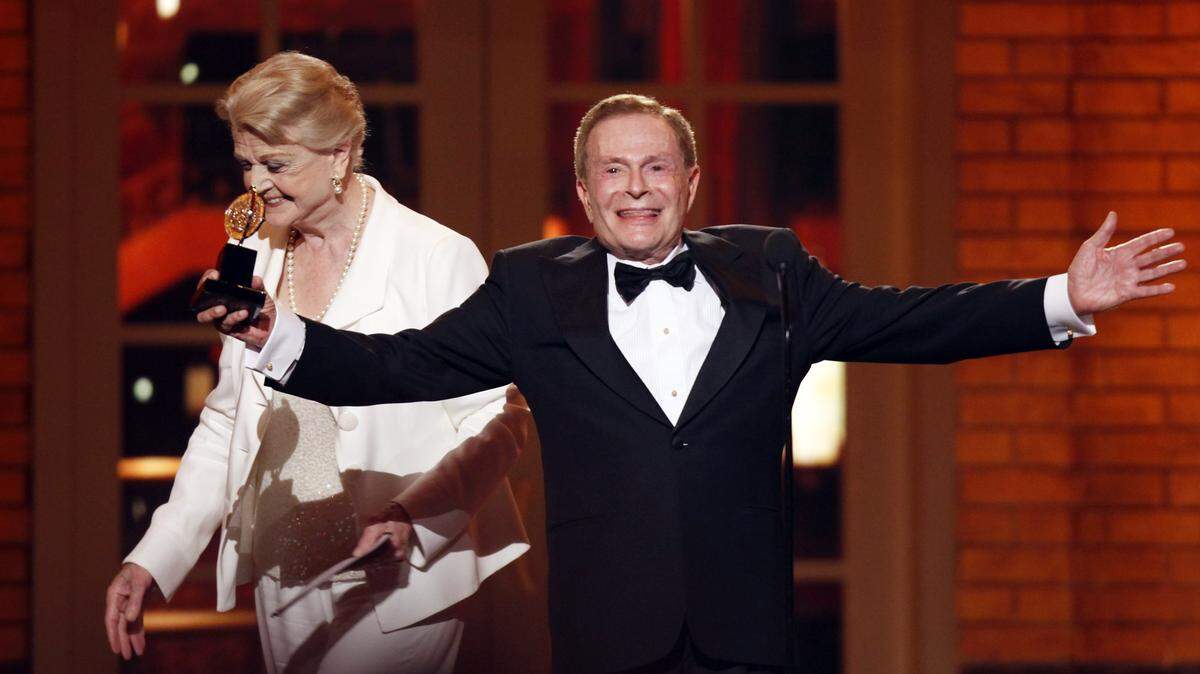
“Mame” followed “Dolly!” in 1966, starring Angela Lansbury, and went on to run for over 1,500 performances. She handed Herman his Special Tony Award for Lifetime Achievement in 2009, saying he created songs like him: “bouncy, buoyant and optimistic.”
In 1983 he had another hit with “La Cage aux Folles,” a sweetly radical musical of its age, decades before the fight for marriage equality. It was a lavish adaptation of the successful French film about two gay men who own a splashy, drag nightclub on the Riviera. It contained the gay anthem “I Am What I Am” and ran for some 1,760 performances.
Living as an out gay man
George Hearn’s opening night performance of “I Am What I Am” on its Boston run in 1983 provided Herman with one of his most revelatory moments in a theater. Herman was in the audience when Hearn sang the anthem, he told the Miami Herald in 1998. The experience was overwhelming.
“I just about fell apart,” Herman said. “I’ve never been so moved.”
Writing the song “was easy” given he spent his entire adult life in the musical theater as an out gay man, he told the Herald
“I came to openings with a man on my arm, and I never hid who I am,” Herman said. “I find people surprised at my openness. ... But who would want to live with a veil on? Or handcuffs?”
Brooklyn-based transgender and HIV activist Tasha Headrick tweeted on Friday that the gifts Herman left behind for others to cherish will never be forgotten.
Leonidas Bachas, dean of the University of Miami’s College of Arts and Sciences, said of Herman: “His profound contribution to the world of Broadway and musical theater illustrates his remarkable gift in creating narrative through the art of songwriting. He will live on as a major visionary and inspirational source for our talented students in the Department of Theatre Arts.”
Michael Bush, artistic director of the Jerry Herman Ring Theatre, said Herman’s contributions to American Musical Theater are profound.
“His songs were light personified. Melodic and positive, they glorified the best human instincts in all of us,” said Bush. “Unabashedly sentimental, he believed that life was to be celebrated. Even in a dark and troubled world, his work, to quote one of his songs from ‘La Cage aux Folles,’ insisted that the best of times is now.”
Bridging the generations
“Put on Your Sunday Clothes” and “It Only Takes a Moment,” two of Herman’s classics from “Hello, Dolly!,” reached a new generation when they were prominently featured in Walt Disney/Pixar’s computer-animated children’s hit movie, “WALL-E” in 2008. At the same time, many of his cast albums were released on digital download platforms.
The modernity delighted the composer, Herman told the Miami Herald in 2008.
“Isn’t that exciting? The best thing that can happen to someone like me is to know his work will go on.”
Herman’s survivors include his partner, Terry Marler, his goddaughter Jane Dorian and her daughter, Sarah Haspel. Plans for a memorial service are still in the works.
This story was supplemented by material from the Associated Press.
This story was originally published December 27, 2019 at 2:12 PM.