
What would Florida be without the multilingual Miami Book Fair? A cultural desert | Opinion
Who could’ve thought, when the launch of the Miami Book Fair made history 40 years ago, that South Floridians would be rallying to defend the freedom to read in 2023?
But, here we are, celebrating a cultural milestone in Miami — and pushing back on the normalization of censorship in Florida, from kindergarten through higher education, when students are legally adults.
What’s in a book that so offends the politicians now charged with deciding what’s read and taught?
Apparently, the tremendous power of literature to shape human thought.
If not, red states like Florida wouldn’t be fiercely engaged in banning books that don’t fit their hard-right, ultra-conservative Christian view of life to the point of normalizing the practice of censorship as an educational tool.
In Florida, any parent of a student or resident of a county can fill out a form — and challenge the presence of a book in a school.
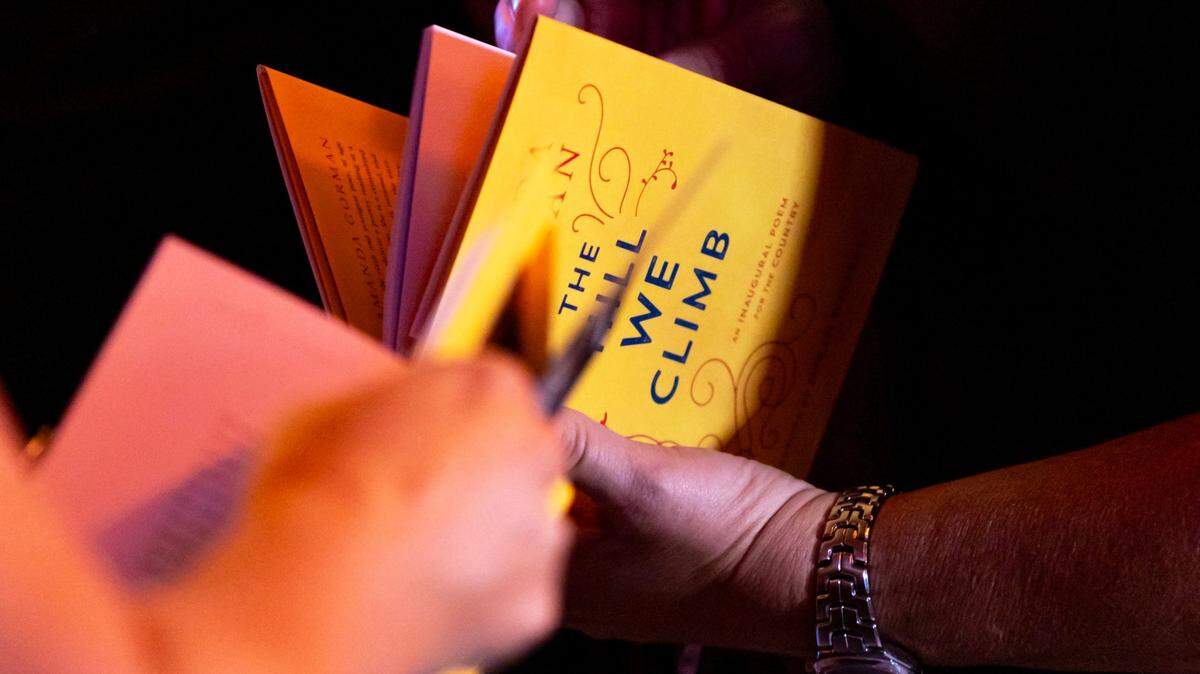
As we saw in Miami-Dade County with Amanda Gorman’s inaugural poem, “The Hill We Climb,” it’s that frighteningly simple to declare war on a book.
No wonder we are the nation’s leader in school-banned books, according to the new Pen America report “Banned in the USA: The Mounting Pressure to Censor.”
The state of the state under Gov. Ron DeSantis, however, only makes this year’s Miami Book Fair at the Miami Dade College downtown campus — which runs through Sunday evening and is the nation’s largest, longest-running literary festival — all the more necessary and relevant.
For thousands of readers, the fair is an oasis of free thought in turbulent times
Books feed the soul and exercise the brain in English, Spanish and Haitian Creole. For the more than 400 authors participating in panels, readings and book signings, landing a spot in the limelight represents an opportunity to share the backstory to their work and engage with fans, up close and personal.
Authors run the gamut of literary genres and points of view.
“We try to create the biggest tent under which we can all find community,” founder Mitchell Kaplan told me Thursday.
READ MORE: For its 40th edition, the Miami Book Fair is ‘a homecoming’ for authors and book lovers
Reading difference
Perhaps in Florida — and the country — the division among us isn’t solely along party lines, the wedge between Democrats and Republicans that seems too often insurmountable.
The deepest gap among Americans lies between those who read critically — meaning with an open mind and enthusiasm for learning instead of seeking what’s familiar to confirm prejudices — and those who haven’t even ever picked up a serious book, yet are highly opinionated and vote.
Failure to read, and to do so widely, leads to political poverty, which is the place where autocratic politicians want their voters to dwell.
A gullible population is a precious asset, a necessary condition for spreading propaganda and misinformation. Navigating a modern world saturated with social media channels and partisan television networks requires an agile, curious mind willing to investigate and probe the credibility of sources.
Free speech tested
As inclusive as the book fair has become, I do remember when freedom of speech was tested in 1997.
For the first time, an author still living in Cuba and unknown to the Cuban exile, Antonio José Ponte✓, was invited to present his book in the Spanish-language program. The usual critics on Cuban radio insinuated impropriety and worse, questioning why he was allowed to even come here, much less publish — and say that he planned to return to Havana.
I interviewed Ponte (exiled in Madrid after not being allowed to return), spent time with him, read him, quickly realizing he was one of the most daring young intellectuals on the island. His stories, I wrote in the Miami Herald, “open a window into those hermetic spaces where suffering and joy often come hand-in-hand.”
I still get chills remembering his revelatory presentation — and the quiet as people intently listening to every word. I remember the applause at the end. It was magical, the breaking of taboos, the opening of spaces on this shore, too.
The book fair — and MDC’s commitment to the free flow of ideas — helped Miami grow up and mature politically, intellectually.
“A testament to the power of unfettered free expression and how it works to bring people together,” Kaplan said. “A testament to the community. People understand the nature of the book fair and that it is a pluralistic thing.”
Like freedom of speech, a good book is a treasure to keep forever. Its power is only a threat to authoritarians imposing their will on others for personal gain. For the rest of us, reading a book equates to armchair travel to unknown worlds — without borders.
And, as Mark Twain famously said, traveling is the antidote to ignorance.
Our book fair is — and, hopefully, will be for generations to come — who we are at our best in Miami.
