The day Cuban fighters downed two Brothers to the Rescue planes, and what happened next
By Miami Herald Archives
Here is the original coverage from the Miami Herald archives of the shoot-down of two Brothers to the Rescue planes on Feb. 24, 1996.
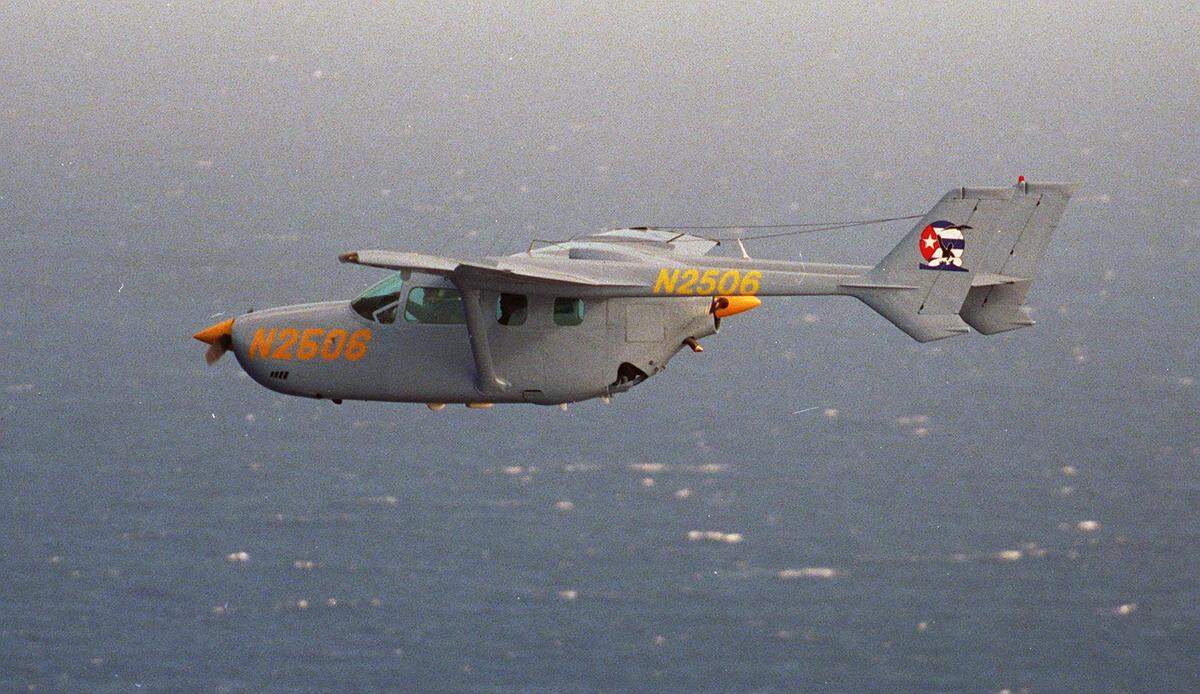
Brothers to the rescue plane flies during a one-year anniversary memorial service in 1997. Al Diaz Miami Herald File
MiGs down two exile planes off Cuban waters
By Martin Merzer and Manny Garcia
Cuban MiG fighters streaking over the Straits of Florida on Saturday shot down two single-engine planes belonging to Brothers to The Rescue, a Miami-based exile group, U.S. officials said. It was unclear if the exiles’ plane had violated Cuban airspace. A third plane returned safely to South Florida.
Coast Guard and Navy planes and helicopters searched into the night for four missing crewmen, but found only oil slicks. A heavily armed Navy cruiser and other naval vessels steamed to the area about 15 miles northwest of Havana, close to Cuban waters.
F-15 fighter planes were scrambled from MacDill Air Force Base in Tampa to provide air cover, according to White House press secretary Mike McCurry. Air Force reserve pilots were summoned to fighter squadrons at the Homestead Air Reserve Base, The Herald learned.
President Clinton, addressing the nation Saturday night, said he instructed U.S. military forces to support the rescue operation “to ensure that it is fully protected.”
“I condemn this action in the strongest possible terms,” he said.
Details of the incident were sketchy. A spokesman for Miami-based Brothers to the Rescue refused to comment on the nature of Saturday’s mission. The group’s pilots often search international waters for wayward Cuban rafters, but also have twice violated Cuban airspace since July.
After one of those flights over Havana, Cuban President Fidel Castro warned that any aircraft violating Cuban airspace risked being shot down.
McCurry, the White House spokesman, said the two planes were engaged Saturday “near the territorial waters of Cuba.”
Coqui Lares, a Brothers spokesman, identified the missing men as Carlos Costa and Pablo Morales on one plane and Mario de la Pena and Armando Alajandre on the other. He said Jose Basulto, who formed the group in 1991, was on the plane that returned safely.
Basulto was being interviewed by American officials at an unknown location, aides said.
The Cuban-American community in Dade County and throughout the nation mobilized for protests -- and for prayers. Supporters waving Cuban flags descended on the Brothers’ hangar at Opa- locka Airport. Dozens of Metro-Dade police officers patrolled the area.
“What we feel is indignation,” said Armando Perez, one of many people who gathered in Miami’s Little Havana to monitor preliminary reports of the incident. “The planes weren’t going to attack Cuba. They didn’t have arms. It was very dangerous, but they just went there to give the Cubans some hope.
“The only thing we can do is to cry. That’s the only thing we can do.”
Said Regla Juviel: “Ay, Dios mio. He (Castro) is crazy. What’s going to happen now?”
The search area was centered in the Straits of Florida, about three miles north of the 12-mile limit claimed by Cuba, according to the Coast Guard.
Petty Officer Scott Carr said two oil slicks, possibly from the downed planes, were spotted in the area before darkness descended.
The first report of the downing came to the Coast Guard at 3:45 p.m. from the Federal Aviation Administration, Carr said.
The U.S. Navy dispatched all available rescue ships and aircraft to the area.
“U.S. Atlantic Command Forces are responding to the reported downing of two civilian aircraft by Cuban fighters,” said Navy Capt. Craig Quigley, with the U.S. Atlantic Command in Norfolk, Va.
There was no immediate statement from Cuban officials in Havana or at the Cuban Interests Section in Washington. Cuban citizens with access to satellite television services first learned about the incident from American news programs.
Reserve pilots assigned to Homestead Air Reserve Base were summoned to duty on an emergency basis, friends and relatives told The Herald. It was unclear if they were on alert for rescue work -- or for other, more ominous duty.
Throughout the night, supporters of Brothers to the Rescue descended on the blue-gray hangar at Opa-locka Airport that serves as the group’s headquarters. U.S. government agents spoke inside with group officials, some of whom huddled in a corner of the hangar, speaking on cell phones, appearing pale and frightened.
Two U.S. Customs agents stood outside the front door, blocking access to most civilians.
“We’re here to offer our support and just allow relatives inside so I can learn what’s going on,” said one person.
“I need to get inside, I need to get inside,” said one desperate man. He was rebuffed.
Another supporter, Jorge Bringuier, president of the Rescue Legion, a Cuban exile group, also was denied entry. “I have four planes I can put in the air for the rescue,” he said. “I have four planes. Let me inside.”
The Brothers have sponsored thousands of missions across the Florida Straits, generally steering clear of Cuban airspace as they searched for wayward rafters.
But after the United States announced last year that it would repatriate rafters, the organization had to redefine its role -- and its actions turned more provocative.
At least twice, pilots dropped leaflets over Cuba as part of their effort to incite revolution. Basulto said his group was responsible for dropping the leaflets, but he has not admitted that his people overflew Cuba.
“It’s another step, and there are many steps required, toward planting the seed that will lead to our people demanding what is rightfully theirs,” Sylvia Iriondo, a Cuban-American activist and Basulto ally, said last year.
Still, the Brothers’ missions were almost universally regarded as humanitarian. The one exception -- the Cuban government.
According to George Dorrbecker, president of the Cuban American Pilots Association, who has flown missions with Brothers pilots, local FAA authorities started issuing new advisories on Cuba about three weeks ago.
“All pilots were told that if you cross the 24th parallel without a flight plan, the Cuban government would not be responsible for your personal security,” he said. “They said they had military operations in the area and anti-aircraft guns were operative.
The 24th parallel cuts through the Florida Straits approximately half way between Cuba and Key West. According to Dorrbecker, Cuba has international policing authority beyond that point and a Cuban air traffic dispatcher takes control of all flights.
“That means if you enter there without permission, they can come out and identify you,” he said. “Maybe they will waggle their wings, ask you to identify yourself, maybe even make you follow them and land in Cuba.
“But to shoot them down, that is a major transgression of international law. They were on a peaceful mission. They were unarmed.”
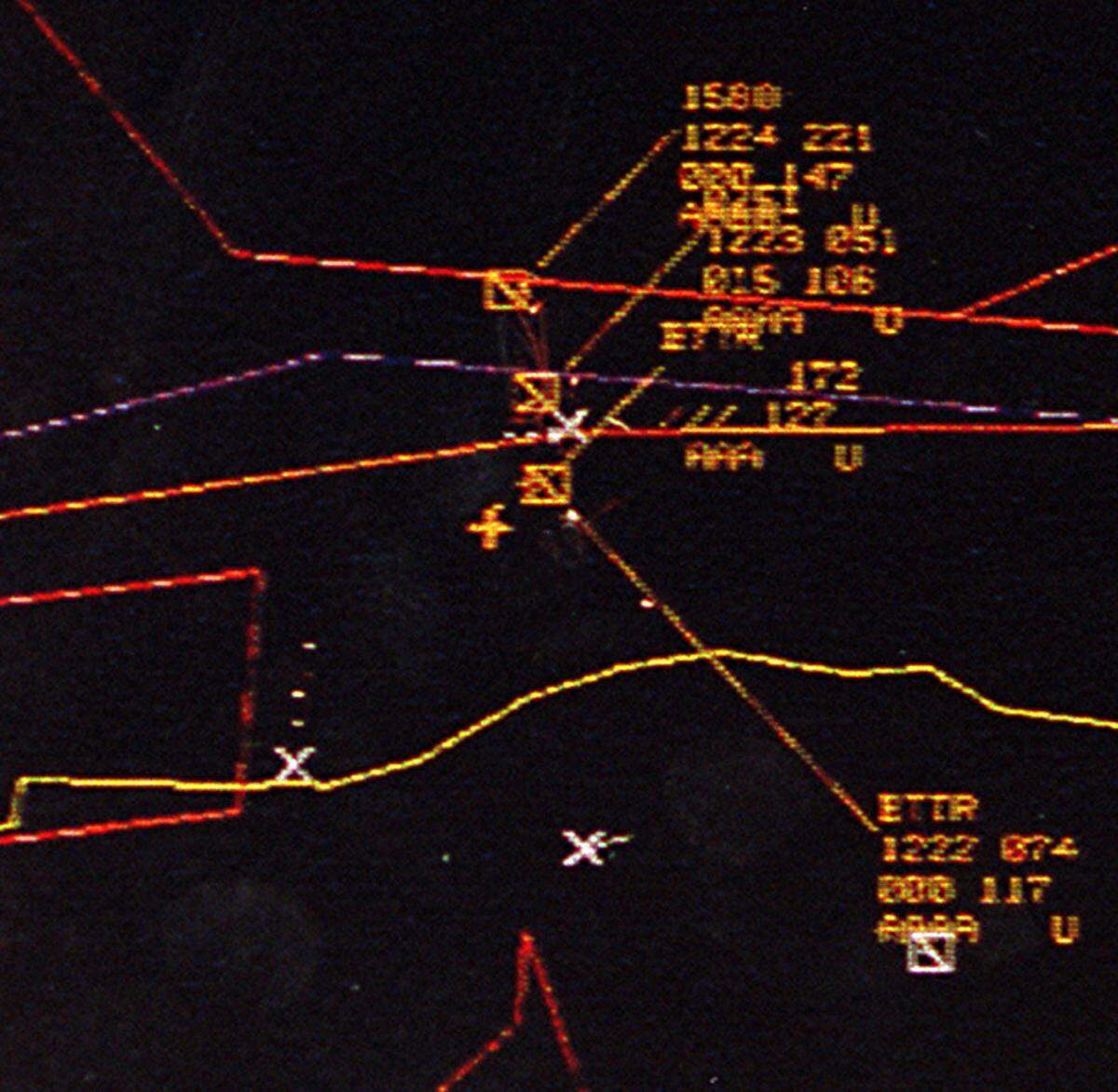
A copy of a screen print from U.S. Customs radar showing the moment that Cuban MIG shoots down the first Brothers to the Rescue Plane. Balsulto’s plane is the bottom of three orange boxes and is inside the Cuban Air Defense identification zone but was turning north. The white X is a MIG shooting down the first plane, north of Balsulto’s. Chuck Fadely Miami Herald File
A bold and risky cat-and-mouse game
By Henri Cauvin
When Brothers to the Rescue began flying its missions over the Florida Straits about five years ago, the group wasn’t all that interested in direct confrontation with the Castro government. Instead it chose to rescue rafters fleeing the island nation.
But after the Clinton Administration dried up the supply of Cuban rafters with an order to repatriate any caught coming to the United States, Brothers started searching for a way to encourage unrest.
Leaflets, filled with anti-government propaganda, soon emerged as the group’s newest, and boldest, tactic at subversion.
Secretly flying over Cuba, the pilots dropped thousands of the leaflets into Havana neighborhoods on at least two occasions.
“Fight for your Rights,” read one dropped on Jan. 13. “The People Own the Streets,” read another dropped that day.
In flying not just into Cuban airspace but right over the country’s capital, Brothers to the Rescue changed the rules of its cat-and-mouse game with the government they sought to topple.
Long supported by the U.S. government, the group drew criticism for its leafletting incursions. Federal aviation officials began investigating Basulto and some of his fellow pilots.
The Cuban government threatened worse: to shoot down planes caught in Cuban airspace.
The change in tactics did nothing to diminish support for Basulto and the Brothers among many exiles.
“What he’s doing with the leaflets, it shows great courage,” Cuban-American activist Sylvia Iriondo, founder of Mothers Against Repression, said earlier this year. “It’s another step, and there are many steps required, toward planting the seed that will lead our people to demanding what is rightfully theirs. It’s a very powerful message.”
Iriondo was in the only plane that made it back Saturday.
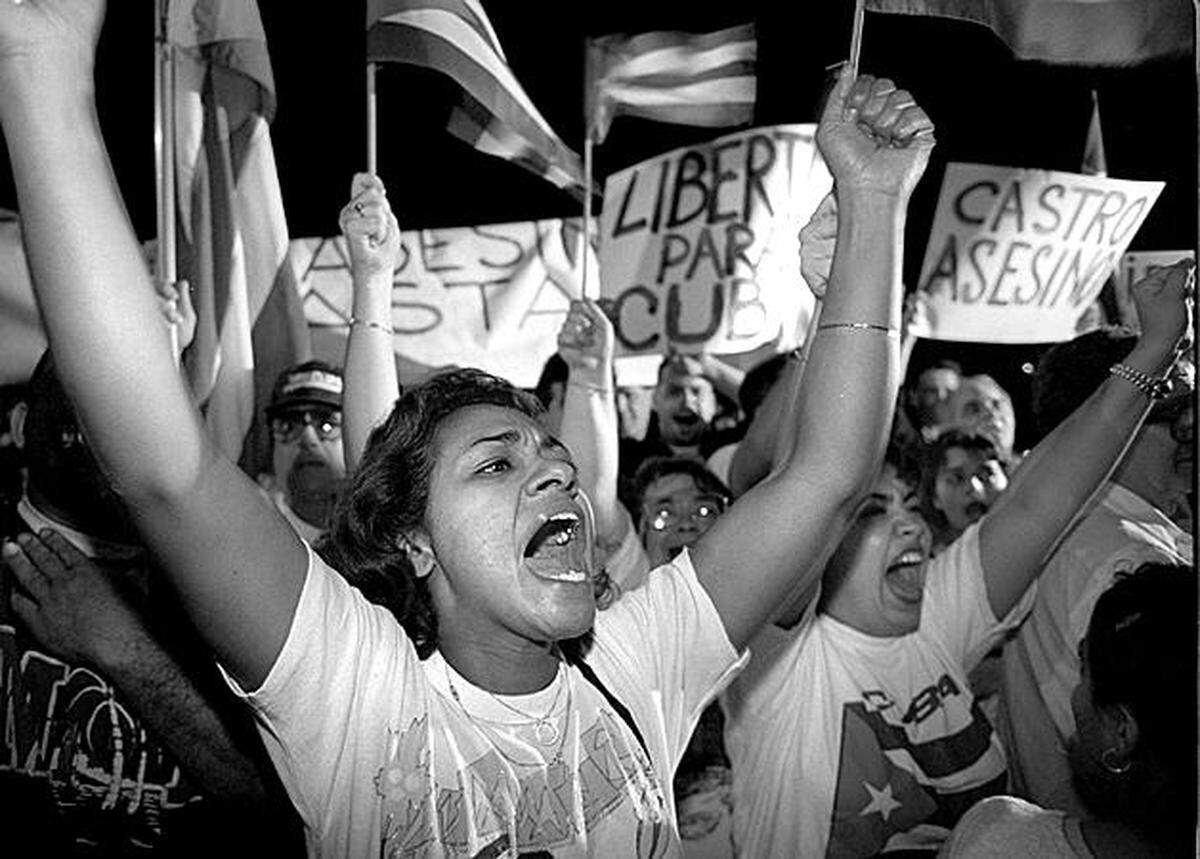
Irma Roman joins hundreds of others protesting against Cuba shooting down Brothers to the Rescue planes. The were outside the Brothers to the Rescue hangar at Opa-locka airport. Chuck Fadely Miami Herald File
Outraged exiles decry ‘act of war’
By Fabiola Santiago, Joanne Cavanaugh and Joseph Tanfani
Anguished and outraged Cuban exiles Saturday condemned as an “act of cowardice” the downing of two Brothers to the Rescue airplanes by Cuban fighter jets.
Some called the Brothers’ thwarted mission “our cry” - a modern-day version of El Grito de Baire, the rebel cry with which 101 years ago Cubans launched the War of Independence against Spain on Feb. 24, 1895.
At the sanctuary to Cuba’s patron saint, La Ermita de La Caridad, the Saturday night Mass customarily transmitted to Cuba through Radio Marti was dedicated to the four missing pilots.
“There are people who will be shortsighted about this and say the pilots knew that it was possible that the government was going to kill them,” said Ramon Rodriguez Rios, 33, a political refugee who came to the United States in August. “But they are simply reclaiming their rights. It’s their country, it’s their sky, and the Cuban government would not permit them to fly there. They never carried arms. It was an act of civil disobedience.”
“This is terrible,” said Miami lawyer and civic activist Rafael Penalver. “This, combined with the repression against Concilio Cubano, shows that the hard-liners are taking control of the political process in Cuba. It is very harmful to any hopes for a peaceful solution.”
The incident hurts recent efforts by the United States to forge democratic change in Cuba through a policy of allowing professional and cultural exchanges and diplomatic missions, Penalver said.
“It shows Fidel Castro is not interested in anything but a process that will bring him investments and more Cuban exiles going to the island to boost his economy,” he said. “We keep waiting for an opening, but that never happens.”
Jorge Mas Canosa, chairman of the Cuban American National Foundation, called for the United States to take strong actions against Cuba.
“For two warplanes of the Castro government to shoot down two unarmed civilian planes with American flags on a humanitarian mission should be considered an act of war against the United States,” Mas Canosa said. “The least President Clinton should do at this point is call an emergency meeting of the Security Council of the United Nations to condemn this gross violation of international law.”
But Eloy Gutierrez Menoyo, who heads Cambio Cubano and seeks a peaceful transition to democracy, said the Cuban government had given Brothers repeated warnings that it would down the planes if they flew close to Havana again.
“We profoundly regret that lives may have been lost in an effort of this kind,” Gutierrez Menoyo said. “We advocate that we all unite in favor of a peaceful solution.”
Many exiles, however, disagreed with that view and said the incident had only renewed their hatred for Castro.
“It’s just one more outrage, one more act of despotism, one more act of murder by Fidel Castro,” said Metro Commissioner Miguel Diaz de la Portilla. “Hopefully those in Washington who favor the soft line will open up their eyes.”
Evelio Ramiro, a Little Havana car upholsterer, swallowed hard when he heard the news. He put his fist to his mouth and blinked away tears. “This is hard. This is going to take me a minute,” he said, shaking his head. “This is like war.”
Some were angry at the United States for not taking a harder stance against Castro.
“The United States knows that Fidel kills whoever he wants to,” Armando Pulido said angrily as he clicked a domino chip hard against a table outside the closed restaurant El Pub, an old Cuban hangout. “They don’t do anything to defend the Cubans.”
Dade and Miami officials heard the news on the way to the Miami Centennial Ball or family outings. Shock soon turned to outrage.
“It makes Castro look that much worse, and that more of a barbarian,” said former Miami Mayor Xavier Suarez. “It’s a totally illegitimate government.”
Suarez said he counseled Brothers pilots about trying to stay within international law and safety guidelines. Suarez said the leaflets are “a way of keeping alive the hope that Castro will leave power. To me they remain heroes.”
Miami City Manager Cesar Odio, on his way to the Brothers hangar at Opa-locka to get more information, said he and the group’s leader Jose Basulto had discussed the dangers.
“Basulto and I have talked about it,” Odio said. “They’re taking a chance every time they do this. They know the risk they’re taking. But I don’t think they ever suspected they’d be shot down.
“That’s cowardice. That’s really an act of cowardice.”
“I’m upset that Castro will shoot these kind of airplanes, for Christ sake. They’re not armed. No civilized country in the world will do that. If that’s true (that they were in international airspace) then that’s an act of piracy.”
Miami’s Cuban radio and television programs were interrupted Saturday with continuous updates. Some stations opened their call-in lines to anguished listeners.
“This is our cry,” a man said on WAQI Radio Mambi. “This is our day of war, the beginning of the end of Fidel Castro’s reign of terror.”
Said Penalver: “This could be the spark the Cuban people need to wake up. Brothers to the Rescue has been a symbol of peace and friendship toward the Cuban people - and the 24th of February is a very significant day in our history.”
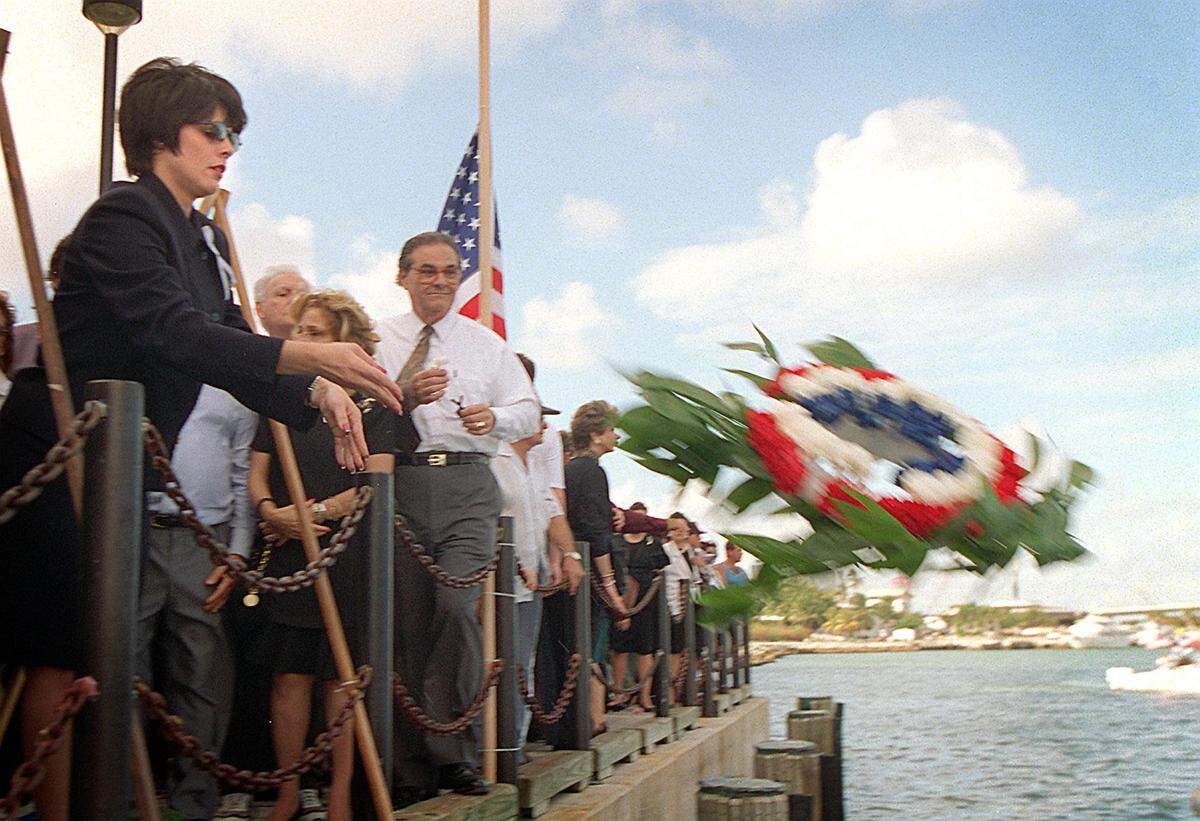
Mirta Mendez, sister of fallen brother to the rescue carlos Costa, throws a reef in Biscayne Bay after a ceremony commemorating the first anniversary of the shoot down over Cuban waters. A.Enrique Valentin Miami Herald File/1997
Pilots dedicated to freedom in homeland
By Andres Viglucci
One is in his 40s, a veteran of anti-Castro protests in Miami. Two others are young but experienced pilots, trained at the famous Embry-Riddle Aeronautical University.
And then there is the fourth: a rafter saved by Brothers to the Rescue pilots who turned around and joined the group.
What Pablo Morales, former rafter, told an interviewer once might stand as a credo for all those feared lost with him Saturday: “I can’t just sit back and watch. I need to do something.”
If they have anything in common besides their membership in the fraternity of Brothers, it is idealism and dedication to the cause of a free Cuba.
The oldest of the four, Armando Alejandre Jr., 45, a towering man at six feet seven inches tall, has been a vocal and hard-to-miss figure at demonstrations in Miami and elsewhere.
“He has always been a militant. He has always been in this country and, yet, always had this yearning to free the land of his father,” said Julio Carbarga, a friend of Alejandre’s.
Together, they were recently elected to a Miami support committee for the Concilio Cubano dissident group in Cuba.
“He has dedicated his life to this,” Carbarga said. “He helped organize the march during the Summit of the Americas during 1994. It does not surprise me that he was up there.”
Alejandre sometimes bodily threw himself into protest. A year ago, he was arrested in Washington after he tried to jump a fence at the Cuban Interests Section during a demonstration. He broke a leg.
Last October, carrying a Cuban flag, he shattered the glass front door of the San Carlos Institute, a Key West landmark built by Cuban emigres. Alejandre said he was upset because the building had been taken over -- briefly, as it turned out -- by a group recognized by the Cuban government.
Born in Havana, Alejandre came to Miami in 1960 with his family. He was 10 years old. At age 18, he volunteered to fight in Vietnam, said his father, Armando Alejandre Sr.
A construction manager for Metro-Dade County, Alejandre, the youngest of four kids, comes from a close-knit family. All live within several blocks of each other in South Miami. He and his wife Marlene have one one daughter, 18, named after her mother. All he told his family before leaving Saturday was that he was going to the Bahamas, said his sister, Ana Alejandre Ciereszko, 47. Though not a pilot, he often accompanied Brothers crews there to take supplies to Cuban refugees detained in Nassau.
The two young pilots are Carlos Costa, who attended Embry- Riddle in Daytona Beach, and Mario de la Pena, who was studying to be a commercial pilot at the school’s Miami campus.
A friend said Costa, who was born in New Jersey and grew up in Miami, worked at Miami International Airport in human resources.
is name is among the most familiar of Brothers pilots: He often answers the phone at the group’s office and serves as their spokesman.
De la Pena, 24, was born in Miami. His parents are Cuban. And though he had never set foot in Cuba, said a cousin, Raquel Perez, he feels very close to the island.
“He believes in the cause of Cuba,” she said. “He believes very much in having those people have their rights and freedom.
“He is very responsible, very religious. He is wonderful, very cheerful, an outgoing person.”
De la Pena was no stranger to risk: When two Brothers planes flew over Havana last year as Cuban gunboats harassed and rammed boats in a peaceful flotilla offshore, he was in one of the aircraft, along with Brothers co-founder Billy Schus.
“He loved doing it,” Perez said. “The first time that he flew over Cuba, he said it was a very emotional experience for him.”
His family worried about him. Before a second flotilla last fall - which de La Pena overflew in one of seven accompanying Brothers planes - he told a reporter his family didn’t want him to go.
In 1992, a Brothers crew spotted a young Cuban rafter on a rickety boat holding up a statue of the Virgin Mary, pointing it toward the plane. It was Morales, who soon joined the group as a spotter while he trained to earn his pilot’s license.
In a 1994 Herald profile, Morales told how he and 11 friends planned the escape for a year, selling items on the black market to make money to buy a 19-foot boat.
“I used to be with the revolution; I felt the passion once,” said Morales, who studied topography at a university in Cuba. “But then I realized that it was all a farce.”
Living alone in an efficiency apartment in Hialeah, he pined for the family he left in Cuba -- his mother, his sister, his brother and his niece.
“He always talked about his family in Cuba,” said a neighbor, Aleida Garcia. “He wanted his mother to come visit. I keep hoping he’s going to drive up, but I think he’s gone.”
During the week, he worked as a salesman for El Sembrador Cuban Products. Neighbors said he had bought a computer and was learning English.
On weekends, he gave back to the people who saved him, flying with Brothers, searching the Straits of Florida for the Cuban rafters who attempt to take that same treacherous voyage he once took.
This story was originally published February 24, 2021 at 6:00 AM.