
With no masks, congregating Miamians prove they can’t be trusted with coronavirus safety | Opinion
Oh, Miami.
If you took a drive on Sunday afternoon from Biscayne Boulevard, mid-town, through downtown Miami, along Brickell Avenue, and crossed the Rickenbacker Causeway into Key Biscayne, you saw throngs of Miamians congregating — most of them without masks.
There were runners and cyclists sharing the sidewalks with walkers and parents with kids on strollers, everyone huffing and puffing without a mask on.
There were people bunched up at lights and street corners waiting to cross an intersection in numbers higher than the recommended 10. And, in front of the Freedom Tower, some 50 people from the Reopen Florida movement staged a demonstration with placards and posed for a group photo shoulder-to-shoulder.
Not a single mask in sight.
The mob-like scene on Rickenbacker Causeway was no different from that of South Pointe Park in Miami Beach, which had to be closed because of the persistent, flagrant violations of coronavirus safety measures of social distancing and wearing protective covering.
Who told all these people congregating in Miami that they could all of a sudden decide to act as if there were no stay-at-home policy in place in the city with the highest number of COVID-19 infections in Florida?
It seems as if after Miami-Dade Mayor Carlos Gimenez announced the opening of county parks, marinas, and golf courses, Miamians took it upon themselves to declare a de facto free-for-all in their city.
I understand their desire to be out on a gorgeous day, but their actions put their lives and those of others around them at risk.
Have they not heard of the infected but asymptomatic?
There are powerful reasons why Miami the city hasn’t begun to open like Miami-Dade the county.
The mayor of Miami, Francis Suarez, saved countless lives when he made the controversial decision to shut down the Ultra Music and Calle Ocho festivals in March, a week before a single case of the novel coronavirus had been reported.
He’s doing it again, this time by bucking pressure to open the city — the epicenter of the state’s hot spot of South Florida — too quickly for the public good.
“I don’t want to hold back the city or the economy or the parks any longer than we have to, but I want to make a responsible decision,” Suarez told me Tuesday. “I haven’t heard that we have met the criteria for Phase 1 opening.”
Suarez was the second Miami-Dade resident listed in Florida’s tally of COVID-19 cases. He only suffered mild symptoms and ended his quarantine on March 30.
Miami most infected city
Miami-Dade County, with 13,224 confirmed cases of COVID-19 and 407 deaths as of Tuesday, leads the state in infections and deaths.
According to the Florida Department of Health, 8,275 of those diagnosed with COVID-19 live in the city of Miami. DOH doesn’t list deaths by city, only by county.
That means 62.57% of the county’s infected live in the city of Miami.
And that number doesn’t include private testing by doctors and clinics, Suarez said. Non-residents who were diagnosed or isolated in the state wouldn’t be included in this DOH data, either.
But you wouldn’t know the extent of the infection by the behavior of some residents.
The “I protect you, you protect me” code of conduct of wearing a mask — which is still in place in the entire county as well, despite some openings, and will continue through the pandemic — has gone out the window.
Just like it did on April 18 when more than 200 gathered near One Miami Condo at 325 S Biscayne Blvd. to hear David Guetta’s two-hour show to raise money for coronavirus relief. Miami police dispersed that crowd.
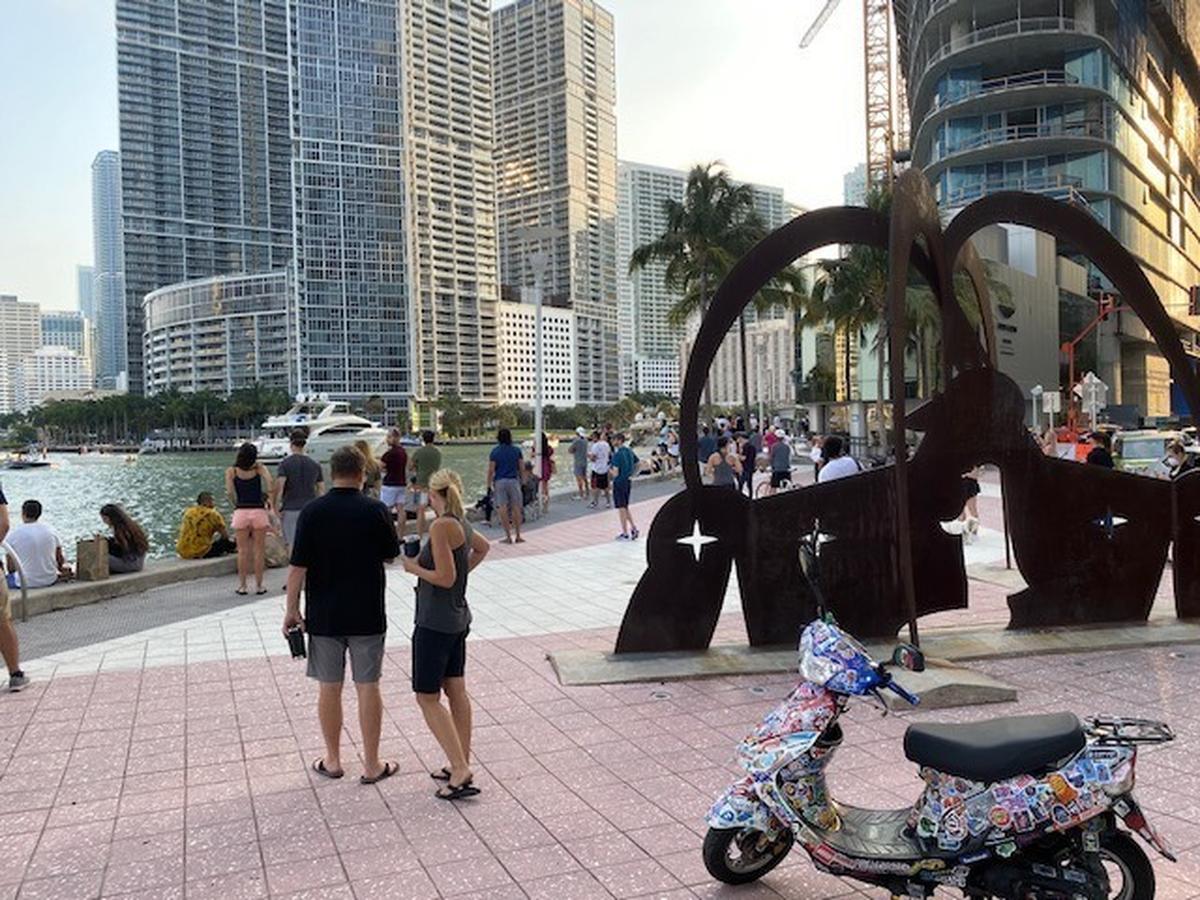
“People are clamoring to go out,” Suarez said, “but do we have the resources as a city to police that? No. Rather than spend money on security guards to police our parks, we spent money on a rental assistance program, a forgivable loan program for small business, and a microloan program to close the gap for people who are suffering between now and when the economy safely opens up.”
He, commissioners, and managers are “working hard” to assess the risk of even a soft opening, “but the data is all over the place,” he said. They’re consulting epidemiologists at Florida International University and the University of Miami as well as DOH, and now, a biostatistician as well.
“I would love to be able to say hopefully soon we have met the criteria or have established a criteria that we are safe,” Suarez said.
But increasing the chances of contamination won’t help achieve that goal.
Breaking mask, distancing rules
Children, too, are breaking face mask and distancing rules.
A large group of children and teenagers without masks was riding bicycles from Overtown to the Venetian Causeway on Saturday, as a video sent to me shows.
Stopped when the bridge went up, they were getting off their bikes and horsing around touching and tousling with each other.
All those kids could be returning home to infect elders. And they, too, could be at great risk, as New York health authorities have reported a coronavirus-linked syndrome that’s sending kids to intensive care.
To be fair, it’s not just Miami running roughshod over coronavirus protocols.
I and other journalists saw many people out and about last weekend in other Miami-Dade and Broward municipalities.
Boat ramps in both counties were packed. Home improvement stores were slammed with people.
But it does seem even more reckless in an international, high-density city leading Florida in infections — and by a long shot.
Breaking face-mask and social-distancing rules will only delay a real substantial opening in Miami, the one we need for people to return to their jobs safely.
Irresponsible residents ruin it for everyone.
They’ve proven Miamians can’t be trusted to obey coronavirus safety rules.
And, they’re giving the mayor more good reason not to open up Miami.
This story was originally published May 6, 2020 at 6:00 AM.
