
Trump’s war with Iran will strengthen Venezuela’s new dictator, Delcy Rodriguez | Opinion
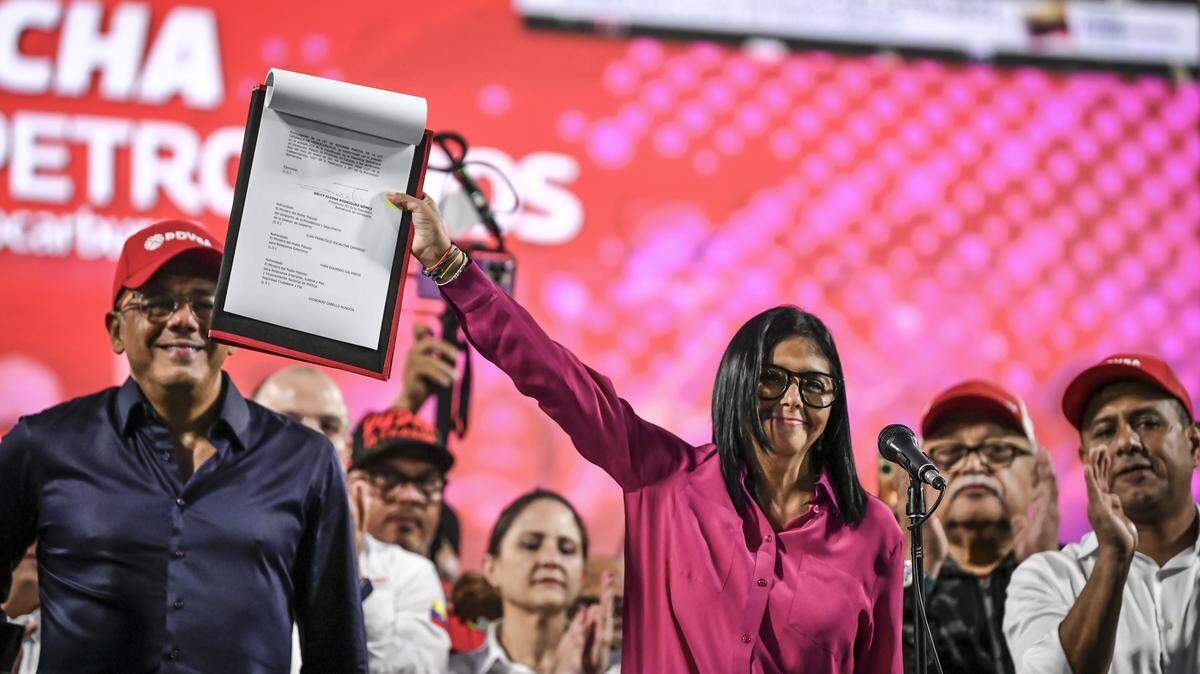
President Trump’s war with Iran and the fall of Supreme Leader Ali Khamenei — arguably the world’s most ruthless autocrat in recent times — may be good news for the world in the long run. But in the short term, it looks like a massive gift to Venezuela’s new dictator, Delcy Rodriguez.
There are three main reasons that Rodriguez, who took over after Nicolás Maduro’s Jan. 3 capture by U.S. forces, stands to benefit from the U.S. war with Iran. These factors are likely to help her consolidate power and potentially postpone any return to democracy in Venezuela.
First, Venezuela will be one of the main beneficiaries of the world rise in oil prices triggered by Trump’ s war. Oil prices jumped 15% to about $82 a barrel in the five days following the Feb. 28 U.S. attack on Iran.
There is a consensus among economists that if the conflict lasts more than a month, oil will hit $100 a barrel or more. After Russia’s 2022 invasion of Ukraine, world oil prices reached $124 per barrel.
Even if Venezuela’s oil refineries are in a shambles, the country sits on the world’s largest oil reserves. If prices soar, the regime’s export income will follow.
Alejandro Werner, a former head of the International Monetary Fund’s Western Hemisphere department, told me that in addition to getting more dollars for its oil exports, Venezuela is likely to get more oil industry investments if the U.S.-Iran war drags on for more than one month.
“In a new world where Middle Eastern oil exports decline or are unreliable, some companies that were hesitating whether to invest in Venezuela until there is a return to democracy will now say, ‘it may be worth taking a risk in Venezuela,’” Werner told me.
Second, Trump’s war with Iran may force him to divert more U.S. military resources from the Caribbean to the Middle East. This would ease the military pressure on the Venezuelan dictatorship to follow Washington’s orders.
The U.S. Navy had already moved the giant air-carrier USS Gerald Ford from the coast of Venezuela to the Middle East shortly before the war with Iran. If the conflict drags on, expect more U.S. troops to follow, reducing the U.S. military presence off the coasts of Venezuela and Cuba.
Third, Trump has already changed his mission goal from “regime change” in Teheran to destroying Iran’s nuclear capabilities. In one interview after another, he’s now citing post-Maduro Venezuela as a model for what he believes would be good outcome in Iran.
This means that Trump’s main priority in Venezuela may not be democracy — in fact, he didn’t even mention the word democracy in his first news conference after Maduro’s capture — but stability. In Trump’s mind, keeping Rodriguez in power to ensure a smooth flow of Venezuelan oil exports to the United States may be better than calling for free elections in Venezuela and risking political turmoil there.
Imdat Oner, a former Turkish diplomat in Venezuela, calls this a “complex moment” for Venezuela’s opposition.
“Trump portrays Venezuela as a foreign policy win abroad, so he would prefer stability over democratic change,” Oner wrote on X. “For Washington, keeping Delcy in power longer could be seen as a useful strategy in projecting an image of success.”
Indeed, Trump has repeatedly praised Rodriguez in recent weeks and cited his capture of Maduro as a major success, even though Venezuela’s repressive regime remains in charge. A Venezuelan popular revolt against Rodriguez at this time could undermine Trump’s narrative for declaring victory in Iran even if the Iranian regime remains in place.
Even before the Iran war, I feared that Trump’s shortage of democratic principles would make him reluctant to start a gradual process for a transition to democracy in Venezuela, mainly because of fears that any potential outburst of political violence there could cost his party votes in the U.S. mid-term elections in November.
I wasn’t wrong about that. It has already been more than two months since Maduro’s capture, and the Trump administration has not yet released a proposed timetable for the appointment of new electoral authorities, the release of all political prisoners, freedom of the press, legalization of banned opposition leaders and free elections.
I hope I’m wrong about this, but now that he’s at war with Iran, I’m even more convinced that Trump will be in no hurry to start a process to restore democracy in Venezuela. The longer this war drags on, the brighter Delcy Rodriguez’s smile will be.
Don’t miss the “Oppenheimer Presenta” TV show on Sundays at 9 pm E.T. on CNN en Español or on YouTube’s “Oppenheimer Presenta” channel. Blog: andresoppenheimer.com