
Chile’s president condemns Putin, but he’s too coy about dictators in Venezuela, Nicaragua, Cuba | Opinion
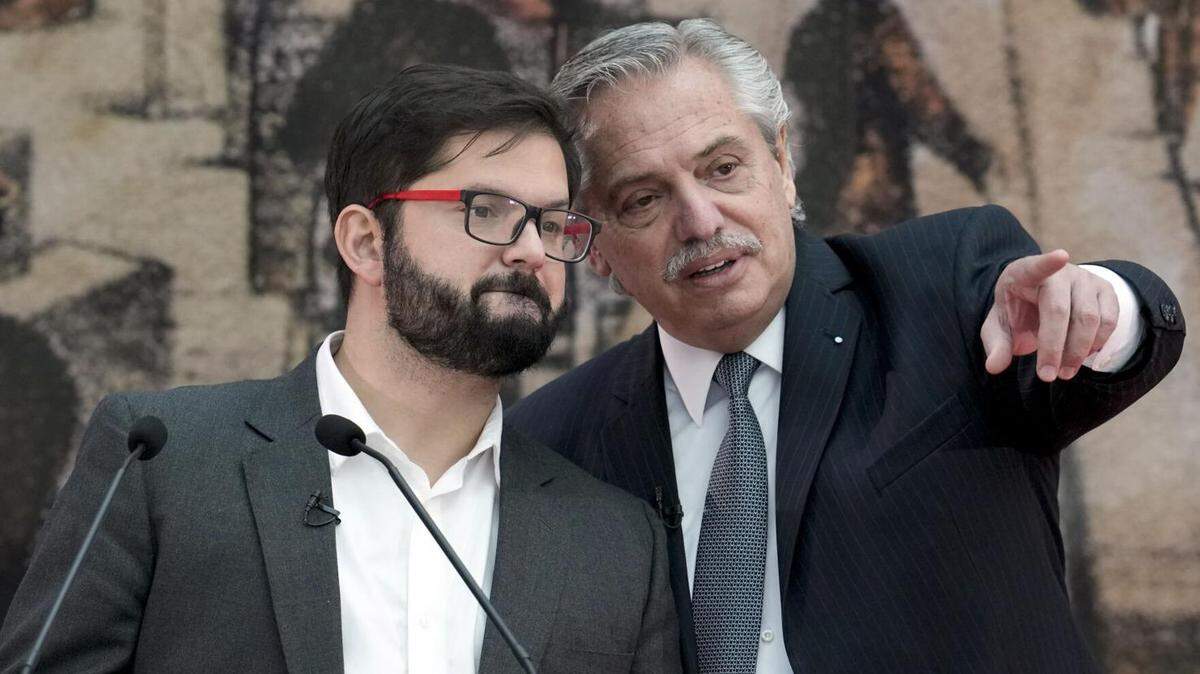
Applaud Chile’s 36-year-old President Gabriel Boric, the new star of Latin America’s left, for his unambiguous condemnation of Russia’s invasion of Ukraine. But he would be much more consistent with his defense of fundamental freedoms around the world if he took a stronger stand on the dictatorships of Latin America.
During a trip to Argentina last week, I was shocked to hear Boric — visiting that country on his first official trip abroad — sidestep reporters’ questions about Venezuela, Nicaragua and Cuba.
During a joint press conference with Argentine President Alberto Fernandez, Boric eluded a question about the three Latin American dictatorships.
“Why do the media always ask me about Venezuela, Cuba and Nicaragua and not about the human-rights violations in our own country [Chile], or about the killings of social activists in Colombia?” he asked. “Let’s not use the suffering of our peoples, be it in Ukraine, Yemen, Palestine, Chile, Venezuela or Nicaragua, to reap political benefits at home.”
A few hours later, when I interviewed Argentina’s foreign minister, Santiago Cafiero, and asked him about human-rights abuses in Latin America’s leftist dictatorships, I got a similar answer.
“Aren’t there human-rights violations in Colombia?” Cafiero asked, repeating the question twice.
While I commend the governments of Chile and Argentina for getting it right on Russia — despite the fact that key members of their respective ruling coalitions support Russia’s autocrat Vladimir Putin — they are using a double standard when it comes to Latin America’s leftist dictatorships.
It is unfair — and misleading — to compare Venezuela, Nicaragua and Cuba with Chile or Colombia. It’s a false equivalency. It obscures the fact that the first three countries are dictatorships, and that their human-rights violations are immensely larger than those of Chile or Colombia.
In Chile, 26 people died during massive anti-government protests in late 2019, in which some demonstrators threw rocks and Molotov cocktails at police and burned public buildings, according to the Human Rights Watch advocacy group.
In Colombia, in addition to kidnappings and deaths by guerrilla and paramilitary groups, 49 human-rights defenders were killed in the first 10 months of 2019, and another 50 suspicious deaths there were being investigated, according to the U.N. High Commissioner for Human Rights.
While every death is one too many, they amount to a tiny fraction of the extrajudicial killings in Venezuela, Nicaragua and Cuba.
In Venezuela, dictator Nicolás Maduro’s security forces killed more than 19,000 people for alleged “resistance to authorities” between 2016 and 2019, the U.N. High Commissioner for Human Rights says.
In Nicaragua, a country of only 6.6 million, at least 355 people were killed in anti-government protests in 2018, according to the Inter-American Commission of Human Rights.
Cuba, which has not allowed a free election in six decades, recently sentenced more than 100 people who participated in last year’s massive pro-democracy protests to draconian prison terms ranging between four years and 30 years.
How can any well-informed leader compare in good faith what’s happening in Chile or Colombia with what’s happening in Venezuela, Nicaragua or Cuba? It’s not even remotely close.
To be fair, Boric has in the past condemned human-rights abuses in Venezuela and Nicaragua — not so much in Cuba — and has picked a foreign minister who is known to fight for fundamental freedoms.
But the Chilean president’s evasive answer at the press conference in Argentina is dangerous, because it has been taken as a mantra by influential Latin American figures. It should not be allowed to go unchallenged.
Boric should follow his own advice, during his visit to Argentina, that governments respect and promote human rights “in all countries in the world,” regardless “of their political color.”
That, President Boric, applies to the rulers of Venezuela, Nicaragua and Cuba. Instead of giving them a pass, you should denounce them for what they are — ruthless dictators.
Don’t miss the “Oppenheimer Presenta” TV show on Sundays at 7 pm E.T. on CNN en Español. Twitter: @oppenheimera Blog: www.andresoppenheimer.com
This story was originally published April 13, 2022 at 4:41 PM.