
Party of Peru’s leading presidential candidate is Marxist — and wants to nationalize everything | Opinion
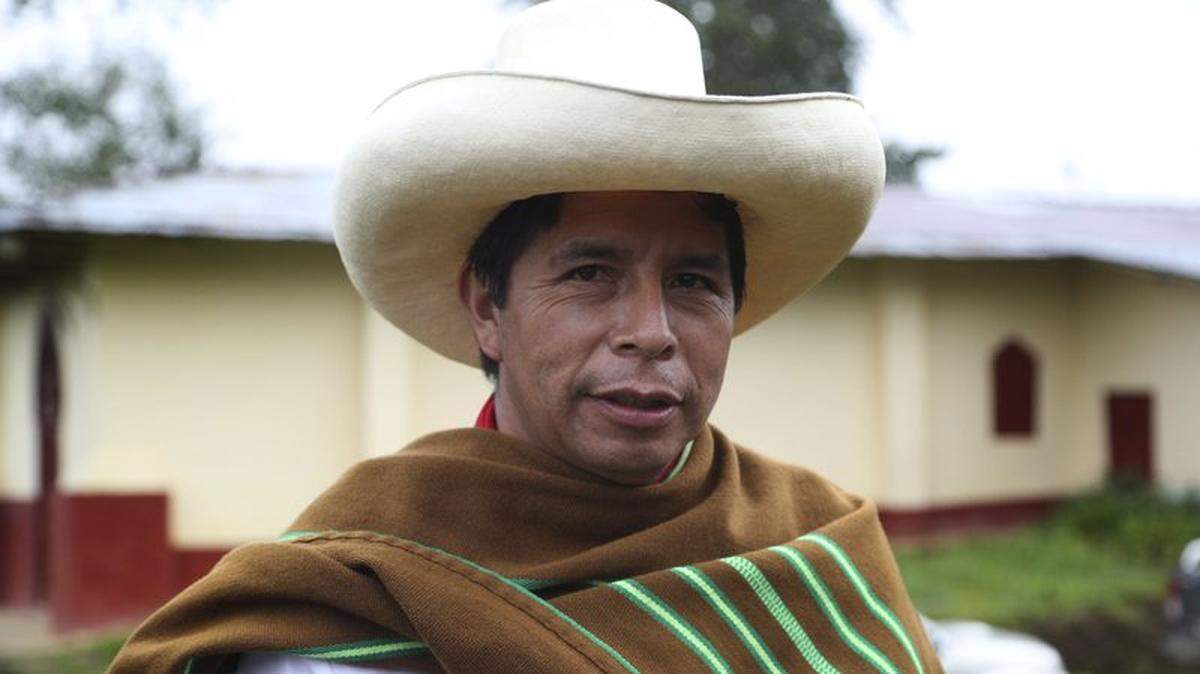
If front-runner Pedro Castillo wins Peru’s June 6 presidential elections, he could be the most radical leftist candidate to win a Latin American election in recent years. The platform he presented to run for the first-round election in April looks like it was lifted from the Russian Revolution in 1917.
Castillo, 51, was an unknown elementary school teacher and union activist who rose to prominence when he led a 2017 teachers union strike. His rival in the runoff elections, right-wing candidate Keiko Fujimori, says that he would turn the country “communist” if he wins.
In recent days, I read the full 77-page political platform with which Castillo’s Perú Libre — Free Peru — party registered his candidacy for the April 11 first-round vote. Although Castillo replaced it with a shorter and politically lighter version after winning that vote — likely in hopes of capturing moderate voters — the document says a lot about where he’s coming from.
The document, “Peru Libre: Ideas and Program” was written by party founder and secretary general Vladimir Cerrón, a Cuban-trained physician and former state governor who describes himself as a Marxist. He was quoted by the daily Gestión as saying in 2019 that, “The left has to learn to remain in power, and that’s what it has done in Venezuela.”
Cerrón appointed Castillo to run as his party’s candidate after being banned from running himself because of a five-year prison sentence on corruption charges.
The party document’s first chapter, “About the Party’s Nature,” says that it is “a leftist socialist organization,” adding that “to be leftist, one has to embrace the Marxist theory” and Marxism-Leninism.
Its second chapter, “Toward a New Political Constitution,” says that once the party attains power, it will draft a new constitution, a document that will pave the way for a “sovereign” country that no longer will be “subjugated” to “the government of the United States” and international financial institutions.
The third chapter, “New State Economic Order,” says that multinational firms will have to pay 80 percent of their profits to the Peruvian government. If they refuse, Peru may go forward with their “nationalization.”
In the fourth chapter, “A New Public School System Aimed at Liberation,” the party calls for a new school system that will form citizens who “will be autonomous and revolutionary.”
In its sixth chapter, “About Transportation and Media Policies,” the document says that Peru’s high concentration of news media in the hands of a few private companies “must not only be fought against, but prohibited.”
A subchapter, “Lenin and Fidel,” concludes that Russian Revolution leader “[Vladimir] Lenin was right in saying that the true freedom of the press in a society will only be possible once it liberates itself from the yoke of capital.” It later quotes a similar statement by late Cuban dictator Fidel Castro.
Castillo’s latest political platform, which he presented in May, looks kinder, gentler, but it’s not too different. It vows to convene a referendum to draft a new constitution, which would replace the current one that it claims “prioritizes private interests over the public interest and profits over life and dignity.”
Castillo’s plan is a copy-and-paste version of the Chavista manual, which has been used in Venezuela, Bolivia and Ecuador: You win elections, use your political honeymoon to replace the constitution, then enact a new one that allows you to stay in power indefinitely.
It sounds crazy that Peru, which has been pretty successful in reducing poverty during the past two decades, would choose to go that route.
But it’s part of the political aftershocks of the COVID-19 pandemic, which has ruined the economy. There are record levels of unemployment, which are driving many Peruvians to seek radical — or, rather, magical — solutions.
Fujimori, too, has authoritarian genes. She’s the daughter of Alberto Fujimori, the right-wing president who illegally shut down Congress in 1992. And she’s also facing corruption charges.
But there’s a big difference between Fujimori and Castillo.
While Fujimori promises to respect the rule of law and has surrounded herself with former critics with strong democratic credentials, Castillo vows to change the constitution to create a de facto authoritarian state and he kept Cerrón as his party’s leader. With Castillo, Peru may choose a road with no return.
Don’t miss the “Oppenheimer Presenta” TV show on Sundays at 8 pm E.T. on CNN en Español. Twitter: @oppenheimera
This story was originally published May 26, 2021 at 5:49 PM.