
Argentina willing to support modern-day slavery by inviting 500 Cuban doctors | Opinion
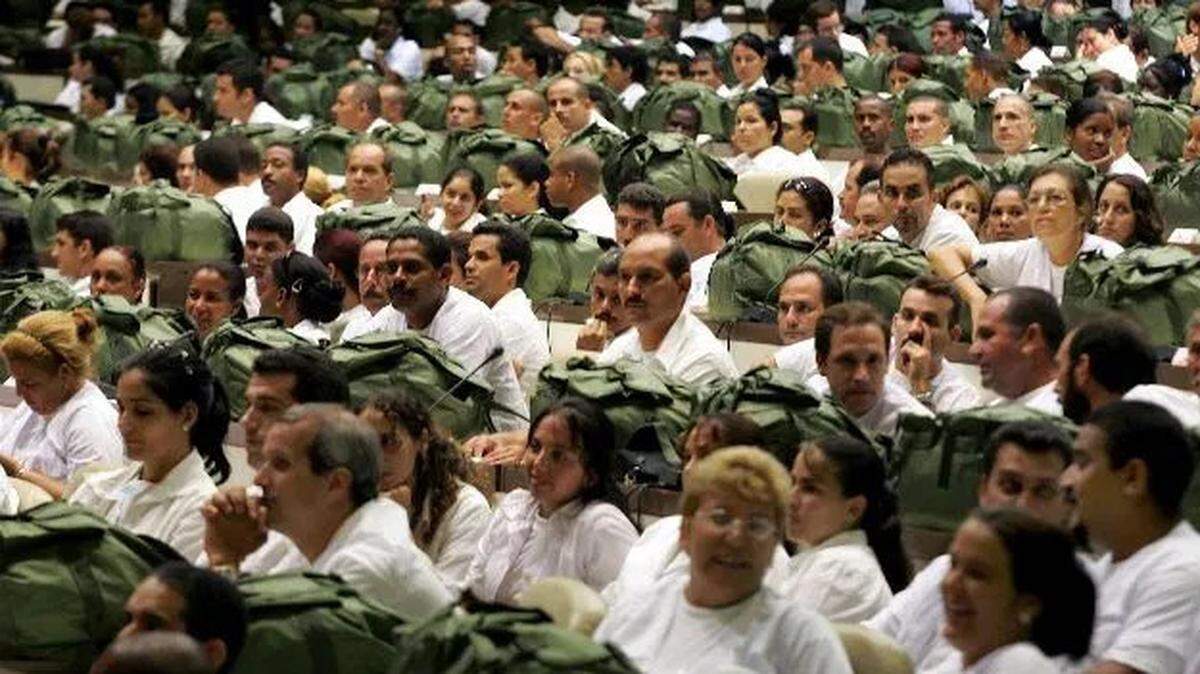
Argentina’s government plan to import up to 500 Cuban doctors to help fight the coronavirus pandemic is one of the most scandalous human rights, economic and public-health decisions in Latin America’s efforts to contain the disease.
Argentina will spend millions of dollars to pay for Cuban workers who in most cases — judging from other countries’ recent experiences — are not even physicians by international standards. Argentina has made a shameful decision.
First, Cuba’s state-run program of exporting doctors for profit amounts to a modern-day slave trade.
I have been writing on this issue since 2013, and Cuban doctors in several countries have consistently told me that they are only paid between 10 percent and 25 percent of what countries pay the Cuban dictatorship for their services. About 80 percent of the money goes to the regime, and 5 percent to the Pan American Health Organization, which is a willful broker of these agreements.
In Brazil, the government had been paying $3,400 a month per doctor to Cuba. But the Cuban physicians only were receiving an average of $790 a month. Several Cuban doctors in Brazil have defected and filed lawsuits demanding payment of their full salaries.
According to a study by the Wharton School at the University of Pennsylvania, there were about 37,000 Cuban doctors in 77 countries in 2015, most of them in Venezuela, Brazil and Central America. Cuba earned about $11 billion a year from this human trade at the time, but that amount has fallen recently because of the expulsion of these doctors from Brazil, Uruguay, Ecuador and other countries.
Second, Argentina is bankrupt and on the brink of defaulting on its foreign debts. How can it afford spending millions in Cuban doctors? If Argentina pays Cuba what Brazil and other countries have been paying per doctor, it would have to pay more than $20 million a year for the 500 doctors.
Third, Argentina doesn’t even need more physicians. It sits among the Latin American countries with most physicians per capita. According to the World Bank, Argentina has four doctors per 1,000 people. To compare, Finland has 3.8 doctors per 1,000 people, the United States 2.6, Brazil 2.1, Mexico 2.2 and Chile 2.0.
Not surprisingly, Argentina’s Confederation of Physicians sent a letter to the country’s health minister saying that, “There are enough physicians in quantity and quality to face any emergency.” A petition on Change.org to cancel Argentina’s plan already has gathered more than 100,000 signatures.
What’s more, there are about 700 Venezuelan exile doctors already in Argentina waiting for professional licenses, according to Yang Alvarez, international coordinator for the Association of Venezuelan Physicians in Argentina.
Also, as of last week, there were more than 100 Argentine doctors who have been stranded overseas since the outbreak of the COVID-19 pandemic, says Andrei Serbin Pont, an analyst with the Argentina-based CRIES Latin American regional think tank.
“It would be much more efficient to bring back the 100 Argentine doctors who want to return to the country, and to allow the 700 Venezuelan doctors who are already here and are waiting for their licenses to start working,” Serbin Pont told me.
Fourth, many of the so-called Cuban doctors that the island sends abroad are nurses, non-medical workers or security agents. When Bolivia recently expelled its 702 Cubans who were said to be doctors, the Bolivian health minister disclosed that only 205 of them were healthcare professionals.
Summing up, there are no legitimate reasons for Argentina to pay for doctors from Cuba.
Most likely, it’s Argentina’s former president and now Vice President Cristina Fernandez de Kirchner’s way of paying Cuba back for its regime’s willingness to host her daughter Florencia for a reported medical treatment last year. Florencia moved to Cuba after she was found to be hiding $4.6 million in undeclared funds in two bank safe boxes in Argentina.
Whatever the real reasons behind Argentina’s decision to bring in 500 Cuban doctors, it amounts to endorsing slave labor and makes a mockery of the government claim to be a champion of human rights.
Don’t miss the “Oppenheimer Presenta” tv show Sunday at 8 p.m. E.T. on CNN en Español. Twitter: @oppenheimera
This story was originally published April 22, 2020 at 6:27 PM.