TPS work permits extended two weeks, but unions, airport brace for firings
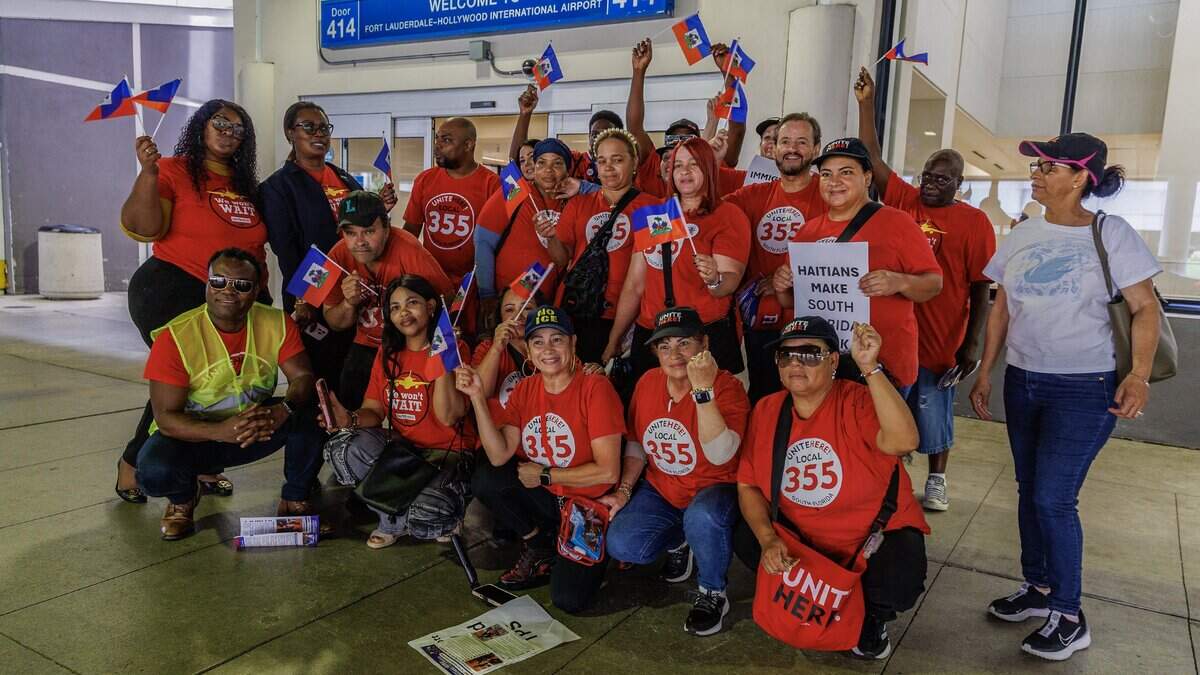
Dozens of airport workers, labor organizers and community leaders gathered at Fort Lauderdale-Hollywood International Airport on Friday as work permits were coming to an end for thousands of Haitian immigrants in South Florida. Last year, over 32 million passengers travelled through Fort Lauderdale International Airport — and in the coming weeks, about 170 employees that clean terminals, ferry disabled travelers and staff stores and restaurants could lose their legal permit to work.
On Friday, the day work permits for Temporary Protected Status beneficiaries of seven countries were due to expire, the Trump administration extended them for two weeks.
The news is a welcome relief to those affected, but still leaves businesses, workers, and communities scrambling to figure out what will happen next. Already, some employees have been put on notice or placed on leave at the airport and other places around the city.
On Friday, a group of affected workers and advocates gathered at the Broward airport to call for an extension on the protections of over 350,000 Haitians and other TPS holders. Workers and advocates say losing those employees will cost the airport knowledgeable workers and leave their families without means to support themselves.
“More thoughtful employers are putting [TPS holders] on administrative leave,” rather than outright firing them, said Wendi Walsh, general vice president of Unite Here, a union representing 300,000 hotel, food service, and airport workers, including at Fort Lauderdale, across the U.S. and Canada.
Walsh said a number of TPS-holding union members at the Fort Lauderdale airport had already been fired or put on administrative leave due to the loss of their work authorization.
“Everybody is scared. Everybody’s walking on eggshells, because they don’t know what’s going to happen. It feels like a waiting game,” Michelle, a Fort Lauderdale airport worker, told the Miami Herald, during a separate rally at the Little Haiti Cultural Complex on Thursday night. She did not share her last name because her aunt is a TPS holder.
The situation at the Fort Lauderdale Airport is also a microcosm of the devastating impact the end of Haiti’s TPS protections will have on South Florida, they say. There are an estimated 90,000 Haitian TPS holders in the Sunshine State – half of whom live in the Miami metro area – working as home health aides, nurses, teachers, business owners, and in other jobs.
That doesn’t include the tens of thousands of Venezuelans who lost their work permits under TPS last fall and live in Florida as well.
One Haitian woman from Jacmel, who asked not to be named because she fears being deported back to Haiti, works at the airport as a cleaner and has lived in the U.S. for a decade. Obtaining TPS changed her and her children’s life. She was able to buy a house for the family.
But should she lose her work permit, she doesn’t know how she will afford her mortgage. She can’t sleep, avoids leaving her house as much as possible, and turns down social invitations. She’s stopped driving to avoid any potential interactions with police. The stress has worsened her hypertension and now she fears she won’t be able to buy her medication if she loses health insurance along with her job.
“We are not living, we are just not alive,” she said.
READ MORE: ‘I am breathing, but I am not living’: Fear rises among Haitians as TPS end nears
Michelle is a U.S. citizen of Haitian descent. But she has coworkers and family members, including her aunt, who are on TPS.
Her aunt, who declined to be interviewed because she is afraid of being deported, came to the United States under the now-defunct parole program put in place by the Biden administration. Originally from Île de la Tortue, an island off Haiti, coming to the U.S. signified reuniting with her siblings, nieces, and nephews and leaving behind extreme insecurity.
When her aunt first arrived, she was going to night school to learn English and ran errands like shopping for groceries on her own, said Michelle. Now, she won’t leave the house where she works as a home health aide seven days a week because she is so scared of being picked up. When she’s home, she won’t even go to the corner stone, and Michelle will often run out to run errands for her.
“Seeing her frustrated and scared, just tears our heart. Her not knowing if it’s going to be her last day in the United States, knowing there’s nothing to go back to because everybody is here and she sold everything before leaving,” Michelle said.
The expiration of the work permits for Haitians, as well as Syrians, comes less than a month after the U.S. Supreme Court ruled that the Trump administration could end TPS for over 350,000 people from those countries. Lower courts had upheld the protections, ruling that comments Trump and his top officials made about Haitians showed racial prejudice in the decision-making process.
But the nation’s top court ruled that TPS decisions by the executive branch made were not reviewable by the courts barring constitutional violations claims, which greatly limits the ability of beneficiaries, advocates and lawyers to challenge them. Experts say that will also have implications for other designations beyond Haiti and Syria.
As part of his mass deportation agenda, President Donald Trump has worked to systematically end the TPS designation for several countries, which his administration says was always designed to be temporary. So far, the administration has moved to end or end TPS for Haiti, Syria, Honduras, Nicaragua, Afghanistan, Myanmar, Cameroon, Ethiopia, South Sudan, Nepal, Yemen, and Somalia.
Congress created TPS in 1990 to grant work permits and deportation protections to people who were in the U.S. already and could not return to their home countries because of war, natural disaster and other dangerous conditions.
TPS can be renewed indefinitely in increments of six, 12 or 18 months, depending on the safety conditions of the country in question. And unlike asylum or other refugee resettlement programs, TPS does not itself provide a pathway to permanent residency or citizenship.
Internal documents published in the Supreme Court case revealed that former DHS Secretary Kristi Noem ignored federal law by forging to review conditions in consultation with the State Department, according to emails between agency officials.
Though some current and former TPS holders have work authorizations through other immigration processes, such as seeking asylum and applying for green cards, the termination of the program has left them vulnerable to detention, deportation, and unable to work.
On Friday, the Department of Homeland Security was expected to decide whether it will renew or extend the TPS for about 170,000 Salvadoreans. El Salvador is the country with the longest-running designation under the federal program. About 150,000 U.S. citizen children depend on a parent who is a Salvadorean TPS holder. People under that country’s designation add about $5.4 billion to the U.S. economy annually and pay $1.5 billion in taxes, according to the National TPS Alliance.
This story was produced with financial support from supporters including The Green Family Foundation Trust and Ken O’Keefe, in partnership with Journalism Funding Partners. The Miami Herald maintains full editorial control of this work.