
They called 911 for help. Police sent them to ICE detention instead
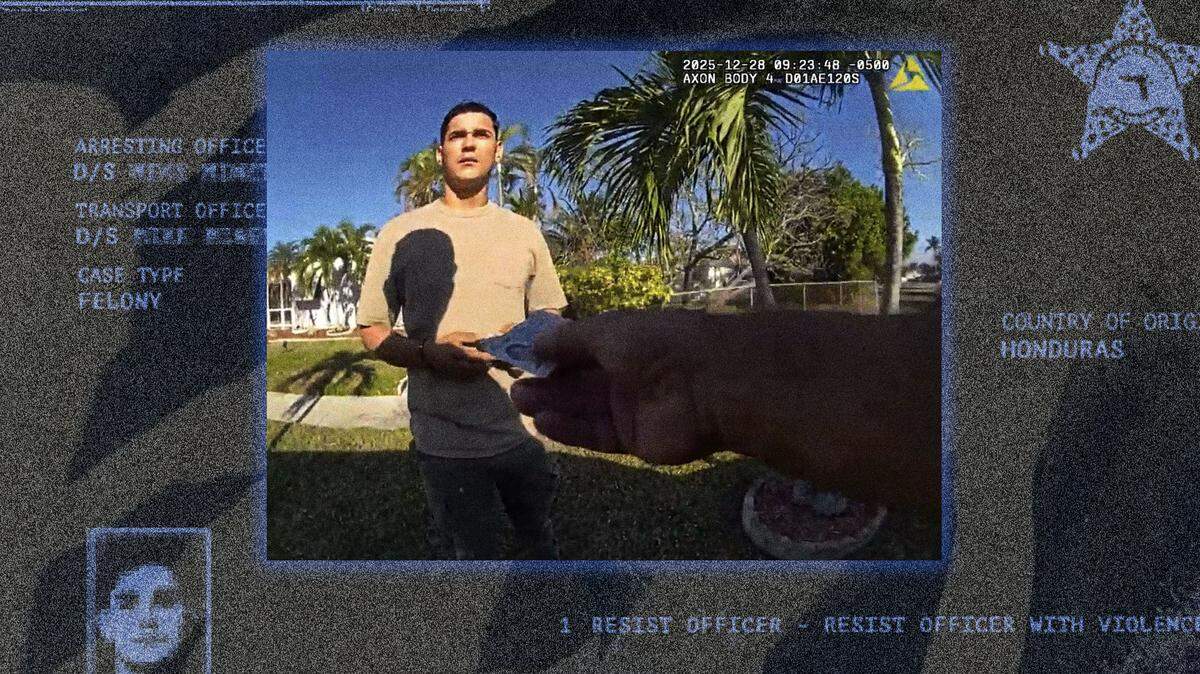
The encounter with the sheriff’s deputies was cordial at first. Axel Sanchez Toledo had called 911 in December to ask the Palm Beach County Sheriff’s Office for a welfare check on his 4-year-old. He shared custody with his ex, and had heard his daughter was sick, he told one deputy, as he stood next to his girlfriend and their infant son.
The deputy asked Sanchez Toledo questions, took his driver’s license and disappeared into a patrol car, body camera footage shows. When the deputy reemerged, he offered another resolution: He accused Sanchez Toledo of being undocumented and said he was being detained for ICE, court records show.
Sanchez Toledo ran, with the two deputies in pursuit. He was shocked with a Taser gun, kicked and tackled, while his girlfriend pleaded with deputies to stop. “Please, guys, I’m not a criminal,” Sanchez Toledo moaned, insisting he had documentation — a pending asylum case, his attorney later said. “I don’t want to go.”
“Too f---ing bad now!” one deputy screamed.
“He just wanted to know about his daughter,” his girlfriend cried. “Why would you guys do this?”
The deputy who arrested Sanchez Toledo was part of the sheriff’s office’s 287(g) Task Force, an arrangement with ICE that allows local police officers to enforce federal immigration law.
As more local law enforcement agencies rush to join President Donald Trump’s anti-immigration dragnet, arrests such as Sanchez Toledo’s reveal a rapidly shifting public safety landscape: Routine police interactions are leaving even some crime victims and people who call 911 for help vulnerable to detention and arrest, The Marshall Project has found.
Lured in part by federal payouts, more than 1,100 law enforcement agencies across the country have signed agreements with ICE, with the heaviest concentration in Southern states. By some estimates, the number of local officers who are deputized to make immigration arrests in the U.S. now outnumber the roughly 12,000 new ICE agents hired during this administration.
Borrowing from Trump’s playbook, local officials have repeatedly said that their goal is to pursue “bad guys,” and have sought to reassure concerned constituents that it is still safe to call the police.
“Do not be afraid of the Sheriff’s Office,” Palm Beach County Sheriff Ric Bradshaw said at a community event last year. “If you’re a victim of a crime, we’re going to be there to help you. We’re not there to deport you.”
But in Florida, the state leading the country in the number of signed agreements with ICE, Bradshaw’s agency serves as a stark reflection of how rapidly the immigration crackdown is expanding to people seeking police help.
The people detained by the Palm Beach County Sheriff’s Office include a restaurant employee reporting information on a possible burglary, a mom who reported a theft and asked for help with her son, a crime victim who was in a minor fender bender while taking his son to school, and Sanchez Toledo, who was also charged with resisting arrest.
Only about 150 of the department’s 1,500 officers are deputized to make immigration arrests, agency records show, but they arrested an average of more than 60 immigrants per month between September 2025 and March, among the highest in the state. Since signing the agreement, the Department of Homeland Security has paid the Sheriff’s Office almost $1 million in immigration-related reimbursements and other incentives, according to payment records obtained by The Marshall Project.
Sheriff Bradshaw, a Democrat who has been in office for more than two decades, did not agree to an interview for this story. Instead, his office sent The Marshall Project a public relations video from March, in which Bradshaw said the agency would detain people in “a normal course of business” if they were wanted by ICE. “Our emphasis is on the bad guys,” Bradshaw said. “The people that are involved in narcotics and gang activity.”
In an email, a spokesperson for the Department of Homeland Security said Sanchez Toledo was now subject to deportation proceedings. The email also said that “illegal aliens are not welcome in the United States.”
After ICE’s aggressive tactics in Minneapolis and other cities faced widespread public backlash, the task force agreements with local police have emerged as a quieter way for the administration to enforce federal immigration law — without incurring the same level of scrutiny.
The 287(g) Task Force agreements have existed in a more limited form for years. The Obama administration suspended the program after finding that several local departments had engaged in racial profiling and civil rights abuses. Those included the Maricopa County Sheriff’s Office in Arizona, where then-Sheriff Joe Arpaio notoriously transformed the agency into an immigration enforcement arm. The first Trump administration restarted the program. In this second term, the administration is offering cost reimbursements and incentive payments, encouraging agencies to carry out ICE directives as often as they can.
But critics of the program say concerns about racial profiling and civil rights abuses persist, now in a vastly different regulatory and political environment. Training for local officers in the program is now shorter than under previous administrations. Trump has gutted the Department of Justice’s arm that investigates local departments for possible civil rights abuses. And the Department of Homeland Security effectively eliminated its in-house watchdog, the Office for Civil Rights and Civil Liberties, leaving the ICE task force program with less oversight, according to Peter Mina, a former DHS official.
“It’s not like they’re short on cash. So I think if they wanted to put the resources into it, they could. They just don’t because they just see it as a speed bump,” said Mina, a former deputy officer at the watchdog office, which previously conducted inspections and investigations of local task force agencies.
The display of brutal tactics by many ICE agents, combined with the lack of training and oversight, Mina said, sends a clear message to participating local law enforcement: “The message is [do it] by any means necessary.”
Several states — including Florida — have passed laws requiring or encouraging local law enforcement agencies to sign agreements with ICE. In Florida, Gov. Ron DeSantis and Attorney General James Uthmeier have gone after municipalities that refused or tried to institute policies limiting immigration enforcement actions.
As local officers have gotten more involved in anti-immigration efforts, some communities have become increasingly fearful of the police.
Mariana Blanco, the director of operations for the Guatemalan-Maya Center, an advocacy and aid group in Lake Worth, Florida, said the task force agreements in Palm Beach have changed deputies’ relationship with the community, and many residents now avoid reporting crimes.
“In the past, we would always say you need to call PBSO. But now we’re thinking twice about it, even when it’s a crime we would have reported previously,” Blanco said. “Because we have seen so many times, the ones to come are harming rather than helping them.”
Figures compiled by the state do not indicate how many immigrants detained by local agencies had called police to report a crime or seek help. But numerous attorneys across Florida described clients who were detained after reporting crimes or calling 911. Most of their clients were too scared to speak publicly, citing fear of retaliation.
The Marshall Project reviewed dozens of incident and offense reports and interviewed advocates, attorneys and individuals in Palm Beach County who encountered the Sheriff’s Office. They described deputies regularly stopping people for questioning, sometimes flagging minor infractions or not citing any reason at all. In records of several encounters reviewed by The Marshall Project, deputies ignored people’s claims that they had documentation and detained them anyway.
In December, a father was driving his son to school when he got into a minor fender bender and stayed at the scene to wait for the police.
Seven years earlier, the father and his family had received a U-visa certification from the Palm Beach Sheriff’s Office after his wife was the victim of a shooting, visa records show. The couple — Ramon and Elsy — asked to be identified by their first names only, citing fear of retaliation. They worked closely with sheriff’s detectives to prosecute the shooter. Their visa application was approved, their lawyer said.
So when a deputy arrived at the scene of the crash in December, Ramon explained that he had documentation. “You know what’s going on in the world, right?” the deputy is seen telling him in the body camera footage, as he cleaned his fingernails with Ramon’s driver’s license. “You should carry that stuff on you.”
Ramon said he could get a copy of the U-visa processing documents, and called his wife to ask her to send it to him. But the deputy didn’t wait to see the records. Within minutes, he handcuffed Ramon and accused him of being in the country illegally. Ramon spent about three months in detention before he was released. He said he never got his driver’s license back.
The couple said they once trusted police officers. Now they fear them.
“Who are we going to call if something happens to us, if we don’t want to call the police, who are supposed to protect us and make us feel safe?” Elsy said in Spanish.
They are far from the only locals who say they now avoid the police. In several arrests reviewed by The Marshall Project, people fled when they spotted officers, fearing deportation. Among them was a woman selling homemade food out of the back of her car, and a man who was riding home on his bicycle from the store without a functioning headlight.
Deputies charged them criminally with resisting arrest, another funnel to ICE. Defense attorneys in Palm Beach County said they have recently seen an increase in such cases. “Come here, I’m not ICE,” one deputy sought to assure a man who was at a CVS store when a shoplifting incident was reported. The man tried to flee, and deputies caught up to him, struck him until he complied, and arrested him on a charge of resisting arrest, the incident records show. Court records show that the man was sent to ICE custody.
Defense attorneys said the cycle of arrest and ICE detention is now clogging local courts with the types of low-level cases often filed during those arrests. Many of those cases, however, are left unresolved as families post bail, only to see their loved one promptly picked up by ICE.
“It’s a regular thing where people bond out and just disappear,” said Tyler Obenauf, a public defender in Palm Beach County. He and other defense attorneys said that they now advise their clients who also face potential transfer to ICE not to pay bail.
“We tell them: Do not post bond. If you post bond, you’re not going to get out, immigration is going to come get you,” Obenauf said. He said when a client disappears into ICE detention, it can become impossible to mount an effective defense.
The evidence in these arrests is rarely put under a microscope. But in the case of Sanchez Toledo, the father who called 911 for a welfare check, the body camera footage provides a lens into how some local police are acting as they detain people for ICE.
As Sanchez Toledo complained of pain from the handcuffs, the deputy who arrested him insisted on cuffing him with a second pair.
After Sanchez Toledo was loaded onto an ambulance for his injuries, the deputy took his dusty brown cowboy boots and held them up in the air. “Not running now,” the deputy said to other deputies, before chucking the boots onto the floor of his patrol car.
The officer also opened the door of a nearby car, where Sanchez Toledo’s girlfriend sat in the driver’s seat crying and trying to comfort their infant son. “You better go, or you’re going to get arrested. Time for you to leave. He’s going back to Honduras,” the deputy said, before slamming the door.
For four months, Sanchez Toledo sat in the Palm Beach County jail, awaiting trial on the resisting arrest charge. On April 29, prosecutors agreed to drop the case — if Sanchez Toledo would write a letter of apology to the deputy who arrested him. Sanchez Toledo complied.
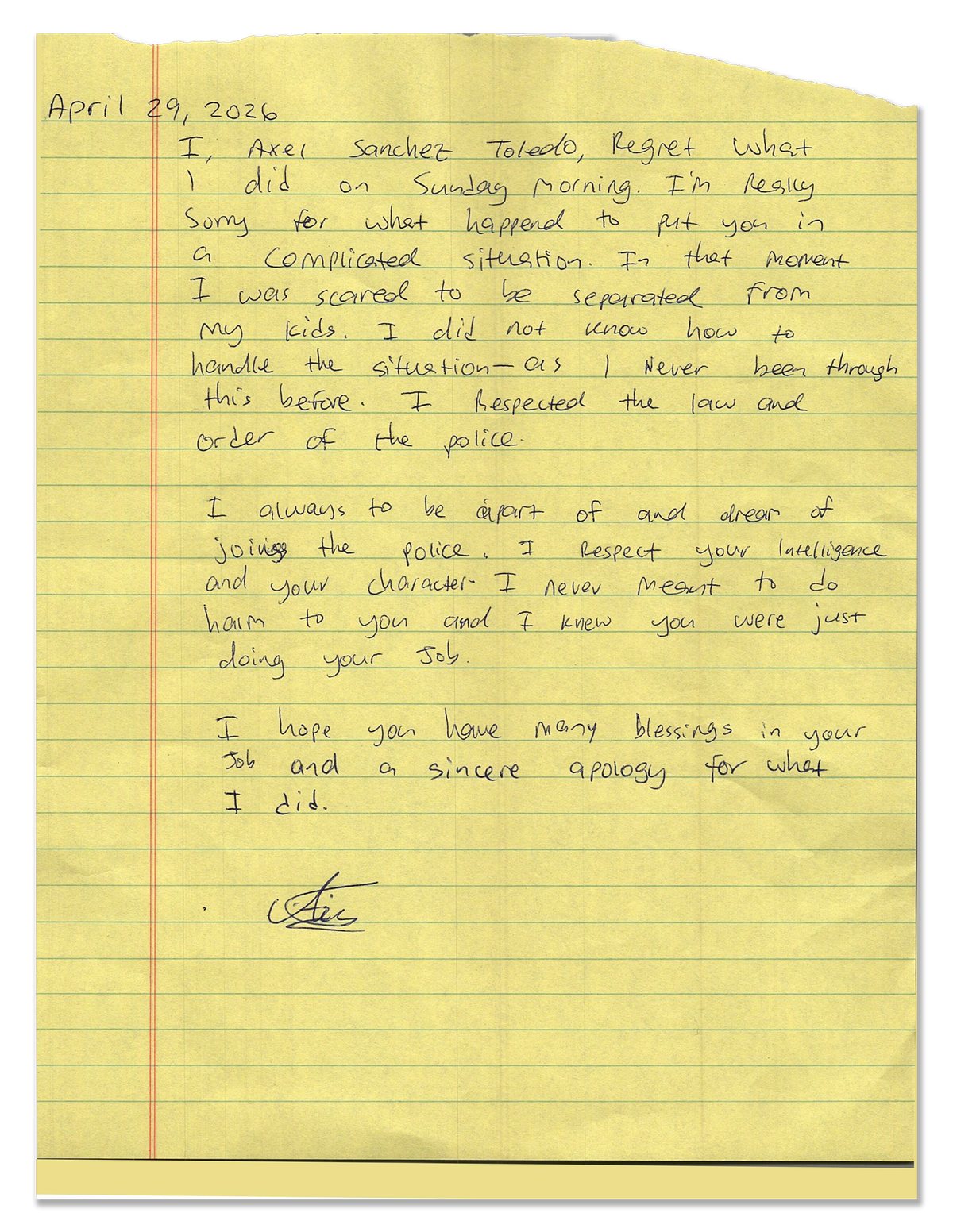
“I’m really sorry for what happened to put you in a complicated situation,” wrote his lawyer, Isai Bonilla, translating Spanish dictation from Sanchez Toledo. “In that moment, I was scared to be separated from my kids. I did not know how to handle the situation — as I never been through this before. I respected the law and order of the police.”
Prosecutors promptly dismissed the charge. But Sanchez Toledo remained in the Palm Beach jail. On May 1st, ICE picked him up, and now he sits in immigration detention, awaiting the possibility of deportation. He has not talked with his daughter since December. The experience, Bonilla said, has completely transformed how Sanchez Toledo and his family view law enforcement.
“They reached out for help, and the complete opposite happened,” Bonilla said. “They’re traumatized by it all.”
Additional reporting contributed by Jill Castellano.
This article was published in partnership with The Marshall Project, a nonprofit news organization covering the U.S. criminal justice system. Sign up for their newsletters, and follow them on Instagram, TikTok, Reddit and Facebook.
This story was originally published May 11, 2026 at 6:00 AM.